


For the past decade, serverless computing has been steadily evolving from a niche cloud experiment into a practical deployment model. By the end of 2026, serverless architecture will mature into a mainstream strategy for startups and enterprises alike. Its appeal lies in reduced infrastructure management, automatic scaling, and a pay-for-what-you-use cost model. However, widespread adoption has also exposed a more nuanced reacloudlity: serverless architectures can be cost-efficient and operationally elegant, but only when applied to the right workloads and designed with discipline. Without careful planning, organizations risk trading traditional infrastructure problems for a new set of financial and architectural challenges.
- How will Serverless Deliver Cost Efficiency in 2026
- Cost-Efficient Deployment of Serverless
- Right-Sizing Functions to Restore Cost Efficiency
- The Illusion of Infinite Savings: When Costs Escalate
- Hidden Costs in the Serverless Ecosystem
- Preventing Pitfalls in Serverless
- Vendor Lock-In as a Strategic Pitfall
- Observability and Debugging Challenges
- Strategic Guidance: Balancing Efficiency and Risk
- Conclusion
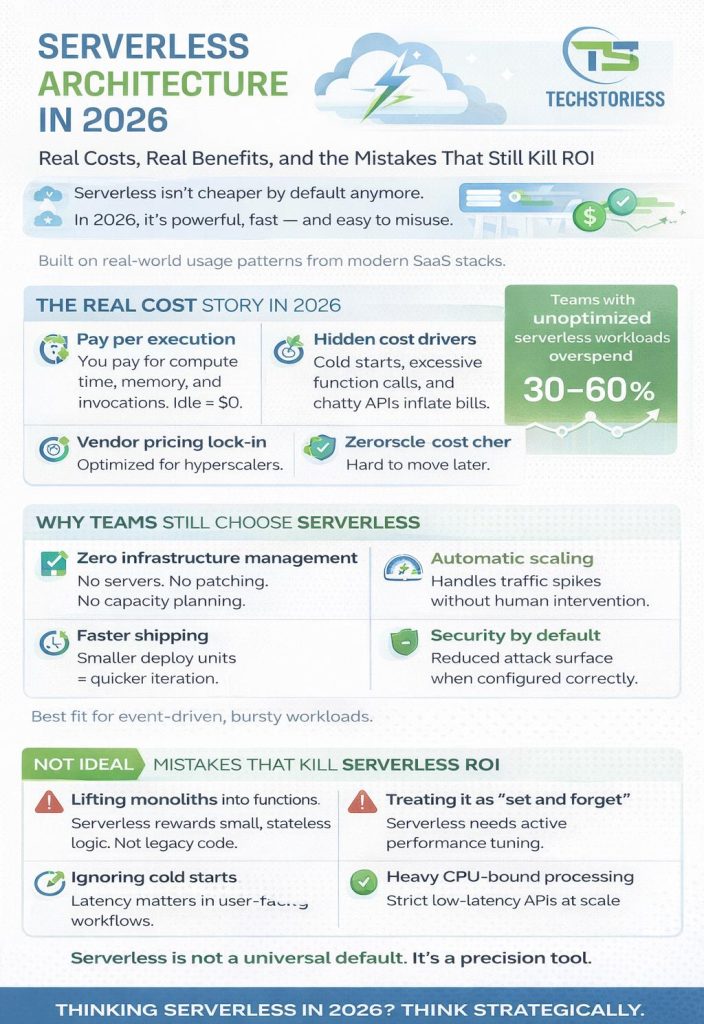
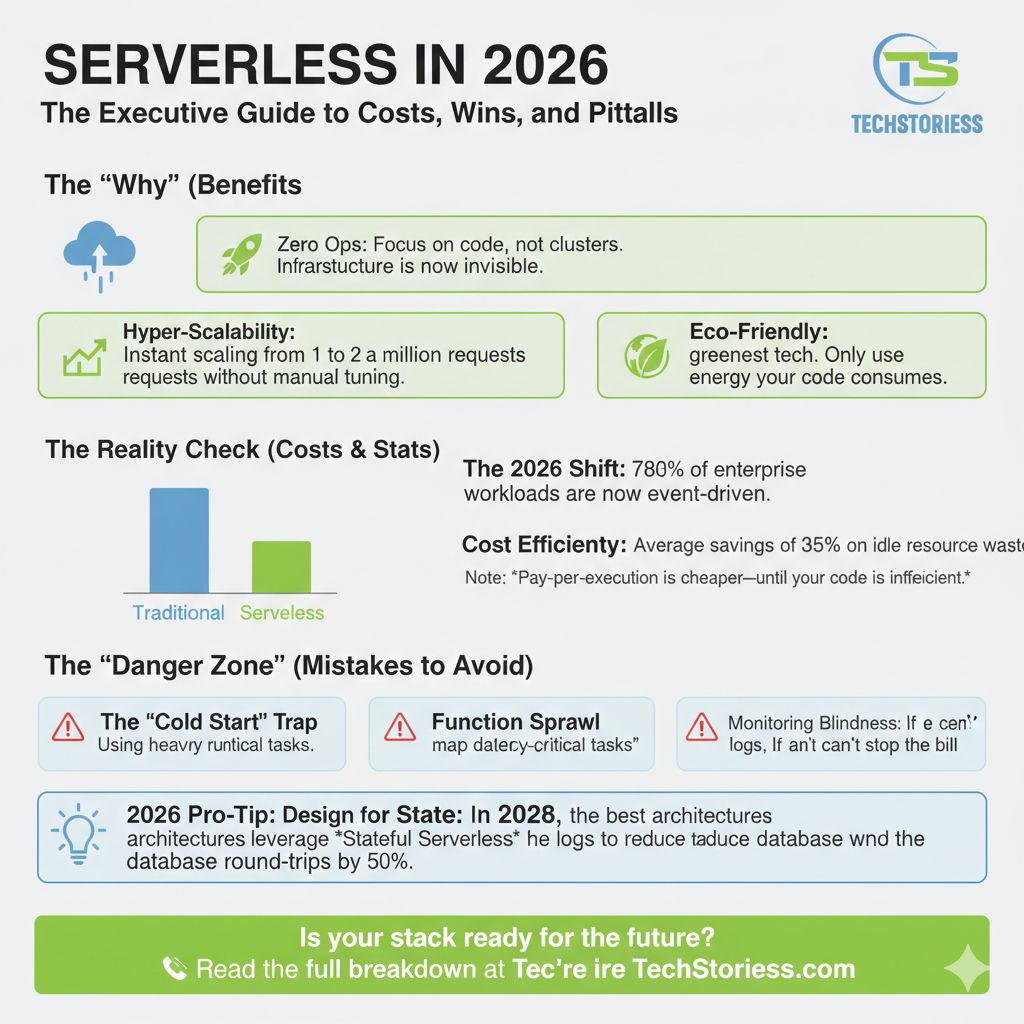
- Infographcis
How will Serverless Deliver Cost Efficiency in 2026
Due to event-driven execution, serverless remains one of the most cost-efficient ways to run cloud workloads. Applications are triggered by specific events instead of running on continuously provisioned servers, which not only reduces idle resource consumption but also aligns costs directly with actual usage. For instance, functions may execute in response to file uploads, API requests, or message-queue activity. In this capacity, serverless architecture enables enterprises to eliminate idle compute costs. Along with automatic scaling, it is especially beneficial for workloads with unpredictable traffic fluctuations such as data ingestion pipelines, real-time notifications, and on-demand processing tasks.
Because of its strong cost and management advantages, serverless architecture has gained widespread adoption over traditional deployments for use cases like automation workflows, backend APIs, and event-driven data processing. This model relieves organizations from estimating peak capacity months in advance to avoid outages. Equipped with managed scaling and execution control, serverless platforms automatically handle capacity decisions, shifting infrastructure expenses toward real business activity instead of theoretical maximum usage.
Cost-Efficient Deployment of Serverless
While serverless offers a range of cost and efficiency benefits for the organizations, these platforms still require engineering discipline to achieve real cost efficiency. One thing to note here is that the pricing structure of serverless may vary significantly depending upon the workloads and use instances. So, here are some ideal ways to utilize serverless to save costs.
Right-Sizing Functions to Restore Cost Efficiency
Many organizations over-allocate resources to “play it safe,” which directly increases pay-per-use costs. Instead of optimizing workloads, such practices often result in inflated bills without measurable performance gains. In 2026, with AI-driven workloads and automation running at scale, it is even more critical to right-size functions. Businesses should treat serverless functions as tightly scoped, single-responsibility components, continuously benchmarking and refining them to prevent unnecessary spend.
Quick instructions
- Keeping functions narrowly scoped reduces execution time and memory consumption.
- Use real production workloads to benchmark performance regularly
- Control spend by automating identification of over-provisioned resources.
The Illusion of Infinite Savings: When Costs Escalate
While serverless infrastructure can reduce baseline costs, outcomes depend heavily on workload characteristics and execution patterns. When misapplied, serverless can actually increase expenses. One of the most common pitfalls in 2026 is high-frequency execution, where functions are invoked continuously. Using serverless for steady, always-on workloads may result in millions of function invocations per day, making it significantly more expensive than container-based alternatives like Kubernetes or managed container services.
Importantly, this cost escalation rarely appears immediately. Initial usage often looks inexpensive, but costs rise sharply as traffic stabilizes and grows. Instead of relying on periodic cost reviews, organizations must monitor invocation patterns continuously to detect unfavorable usage trends early. This proactive approach allows teams to intervene before costs spike unexpectedly.
Quick instructions
- Watch for sustained high invocation rates without proportional business growth.
- Recognize traffic patterns that resemble always-on workloads.
- Intervene immediately if costs grow faster than delivered value.
Hidden Costs in the Serverless Ecosystem
In real-world deployments, serverless functions operate alongside several managed services such as databases, API gateways, logging systems, message brokers, and monitoring tools. Each of these components carries its own pricing model. In many cases, the cumulative cost of these supporting services exceeds the cost of the functions themselves. Enterprises must therefore account for the entire ecosystem when estimating the total cost structure.
Common cost drivers include excessive logging, verbose tracing, and high inter-service data transfer. Often, it is not the compute layer itself but unmanaged growth in ancillary services that inflates monthly bills.
Quick instructions
- Where possible reduce overly detailed logging and shorten retention.
- Minimize unnecessary inter-service communication.
- Review and optimize default service configurations for cost efficiency.
Preventing Pitfalls in Serverless
With the fast-growing popularity of serverless in 2026, many organizations have already started large-scale, enterprise-grade serverless, production-critical deployments. At this stage, organizations need to understand how it is used and governed over time to achieve expected results without unexpected trade-offs. In the absence of deliberate architectural decisions and continuous cost monitoring, the very flexibility that makes serverless an attractive option can result in increasing expenses, performance issues, and strategic lock-in risks. Here are some of the most common cost and architectural pitfalls encountered in mature serverless environments.
Cold Starts and Performance Trade-Offs
Among the technical and financial considerations in serverless architecture, cold start latency remains a key challenge. When functions are invoked after a period of inactivity, initialization delays can affect user experience. To mitigate this, organizations often enable provisioned concurrency or similar mechanisms that keep functions warm.
While this improves performance, it introduces fixed costs that partially undermine the pay-as-you-go model of serverless computing. A more balanced approach is to adopt hybrid architectures—using serverless for asynchronous or background processing while reserving containers or edge services for latency-sensitive workloads.
Quick instructions
- Provisioned concurrency should be used only for latency-critical execution paths.
- Route background and batch processing to pure serverless execution.
- Strategically design user flows to minimize exposure to cold starts.
Vendor Lock-In as a Strategic Pitfall
Deep integration between serverless platforms and cloud-specific services simplifies development and accelerates deployment. However, it also increases dependency on a single provider. Migrating a complex serverless application across cloud platforms in 2026 can be technically difficult and financially prohibitive.
To avoid this risk, enterprises must evaluate portability during initial architectural planning. Designing with abstraction and portability in mind helps ensure that organizations are not constrained by pricing changes, service limitations, or regional availability issues later.
Quick instructions
- Wherever possible, separate business logic from provider-specific services.
- Standardize event formats and service interfaces.
- Periodically reassess migration feasibility as architectures evolve.
Observability and Debugging Challenges
Serverless functions are short-lived and distributed across multiple managed services, making visibility more complex. Without strong observability practices, identifying performance bottlenecks or cost anomalies becomes difficult.
Organizations should therefore treat monitoring, tracing, and cost analytics as core architectural components rather than optional enhancements. This mindset helps maintain control over reliability, performance, and spending as systems scale.
Quick instructions
- Correlate logs, metrics, and traces across all services and functions.
- Track cost metrics alongside performance and reliability indicators.
- Regularly detect anomalies to surface unusual behavior early.
Strategic Guidance: Balancing Efficiency and Risk
To realize the full benefits of serverless in 2026, organizations should favor selective adoption over blanket usage. Rather than forcing every workload into a serverless model, enterprises should strategically combine serverless with alternatives such as managed services, containers, and edge computing—assigning each workload to the model that best matches its execution pattern and cost profile.
Serverless delivers maximum value for highly variable workloads, short-lived executions, and unpredictable scaling demands. When treated as a universal replacement for all infrastructure needs, however, it often introduces inefficiencies rather than savings.
Conclusion
In 2026, cost-efficient deployment is achievable with serverless architecture—but adoption alone does not guarantee savings. Organizations must understand both the strengths and limitations of serverless platforms and apply them strategically. Key success factors include workload suitability, architectural flexibility, and continuous cost visibility. By aligning serverless usage with these principles, businesses can avoid common pitfalls while extracting long-term value.
In short, Serverless is not a shortcut to lower costs; it is a strategic choice that requires thoughtful design and ongoing optimization to deliver sustainable benefits.
Infographcis