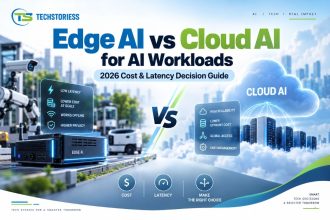



As AI systems move from experimental deployments to real-world, large-scale usage, organizations face growing challenges around latency, bandwidth costs, privacy, and reliability. Cloud-centric AI architectures alone struggle to meet the demands of time-sensitive and connectivity-constrained environments such as autonomous systems, industrial operations, and distributed IoT networks. This has driven the adoption of Edge-AI, often combined with Micro-LLMs, to enable faster, more resilient, and context-aware intelligence closer to where data is generated.
What Is Edge-AI?
Edge-AI refers to the deployment and execution of AI models directly on devices located near the source of data generation—such as smartphones, embedded systems, industrial machines, vehicles, and IoT sensors. Instead of sending raw data to centralized cloud servers for inference, Edge-AI performs data processing and decision-making locally, reducing latency, bandwidth usage, and dependence on continuous connectivity.
What Are Micro-LLMs?
Micro-LLMs are compact, resource-efficient language models designed to operate under the compute, memory, and power constraints of edge devices. Unlike large, general-purpose LLMs, Micro-LLMs are optimized for specific tasks such as command interpretation, intent detection, summarization, or domain-specific reasoning. They prioritize fast inference and efficiency over broad general knowledge.
How Edge-AI and Micro-LLMs Work Together
Edge-AI provides the infrastructure and execution environment for local inference, while Micro-LLMs supply lightweight language understanding and reasoning capabilities within that environment. Edge-AI handles perception, signal processing, and real-time data handling, and Micro-LLMs interpret context, intent, or instructions derived from that data. Together, they enable intelligent on-device decision-making, while the cloud continues to manage model training, updates, orchestration, and system-level governance.
Present Challenges and How Edge-AI & Micro-LLMs Address Them
To truly understand the role of Edge-AI and Micro-LLMs in shaping generative systems, we need to look at the real-world challenges that exist today—and how these technologies work together to solve them.
Challenge: High Latency in Cloud-Dependent AI Systems
Cloud-based inference introduces network delays that are unacceptable for time-critical applications such as autonomous navigation, robotics, and industrial control.
EdgeAI & MicroLLM Solution:
Edge-AI enables local inference, and Micro-LLMs provide on-device reasoning and language understanding. This combination delivers faster, more predictable responses without relying on cloud round trips.
Challenge: Excessive Bandwidth Usage and Rising Cloud Costs
Continuously streaming raw data to the cloud increases bandwidth consumption and operational expenses.
EdgeAI & MicroLLM Solution:
Edge-AI processes data locally, while Micro-LLMs extract meaning and context on-device. Only relevant insights or summaries are transmitted to the cloud, significantly reducing data movement and cost.
Challenge: Privacy and Compliance Risks
Sending sensitive personal, medical, or industrial data to the cloud increases exposure to security threats and regulatory challenges.
EdgeAI & MicroLLM Solution:
Edge-AI keeps data local, and Micro-LLMs analyze and act on it without persistent external transmission. This supports privacy-by-design architectures while still allowing centralized oversight when needed.
Challenge: Unreliable or Intermittent Connectivity
Many deployments operate in environments with unstable or limited internet access, where cloud-only AI systems fail to perform reliably.
EdgeAI & MicroLLM Solution
Edge-AI allows systems to operate independently of continuous connectivity, and Micro-LLMs enable basic reasoning and decision-making during network outages, synchronizing with the cloud when connectivity is restored.
Challenge: Centralized Cloud AI Creates Single Points of Failure
Cloud-centric AI systems depend heavily on centralized inference endpoints. Any outage, regional failure, throttling, or service degradation at the cloud layer can impact large numbers of dependent applications simultaneously. This introduces systemic risk, especially for mission-critical systems such as industrial automation, logistics, healthcare devices, and public infrastructure.
EdgeAI & MicroLLM Solution
Edge-AI decentralizes inference by distributing intelligence across devices, reducing reliance on a single cloud endpoint. Micro-LLMs enable localized language understanding, reasoning, and decision support directly on devices, allowing systems to continue operating safely and intelligently even when cloud services are degraded or unavailable. The cloud shifts from being a real-time dependency to a coordination and lifecycle management layer.
Challenge: Lack of Local Context in Centralized Models
Centralized AI models often fail to adapt quickly to local languages, terminology, or operational conditions.
EdgeAI & MicroLLM Solution:
Micro-LLMs can be configured or lightly adapted for specific domains at the edge, while Edge-AI ensures consistent execution. The cloud remains responsible for broader training and lifecycle management.
Challenge: Scaling AI Across Large Device Fleets
Cloud-based inference becomes a bottleneck when scaling across thousands or millions of devices.
EdgeAI & MicroLLM Solution:
Edge-AI distributes inference workloads across devices, and Micro-LLMs provide localized intelligence. The cloud coordinates updates and monitoring rather than serving as a single inference endpoint.
Conclusion
Edge-AI and Micro-LLMs together enable a practical, hybrid AI architecture that balances real-time performance, privacy, and cost efficiency with centralized control and scalability. Edge-AI brings computation closer to data sources, while Micro-LLMs add focused language and reasoning capabilities within edge constraints. Rather than replacing cloud AI, this combination complements it—making intelligent systems more resilient, responsive, and suitable for real-world deployment.