


Industrial IoT Edge Latency is quietly becoming one of the most misunderstood variables. In boardroom discussions, it’s often expressed in a single number-“milliseconds”-reflecting the leadership perspective that lower is always better and simplifying the distinction between cloud versus edge deployment distance. In real deployments, however, latency behavior is far more dynamic, less like a fixed metric and more like a system-level outcome determined by multiple factors like network variability, processing location, workload type, and operational constraints.
- Latency Isn’t One Number-It’s a Stack
- What Real Benchmarks Actually Show
- Where Latency Becomes Business-Critical
- Edge AI Inference Latency: Where the Gap Widens Further
- The ROI Question: When Does Edge Actually Pay Off?
- Industrial IoT Edge Latency Architecture: What Works in Practice
- What Most Benchmarks Get Wrong
- Strategic Takeaways for 2026
- Conclusion
That’s why most edge computing latency benchmarks Industrial IoT Edge Latency 2026 conversations feel incomplete and oversimplified. They unreasonably focus on network-theoretical comparisons-the to-and-fro traveling time between the device and cloud-but tend to overlook what actually happens inside factories, hospitals, and retail environments. Diving deeper into published benchmark data from real deployments reveals a more nuanced picture: instead of simply reducing latency, edge computing reshapes how latency impacts decisions, downtime, and ultimately, revenue.
Latency Isn’t One Number-It’s a Stack
Instead of directly jumping to interpreting benchmarks, it’s critical to understand what “latency” actually includes. In practice, most Industrial IoT systems experience latency not as a single delay but a combination of multiple layers:
- Network latency – time taken for data to travel between device and compute location
- Processing latency – time required to analyze or transform the data
- Inference latency – time taken by AI/ML models to generate decisions
These layers are distributed across geographies in cloud-centric architectures. In edge environments, they move closer to the source of data. More than just speed-the real difference lies in predictability.
Gartner research consistently highlights that the primary risk factor in real-time systems is latency variability-and not just latency itself. Consider a realistic example: a cloud round-trip averaging 80 ms but spiking to 300 ms under congestion is far more disruptive than a consistent 20 ms edge response, as consistency ensures reliable system behavior and timely decision-making.
At this point, the edge vs cloud real-time processing discussions become less about theoretical averages and more about operational reliability.
What Real Benchmarks Actually Show
Instead of relying only on lab conditions to inform the performance narrative, we need to move to real-world deployments, where latency gaps between edge and cloud become clearer, more contextual, and operationally relevant.
According to studies and deployment analyses from McKinsey & Company and Deloitte:
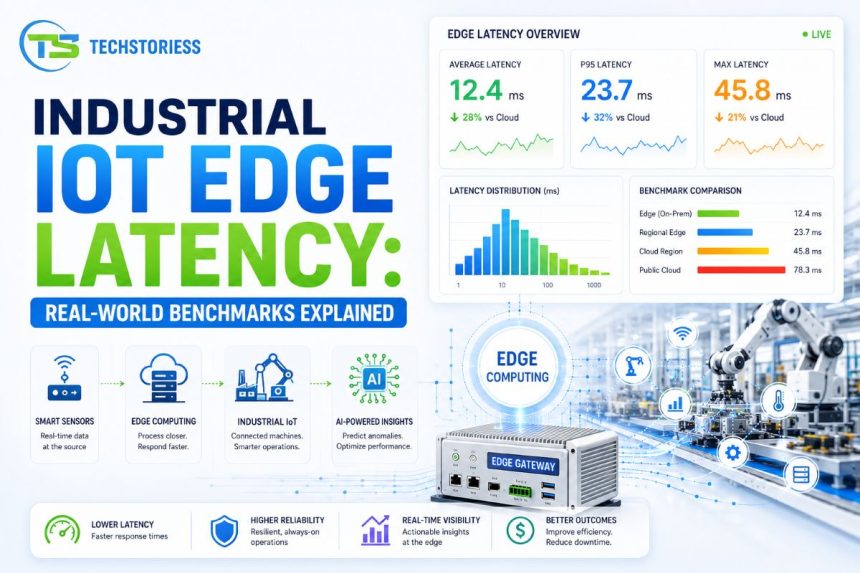
- Cloud-based IIoT systems typically operate in the range of 50–200 ms latency, depending on factors like geography and network conditions
- Edge-enabled systems often achieve 5–20 ms latency, with significantly lower jitter
- In constrained environments (remote plants, congested networks), cloud latency can exceed 300 ms, while edge remains stable
At first glance, this points to a simple performance comparison-a straightforward 10x improvement. But the real significance of these numbers lies in what those milliseconds enable or prevent.
For instance, in fast-paced manufacturing lines, even a 50 ms delay can mean the difference between correcting a real-time defect versus identifying it after production. In business terms, this gap translates directly into the difference between proactive correction and reactive loss mitigation.
Benchmarks published through IEEE further indicate that deterministic latency-consistent response times-often delivers better value than absolute speed in industrial control systems.
Where Latency Becomes Business-Critical
Latency only matters in the instances where it directly influences real-time decisions. That intersection is becoming more frequent and more critical in Industrial IoT.
Smart Manufacturing
In modern factories driven by automation and AI-based inspection systems, machine vision systems analyze products in milliseconds. In this environment, delayed inference can result in defective items passing through undetected.
- Edge latency: ~10 ms
- Cloud latency: ~80–150 ms
This seemingly small gap translates into:
- Increased defect rates
- Higher rework costs
- Production inefficiencies
This makes IIoT edge deployment use cases in manufacturing heavily skewed toward quality control, robotics, and predictive maintenance.
Healthcare Systems
In healthcare environments, latency is not just about efficiency-it can be a safety issue.
Real-world deployments evaluated by NIST reveal that:
- Remote monitoring systems relying on cloud processing can experience latency spikes during peak network usage
- Edge-enabled systems maintain consistent response times, critical for real-time alerts
For critical applications like ICU monitoring or imaging diagnostics, even minute delays in data processing and alert generation can disrupt workflows or delay interventions.
Retail and Real-Time Analytics
becomes a customer-facing metric.
Edge AI Inference Latency: Where the Gap Widens Further
Introducing AI into the equation makes the discussion even more interesting.
A fundamental aspect of Edge AI inference latency is that it differs from cloud inference by eliminating the need to transmit data before processing. This is particularly relevant in use cases like:
- Video analytics
- Autonomous systems
- Predictive maintenance
Benchmarks reveal some key points:
- Cloud inference latency: 100–300 ms (including data transfer)
- Edge inference latency: 5–30 ms
However, along with speed, edge inference offers:
- Data locality (no need to send sensitive data externally)
- Reduced bandwidth costs
- Improved resilience in disconnected environments
It does involve tradeoffs though. Edge devices may not be comparable to the raw processing power of cloud infrastructure, creating the need for careful model optimization.
The ROI Question: When Does Edge Actually Pay Off?
Latency improvements aren’t the sole factor that justifies investment. For decision-makers, the real question is whether those improvements tangibly translate into quantifiable business value.
In edge computing ROI manufacturing scenarios, the equation typically involves:
- Reduction in downtime
- Improvement in product quality
- Lower bandwidth and cloud costs
- Faster decision cycles
McKinsey & Company reports that predictive maintenance enabled by low-latency edge processing can cut down equipment downtime by 30–50% in some industrial settings.
However, it doesn’t imply that edge is universally cost-effective. It introduces additional considerations too, such as:
- Hardware costs
- Deployment complexity
- Maintenance overhead
So, the ROI becomes meaningful only when latency directly impacts:
- Revenue
- Safety
- Operational continuity
Industrial IoT Edge Latency Architecture: What Works in Practice
In 2026, the most effective architectures are not purely edge or cloud, but hybrid in nature-combining both.
An ideal low latency IoT architecture should include:
- Edge layer for real-time processing and immediate decisions
- Cloud layer for analytics, storage, and model training
- Data filtering at edge to reduce unnecessary transmission
This approach balances:
- Speed (edge)
- Scale (cloud)
- Cost efficiency (optimized data flow)
Rather than replacing the cloud, edge computing is simply changing its role. The cloud is shifting from a real-time processor to a strategic intelligence layer.
What Most Benchmarks Get Wrong
While the volume of data is rapidly growing, many latency benchmarks still fail to reflect operational reality.
Common issues include:
- Lab conditions vs real environments
Benchmarks often ignore network congestion, hardware variability, and environmental constraints - Average latency masking spikes
Averages hide the worst-case scenarios that actually cause failures - Ignoring end-to-end latency
Many reports measure network delay but exclude processing and inference time - Overlooking workload differences
Not all applications require the same latency sensitivity
This is why decision-makers relying purely on headline numbers often misjudge the true impact of edge computing.
Strategic Takeaways for 2026
For organizations evaluating edge computing latency benchmarks industrial IoT 2026, the decision is less about speed and more about alignment with operational needs.
- Choose edge when latency directly affects safety, quality, or real-time control
- Stick with cloud when workloads are non-critical, batch-oriented, or cost-sensitive
- Adopt hybrid models when both real-time response and large-scale analytics are required
The goal is not to minimize latency everywhere, but to optimize it where it matters most.
Conclusion
With increasing maturity in Industrial IoT deployments, it is time to evolve the conversation around edge computing and cloud. It is no longer only about speed-that’s already established. The real question now is whether that speed translates into meaningful, practical outcomes.
Real-world benchmarks prove that edge computing can offer significant latency benefits. However, those advantages only matter in the right context. In Industrial IoT systems, fast-paced retail environments, and healthcare sectors-where milliseconds can influence machines, decisions, and safety-edge presents itself as a strategic asset. But in scenarios where latency sensitivity is low or workloads are not time-critical, it remains an unnecessary complexity.
As 2026 advances, organizations must understand what the numbers actually mean – and where they truly matter, instead of blindly adopting edge computing.