


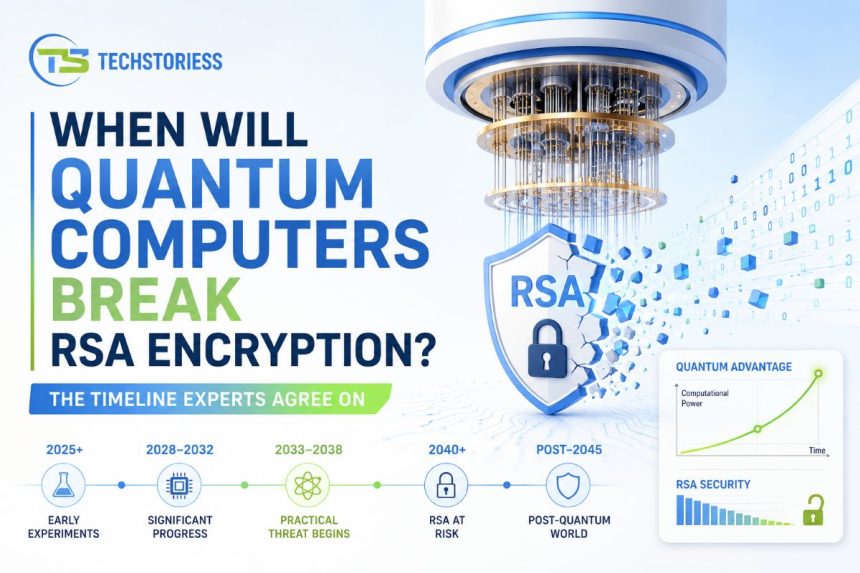
RSA encryption has been quietly acting as a reliable trust guardian of the internet for over two decades. It secures the crucial interactions and transactions in digital space such as enterprise communications, financial transactions, identity systems, public key infrastructure, and national security systems. However, now this digital security lock is at risk, and the pressing challenge today is how soon quantum computers will break RSA encryption, endangering sensitive data across the globe.
- A Material Shift in the CRQC Timeline Estimate
- The Engineering Behind the Acceleration
- Why RSA-2048 Is a Systemic Risk Point
- Hardware Constraints: The Remaining Barrier
- The Immediate Risk: Harvest Now, Decrypt Later
- Policy Alignment: Why 2030 Is Not Arbitrary
- A Structured Risk-Horizon Framework
- Real-World Complexity of Migration
- Post-Quantum Cryptography: Strategic Direction
- Conclusion
Beyond just theoretical progress, it is the strategic combination of engineering practicalities, credible research, and policy urgency that is driving this shift. Instead of vague assumptions, the research provides a mature, well-presented timeframe supported by strong technical evidence. In the wake of recent developments in quantum computing, this research challenges the long-held belief that RSA-2048 would remain unbreakable for several decades.
The consensus is both measured and consequential with clear implications: the real possibility of weakening classical public-key cryptography is fast approaching, and the required lead time for transition is longer than most enterprises are ready for. This leads to a strategic planning challenge – where the threat timeline remains uncertain, but the preparation timeline is well defined.
A Material Shift in the CRQC Timeline Estimate
It was in 2019 that the idea of a cryptographically relevant quantum computer (CRQC) capable of breaking RSA-2048 was discussed with initial resource estimates. Based on credible models, it was assumed that approximately 20 million physical qubits would be needed to factor a 2048-bit RSA key within a realistic time window.
Recent research has disrupted that baseline.
Fast forward to 2026, the latest research suggests that it will require fewer than one million physical qubits-combined with sophisticated error correction and optimized algorithms-to achieve the same result within about a week of sustained computation. It indicates significant progress-around a 95% reduction in qubit requirements and a shift in execution time from several years to just a few days.
It represents a nearly 20X efficiency improvement. Classical computing might absorb such improvements over multiple product cycles. The case of cryptography, however, is different-here such significant shifts fundamentally alter the risk posture due to the binary nature of security assumptions-either the system remains secure, or it fails.
For all the above-mentioned reasons and discoveries from the latest research, the timeline for a cryptographically capable quantum computer should no longer be perceived as a distant abstraction but as a concrete factor to shape enterprise security planning and risk assessment strategies.
The Engineering Behind the Acceleration
Let’s first understand the reason behind this dramatic reduction in resource requirements. It’s not due to a single breakthrough but is driven by a collective set of advancements. Examining more precisely from an engineering perspective, four factors clearly stand out:
Approximate Arithmetic and Algorithmic Refinement
A key driver of this shift is the latest refinement of Shor’s algorithm, which introduces controlled approximations instead of relying on perfect precision. This significantly improves computational efficiency while still reasonably preserving the accuracy of the final result. As a result, factoring large numbers is moving closer to practical feasibility for real-world systems.
These optimizations simplify the most resource-intensive step-modular exponentiation. As a result, fewer qubits are required, and the overall process becomes faster and more efficient.
Error Correction Efficiency Gains
In quantum systems, error correction has historically been the dominant overhead. However, recent approaches are emerging that significantly reduce this burden. Two such approaches involve denser code layouts and improved logical qubit encoding. By strategically optimizing surface codes and refining state distillation processes, fault tolerance can be improved without proportionally increasing the number of physical qubits.
Qubit Utilization and Architecture Design
More recently, quantum systems are undergoing architectural shifts to improve efficiency and scalability. For instance, designs now incorporate specialized zones-compute regions, hot storage, and cold storage-that manage qubits based on their activity levels. This optimizes utilization efficiency and minimizes the total number of active qubits required at any point in time.
Circuit-Level Optimizations
Enhanced state preparation, improved gate synthesis, and optimized circuit depth have collectively made it possible to perform computations with a relatively lower number of operations. According to credible estimates, more than 6.5 billion quantum gate operations may be involved in RSA-2048 factorization-a number that initially seems impractical. However, improvements in reliability, scheduling, and execution efficiency make it increasingly feasible to complete such operations within realistic timeframes.
Each of the above-mentioned improvements is incremental when seen individually. Collectively, they redefine practical feasibility, significantly lowering the barriers to quantum-based factorization of cryptographic systems.
Why RSA-2048 Is a Systemic Risk Point
More than just another encryption standard, RSA-2048 represents the backbone of global digital infrastructure. Its security is based on the assumption that classical systems cannot feasibly factor a 617-digit number into its prime components due to extreme computational difficulty, making it practically infeasible.
This assumption underlies:
- TLS/SSL protocols securing web traffic
- Digital certificate authorities validating identity
- Secure email frameworks
- Financial transaction systems across banking networks
The implications of a successful quantum attack on RSA-2048 would not be limited to isolated security incidents but would lead to cascading failures across systems that rely on shared trust frameworks. The WannaCry ransomware incident of 2017 offers a useful analogy. While it was not related to cryptography, it demonstrated how a single vulnerability in widely deployed infrastructure can propagate globally within hours, disrupting critical systems. In comparison, a compromised RSA ecosystem would present a far more severe challenge, as it would directly undermine the foundational trust mechanisms of the internet.
Hardware Constraints: The Remaining Barrier
This theoretical progress might sound alarming, but the risk is not immediate. Current quantum hardware still remains well below the required threshold to facilitate a practical attack. Most operational quantum systems today range between hundreds to a few thousand qubits, which is far below the required scale. Additionally, their error rates are significantly higher than acceptable thresholds, and limited coherence times further restrict sustained computation.
None of the present (or near-future) quantum systems satisfy all the conditions required to execute an RSA-2048 attack under the revised model:
- Continuous operation for approximately 5 days
- Error rates at or below 0.1% per gate
- Surface code cycles on the order of microseconds
- Real-time control feedback within 10 microseconds
Presently, achieving all these conditions remains a major engineering challenge. However, there are strong reasons for cautious optimism. First, leading quantum hardware providers have published roadmaps targeting systems with hundreds of thousands to millions of qubits by the early 2030s. Second, enterprise-scale cryptographic transitions historically take several years to fully replace conventional systems. Finally, the global importance of secure digital infrastructure is driving sustained investment and innovation in this space.
These projections are not merely speculative-they are supported by consistent year-over-year improvements in system stability, qubit fidelity, and error correction techniques.
From a risk perspective, these developments place the CRQC timeline within a planning horizon rather than a purely theoretical one.
The Immediate Risk: Harvest Now, Decrypt Later
One of the most important but often overlooked dimensions of the quantum computing RSA threat 2026 discussion is the harvest now, decrypt later attack model.
In this model, attackers capture encrypted data today and store it for future use when quantum decryption capabilities become available. They can begin collecting large volumes of encrypted data with long-term value, such as:
- Government communications
- Intellectual property
- Healthcare records
- Strategic enterprise data
Once quantum capabilities mature, adversaries can retroactively decrypt this archived data.
This is not merely a theoretical concern-it reflects a real and practical risk. Intelligence agencies have long employed data retention strategies anticipating future decryption capabilities. The implication is clear: sensitive data that is securely transmitted today may already be vulnerable in the future.
This risk varies across sectors. While smaller organizations may face limited exposure, large enterprises and critical sectors-such as defense, pharmaceuticals, and infrastructure-face significantly higher risk due to the long lifecycle and strategic value of their data. For these sectors, the harvest now, decrypt later threat is not a distant possibility but an immediate strategic concern.
Policy Alignment: Why 2030 Is Not Arbitrary
To address this emerging risk, regulatory and standards bodies have defined timelines that reflect operational realities rather than speculative technological milestones.
Current guidance suggests:
- Deprecation of vulnerable cryptographic systems by 2030
- Complete disallowance by 2035
Many organizations misinterpret these timelines as predictions of quantum capability. In reality, they represent a migration window, accounting for the complexity of transitioning global infrastructure.
For example, the migration from SHA-1 to SHA-256 took nearly a decade despite known vulnerabilities. Post-quantum migration is expected to be even more complex due to deeper cryptographic dependencies.
Therefore, quantum safe encryption urgency is framed in terms of preparation time rather than immediate threat realization.
A Structured Risk-Horizon Framework
To ensure post-quantum data security, organizations must adopt a structured, phased governance strategy:
Phase 1: Assessment (Present–2027)
Build a comprehensive inventory of all RSA/ECC-reliant systems. Set priorities based on data sensitivity and lifecycle requirements.
Phase 2: Transition Planning (2027–2030)
Develop migration roadmaps incorporating hybrid cryptographic models. Begin pilot implementations of post-quantum algorithms and validate performance and interoperability.
Phase 3: Execution (2030–2035)
Gradually phase out vulnerable systems. Enforce compliance with updated standards and continuously monitor residual risks to ensure long-term cryptographic agility.
By adopting this phased approach, organizations can align technical feasibility with operational requirements and reduce transition risk.
Real-World Complexity of Migration
Cryptographic migration can become complex and resource-intensive due to multiple dependencies. Large enterprises often deal with:
- Legacy systems lacking update mechanisms
- Embedded cryptography in hardware devices
- Third-party dependencies with limited visibility
- Regulatory constraints across jurisdictions
The complexity varies based on sector, scale, and system architecture. For instance, a financial institution relies on encryption across multiple layers, including ATM networks, core banking systems, payment gateways, and mobile applications. Each of these systems has distinct upgrade cycles and risk tolerances, making coordinated migration a significant challenge.
Proactive planning is therefore essential to ensure a smooth and secure transition.
Post-Quantum Cryptography: Strategic Direction
Post-quantum cryptography (PQC) refers to advanced cryptographic algorithms designed to resist both classical and quantum attacks. Current standards primarily focus on lattice-based methods for key exchange and digital signatures.
However, PQC introduces new challenges:
- Larger key sizes impacting bandwidth and storage
- Performance trade-offs in constrained environments
- Need for cryptographic agility to accommodate future updates
Organizations must therefore treat PQC as an evolving capability rather than a one-time upgrade.
Conclusion
We do not yet have a single definitive date for when quantum computers will break RSA encryption. However, we are clearly approaching a convergence window shaped by algorithmic advances, hardware progress, and policy direction.
The nature of the risk has fundamentally changed:
- It is no longer purely theoretical
- It is not immediate, but it is accelerating
- It requires proactive action well before realization
Decision-makers must recognize that the cost of early preparation is finite and manageable, whereas delayed response could lead to systemic and potentially irreversible consequences.
By acknowledging this shift and acting decisively, organizations can position themselves to navigate the transition to a post-quantum world with confidence and resilience.