


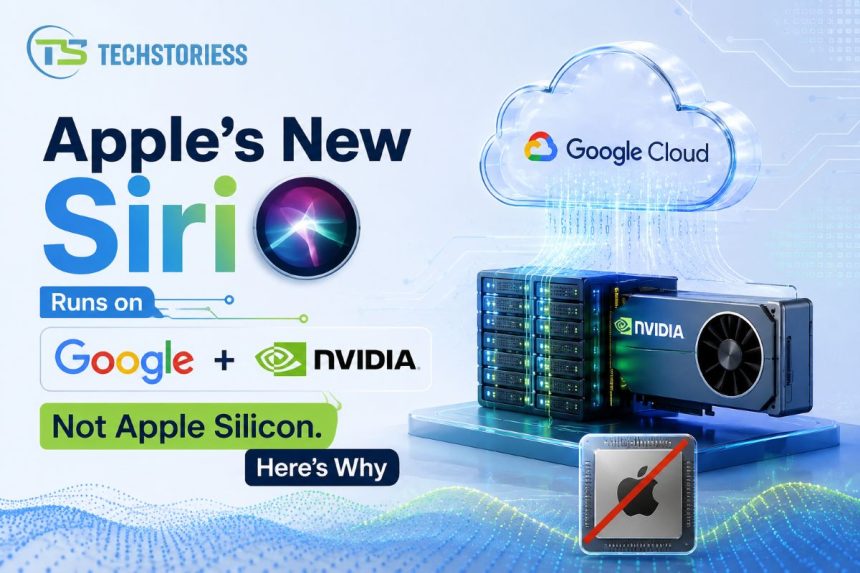
On June 8, Apple launched Siri AI, a ground-up rebuild of its voice assistant built around new foundation models developed in partnership with Google. The flagship cloud model, internally called AFM Cloud Pro, is powered by Nvidia Blackwell B200 GPUs inside Google Cloud instead of Apple’s own Private Cloud Compute infrastructure, or Apple Silicon. Software chief Craig Federighi confirmed the architecture directly in a post-keynote briefing. Apple Intelligence’s on-device layer still runs on Apple’s own models, he confirmed.
The deal reportedly is worth around $1 billion a year, according to Bloomberg reporting cited by MLQ. Siri AI needs an iPhone 17 Pro or iPhone Air, will not be available in the EU or China due to regulatory constraints, and is expected to ship in September.
Why Apple couldn’t just build this itself
To put it plainly, the reason is scale. The Information, a subscription technology-news outlet, reports that the full Gemini model Apple is licensing runs into the trillions of parameters and demands more computing horsepower than Apple’s Private Cloud Compute servers – built on Apple Silicon – can currently deliver. This deal quietly undercuts Apple’s years-long argument that its own chips were sufficient for its AI ambitions, at least for frontier-scale cloud reasoning.
Apple built a hybrid workaround: each query is routed by a system orchestrator to an on-device Apple model or up to the cloud model, depending on how much reasoning power and personal context the request needs. This system orchestrator, in Federighi’s own telling, is central to the privacy architecture. Simple tasks – setting a reminder, checking a calendar – largely stay on-device, on Apple Silicon. Anything closer to genuine reasoning gets handed off to Google’s infrastructure.
The privacy question nobody’s fully answered yet
Routing user queries through a third party’s cloud, running on a fourth party’s chips, is a real departure for a company that has built its brand on data staying put. Apple’s answer rests on confidential computing – a hardware-level encryption feature built into Nvidia’s chips that keeps data and models encrypted while being processed, even from the cloud operator running the hardware. Apple reportedly approved use of that Nvidia privacy technology specifically to make this arrangement workable, according to The Information’s reporting via 9to5Mac.
However, whether that satisfies regulators and privacy-focused customers remains an open question. The EU exclusion at launch suggests Apple itself isn’t confident the arrangement clears every regulatory bar yet.
What this means for the AI hardware map
This deal quietly rewrites a piece of the AI infrastructure story that had mostly been framed as a two-horse race – Nvidia’s chips powering everyone else’s clouds, with Apple as the noteworthy holdout building its own silicon stack. That framing no longer holds.
For Nvidia, it’s another validation point: even the company most publicly committed to vertical integration on its own chips is, for its most demanding AI workloads, buying compute from Nvidia anyway. For Google, this arrangement extends Gemini’s reach into roughly a billion active iPhones without Google needing to touch a single device, while collecting a licensing fee that reportedly runs near $1 billion annually. Around the time the partnership was first confirmed in January, Alphabet’s market value briefly topped $4 trillion. This was a milestone that reporting connected in part to the Apple deal’s implications for Google’s cloud and model business.
For Apple, the calculus is blunter: better to rent frontier-model capability from a rival than ship a Siri that can’t compete on reasoning. Apple shares fell 3.5% following the June announcement, a signal that investors read the deal as much as an admission of limits as a product win.
The bigger tell
Apple built its entire hardware business on the idea that silicon ownership means owning the experience. Siri AI, however, is the first major admission that, at the frontier of AI reasoning, owning the chip and owning the intelligence are no longer the same thing. Apple Silicon still runs the phone. It just isn’t running the smartest part of Siri anymore – Nvidia’s chips, in Google’s data centers, are.
This falls short of Apple conceding the AI race outright. But it’s a real concession, and it’s likely to become the template other hardware-first companies reach for once they hit the same wall Apple just did.