


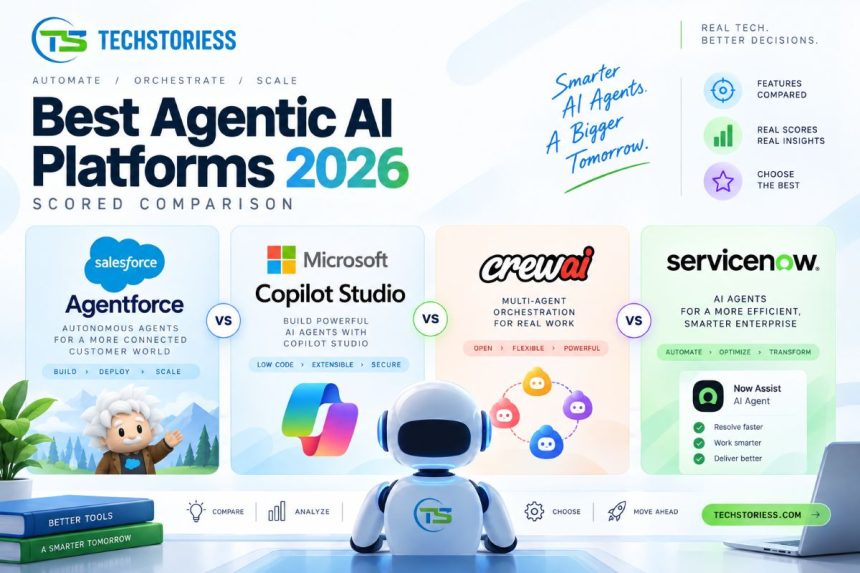
According to Gartner, 40% of enterprise applications will embed AI agents by the end of 2026. More than just a forecast, it is a procurement reality that is approaching fast. Today’s platform decision will have a long-term impact—it will define integration debt, governance posture, and operational capability for years. This market is primarily led by four serious contenders: Microsoft Copilot Studio, Salesforce Agentforce, CrewAI, and ServiceNow AI Agents. Each represents a distinct architectural philosophy and enterprise value proposition.
This comparison evaluates all four across six key dimensions that matter most to enterprise buyers in 2026: multi-agent orchestration, enterprise integration depth, security and governance, developer experience, total cost of ownership, and ecosystem readiness. We have scored each platform on a ten-point scale for every dimension to help organisations compare strengths and weaknesses objectively, alongside an aggregate score and a clear recommendation profile. Rather than identifying a universal winner, this exercise maps each platform to the organisational context where it genuinely excels.
The Evaluation Framework
Before scoring, it is important to understand the three structural forces defining the 2026 agentic AI platform evaluation matrix.
MCP (Model Context Protocol) adoption is rapidly becoming table stakes. According to Forrester projections, 30% of enterprise software vendors will ship MCP integrations in 2026. Alongside native connector libraries, MCP compatibility is increasingly becoming a critical parameter for measuring platform extensibility. Rather than building integrations through proprietary APIs and SDK layers, enterprises increasingly view MCP as a standard interface for connecting agents with enterprise systems and tools.
Multi-agent orchestration has emerged as a primary technical differentiator. With the maturation of single-agent deployments, the coordination layer has become a competitive battleground. IT teams are evaluating whether a platform can reliably manage functions such as parallel agent execution, inter-agent communication, conflict resolution, and state persistence across long-running workflows.
Governance pressure from the EU AI Act’s August 2026 enforcement introduces a compliance requirement that effectively eliminates platforms unable to provide audit trails, human-in-the-loop controls, and documented access governance. These capabilities have become essential for enterprises operating in regulated environments.
Microsoft Copilot Studio
Aggregate Score: 8.2 / 10
In this comparison, Microsoft enjoys a structural advantage that no competitor can easily replicate in the near term: 90% of Fortune 100 companies already use Microsoft infrastructure, while 20 million+ GitHub Copilot users are familiar with AI-assisted workflows within the Microsoft ecosystem. As a result, Copilot Studio does not require enterprises to adopt an entirely new platform—it simply extends capabilities within an environment they already operate.
Multi-agent orchestration: 8/10
The Copilot Studio agent builder supports multi-agent workflows through integration with Azure AI Foundry. It enables agent chaining, handoff protocols, and state management across complex pipelines. However, the most advanced production-grade orchestration capabilities reside within Azure AI Foundry itself. Organisations seeking highly customised orchestration patterns typically need to work directly within Azure AI Foundry, requiring engineering expertise beyond Microsoft’s predefined templates.
Enterprise integration depth: 9/10
Among the platforms evaluated, Copilot Studio stands out because of the Microsoft Graph connector library, native Teams and SharePoint integration, and Power Platform compatibility. These capabilities create one of the deepest integration ecosystems available for Microsoft-centric enterprises. The addition of native MCP server support in 2026 further strengthens this position by allowing agents to connect to third-party tools without extensive custom connector development.
Security and governance: 9/10
Capabilities such as Active Directory identity management, Microsoft Purview compliance integration, and granular data loss prevention controls provide one of the most mature governance frameworks in this comparison. For Microsoft-centric enterprises, Copilot Studio inherits these controls directly, creating a highly integrated governance environment.
Developer experience: 7/10
Its low-code environment makes it accessible to business analysts and citizen developers. Professional developers seeking advanced orchestration patterns often find the abstraction layer restrictive and frequently use Azure AI Foundry alongside Copilot Studio, effectively operating across multiple development environments.
TCO: 7/10
While Microsoft 365 Copilot licensing can make Copilot Studio appear cost-effective for existing subscribers, the true cost-per-agent calculation can become opaque at scale. Enterprises planning large agent deployments should carefully model licensing, capacity consumption, and operational costs.
Ecosystem readiness: 9/10
Microsoft’s extensive partner ecosystem, combined with growing MCP adoption, provides one of the strongest third-party extensibility environments available today. The platform benefits from broad enterprise support, consulting expertise, and marketplace maturity.
Best for
Microsoft-stack enterprises seeking governed, scalable agent deployment without platform fragmentation. It is especially well-suited to organisations where agents must operate across Teams, SharePoint, Dynamics, and Azure data services within a unified governance model.
Salesforce Agentforce
Aggregate Score: 7.8 / 10
Salesforce enters this market with significant enterprise credibility. With 8,000+ Agentforce customers and approximately $900 million in AI and Data Cloud ARR as of Q1 FY2027 (reported in 2026), the platform has demonstrated substantial adoption within Salesforce’s CRM ecosystem. The key question for enterprise buyers is how effectively this Salesforce-centric strength translates into broader cross-platform agent architectures.
Multi-agent orchestration: 8/10
Agentforce’s orchestration capabilities are built on the Einstein platform and Agent Network architecture introduced in 2026. These enable specialised agents to coordinate customer-facing workflows effectively. The orchestration model is particularly strong for sales, service, and marketing use cases. Workflows extending significantly beyond Salesforce environments typically require additional integration effort.
Enterprise integration depth: 7/10
Within Salesforce, integration depth is exceptional. Agents can operate natively on CRM records, Flow automations, and Apex business logic. Outside the Salesforce ecosystem, Agentforce relies heavily on MuleSoft for connectivity. While MuleSoft is powerful, it adds licensing costs and architectural complexity. Salesforce’s MCP roadmap is promising but remains less mature than some competing approaches.
Security and governance: 8/10
Enterprise-grade governance capabilities are supported through Salesforce Shield, field-level encryption, and event monitoring. The Einstein Trust Layer’s zero-data-retention approach for LLM interactions is particularly attractive to regulated industries concerned about production data exposure during AI inference.
Developer experience: 8/10
Existing Salesforce developers benefit significantly from Apex familiarity and native platform tooling. The Agentforce builder integrates directly into the Salesforce administration experience, reducing onboarding friction. Organisations without Salesforce expertise face a steeper learning curve.
TCO: 7/10
At scale, Agentforce pricing becomes increasingly complex due to the combination of Salesforce platform licensing and consumption-based agent action fees. While customer adoption indicates willingness to invest, enterprises should carefully model projected agent action volumes before committing.
Ecosystem readiness: 8/10
The growing Agentforce ecosystem benefits from the strength of AppExchange, providing a large repository of prebuilt integrations, extensions, and workflow templates.
Best for
Salesforce-native enterprises seeking AI agents for customer-facing CRM processes such as sales automation, customer service, and marketing personalisation. It is less compelling as a general-purpose cross-platform orchestration layer.
CrewAI
Aggregate Score: 7.4 / 10
CrewAI represents the leading open-source challenger in this comparison. According to CrewAI’s enterprise survey findings, a growing percentage of organisations prefer open-source AI frameworks due to concerns around vendor lock-in, customisation limitations, and long-term cost control. At enterprise scale, CrewAI’s framework-first approach delivers maximum architectural flexibility, though it transfers operational responsibility to the organisation.
Multi-agent orchestration: 9/10
Multi-agent orchestration is CrewAI’s strongest capability. The framework provides a role-based orchestration model in which agents are defined by roles, goals, and responsibilities while coordinating through structured task delegation. Organisations can implement sequential, hierarchical, and parallel execution patterns alongside custom tool integrations, enabling highly sophisticated workflows without vendor-imposed constraints.
Enterprise integration depth: 6/10
CrewAI can integrate with virtually any LLM API and any tool accessible through Python, providing extensive flexibility. However, this flexibility requires engineering effort that proprietary platforms often reduce through prebuilt connectors. MCP tool integration is supported, but connector maintenance remains the responsibility of the implementation team.
Security and governance: 6/10
CrewAI provides foundational security capabilities such as scoped tool access, execution controls, and logging hooks. However, governance remains largely the responsibility of the enterprise. Organisations must build their own compliance reporting, audit trail structures, and identity management capabilities.
Developer experience: 9/10
CrewAI offers an excellent developer experience for Python-proficient engineering teams. The framework is well documented, actively maintained, and familiar to developers experienced with LangChain and related ecosystems.
TCO: 9/10
Open-source licensing significantly reduces costs by eliminating per-user and per-action fees. Infrastructure and operational costs remain, but these are largely controllable. For engineering-led organisations capable of managing the stack, CrewAI offers one of the lowest total costs of ownership at scale.
Ecosystem readiness: 7/10
The CrewAI community continues to expand rapidly. Community contributors maintain integrations for major LLM providers, vector databases, and enterprise tools. However, the ecosystem lacks the enterprise-grade support and contractual assurances often required by procurement and legal teams.
Best for
Engineering-led organisations prioritising architectural control, customisation, and cost efficiency. It is particularly suitable for advanced multi-agent orchestration scenarios requiring highly customised workflow patterns. However, it requires strong AI and platform engineering capabilities.
ServiceNow AI Agents
Aggregate Score: 7.6 / 10
ServiceNow’s differentiator lies in its deep alignment with enterprise workflow automation, including IT service management, HR operations, and enterprise process automation. Organisations focused on ITSM ticket resolution, change management, and employee self-service often achieve faster time-to-value than with general-purpose platforms.
Multi-agent orchestration: 7/10
ServiceNow’s orchestration capabilities leverage the Now Platform’s workflow engine to simplify structured enterprise processes. Recent Now Assist enhancements have improved orchestration across ServiceNow and external systems, though flexibility remains lower than that offered by Microsoft or CrewAI.
Enterprise integration depth: 8/10
Enterprises benefit from deep integration across CMDB, ITSM, and HR workflows. IntegrationHub expands connectivity to third-party systems. ServiceNow has confirmed MCP adoption initiatives, although implementation timelines continue to evolve.
Security and governance: 8/10
ServiceNow extends its existing compliance posture—including SOC 2, ISO 27001, and FedRAMP certifications where applicable—to its AI capabilities. Audit trails are generated natively through the platform’s workflow engine, helping organisations address regulatory requirements efficiently.
Developer experience: 7/10
Developers familiar with Flow Designer and Scripted REST APIs can build agents efficiently. However, the proprietary environment feels more restrictive to general-purpose AI engineers when compared with open-source alternatives.
TCO: 6/10
ServiceNow remains one of the more expensive enterprise software platforms. Agent capabilities introduce additional licensing costs beyond core platform subscriptions. Existing ServiceNow customers may realise stronger value, but greenfield deployments often face less favourable TCO calculations.
Ecosystem readiness: 8/10
ServiceNow’s partner ecosystem continues to mature around AI agents. Major system integrators have established dedicated ServiceNow AI practices, providing implementation and advisory support.
Best for
Enterprises already using ServiceNow as their primary operations platform and seeking AI agents for ITSM, HR, and employee experience workflows will find the platform particularly compelling.
Conclusion
With 40% of enterprise applications expected to embed AI agents by year-end, the critical decision is selecting the right foundation for building and scaling agentic AI capabilities. While scoring highlights relative strengths, the optimal choice ultimately depends on organisational context, existing technology investments, and operational readiness.
Copilot Studio is often the strongest fit for Microsoft-first enterprises requiring governance, scalability, and broad enterprise integration. Agentforce remains highly compelling for Salesforce-centric customer operations teams. Engineering-driven organisations seeking maximum orchestration flexibility and cost efficiency should evaluate CrewAI seriously. Meanwhile, organisations already running ServiceNow as their operational backbone can often accelerate adoption by activating ServiceNow AI Agents within existing workflows.
Most importantly, enterprises should avoid treating this comparison as a winner-takes-all decision. As MCP continues standardising agent interoperability and Forrester projects 30% of enterprise software vendors will support MCP integrations in 2026, the long-term architecture is likely to consist of specialised agents operating across multiple platforms through standard protocols rather than forcing every use case onto a single platform.