


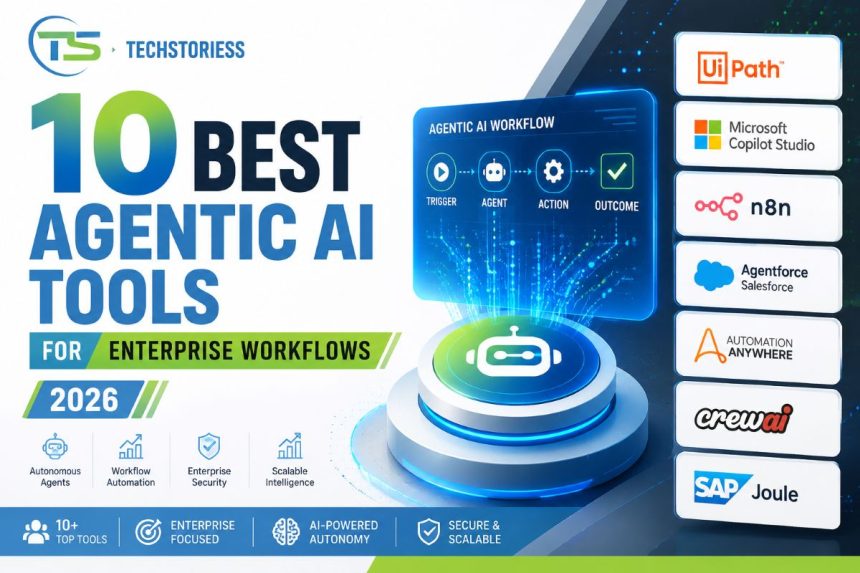
Agentic AI Tools for Enterprise are software platforms that let AI agents plan, act, and coordinate across systems to complete entire workflows. They need minimal human input. That’s different from a chatbot, which just answers prompts. The strongest enterprise options in 2026 are UiPath, Microsoft Copilot Studio, n8n, Salesforce Agentforce, Automation Anywhere, LangChain + LangGraph, SAP Joule, CrewAI, Dify, and ServiceNow. Each wins on a different axis: governance depth, ecosystem fit, self-hosted control, or developer flexibility. The “best” one depends on your stack, your compliance requirements, and how much engineering capacity you have.
Gartner estimates that of the thousands of vendors now marketing “AI agents,” only about 130 offer genuinely agentic capability. The rest are RPA, chatbots, or assistants relabeled for the hype cycle. Gartner calls this pattern “agent washing.” This guide focuses only on platforms with a credible, verifiable claim to real orchestration: persistent memory, multi-step reasoning, and the ability to act across systems without a human triggering every step.
Quick Comparison
| Platform | Best For | Core Strength | Primary Trade-off | Deployment |
|---|---|---|---|---|
| UiPath | Best overall enterprise orchestration | Governance, auditability, human-in-the-loop control at scale | Steep learning curve for small teams | Cloud / on-prem / hybrid |
| Microsoft Copilot Studio | Microsoft-centric enterprises | Near-zero integration friction inside M365/Azure | Weaker outside the Microsoft stack | Cloud (Azure) |
| n8n | Self-hosted, data-sovereign workflows | Full execution visibility, no vendor lock-in | Requires real engineering investment | Self-hosted or cloud |
| Salesforce Agentforce | Customer operations & CRM workflows | Deep native access to CRM context and history | Tied to the Salesforce data model | Cloud (Salesforce) |
| Automation Anywhere | AI-enhanced automation at scale | Layers onto legacy RPA without a rip-and-replace | Less developer-friendly than code-first tools | Cloud / on-prem / hybrid |
| LangChain + LangGraph | Custom, stateful multi-agent systems | Graph-based control over long-running, multi-day workflows | Needs a mature in-house engineering team | Self-hosted / custom |
| SAP Joule | ERP-centric enterprises | Agents grounded in SAP’s Knowledge Graph, embedded in core processes | Most valuable only if you’re already deep in SAP | Cloud (SAP BTP) |
| CrewAI | Role-based multi-agent collaboration | Clean mental model: specialized agents, not one generalist | Developer-oriented, no enterprise turnkey UI | Self-hosted / custom |
| Dify | Mid-market low-code experimentation | Fast time-to-value between no-code tools and dev frameworks | Ecosystem and integrations still maturing | Cloud or self-hosted |
| ServiceNow | Enterprise service operations | Deepest context on tickets, incidents, and org structure | Strongest when you’re already on ServiceNow | Cloud |
Methodology note: this comparison is built from public vendor documentation and named analyst research (Gartner, McKinsey, Menlo Ventures) current as of July 2026, not independent hands-on benchmarking. Validate governance, integration effort, and total cost against your own pilot before procurement — see our agentic AI deployment playbook for a 90-day framework.
What Is Agentic AI, and How Is It Different from RPA?
RPA (robotic process automation) executes fixed, rule-based steps. It breaks the moment a workflow deviates from its script. Agentic AI adds reasoning, memory, and tool use on top of that. A system can handle exceptions, call APIs on its own judgment, and pursue a multi-step goal without a human re-triggering each stage.
For the past decade, RPA freed employees from repetitive tasks like data entry and invoice processing. But RPA only works within defined rules and structured triggers. Real business processes rarely stay inside those lines. Take a procurement approval: it might touch an ERP system, a compliance check, a finance tool, a vendor database, and internal messaging. Any one of those can throw an exception that stops a rules-based bot cold. Agentic systems are built to navigate exactly that kind of ambiguity.
The “Agent Washing” Problem
Gartner named this pattern in a June 2025 research note. It describes vendors rebranding existing chatbots, assistants, or RPA bots as “AI agents” without adding real autonomous capability. Gartner also forecasts that more than 40% of agentic AI projects will be canceled by the end of 2027, largely due to escalating costs, unclear ROI, and weak governance. The technology usually isn’t the failure point. The lack of a deployment strategy is.
A genuinely agentic platform, by contrast, typically shows most of the following:
- Persistent contextual memory across sessions
- Multi-step reasoning toward a goal, not just single-turn responses
- Dynamic tool and API orchestration
- Human-in-the-loop approval gates
- State-aware execution over long-running workflows
- Multi-agent collaboration and delegation
- Policy-aware permissions and runtime observability
- Exception recovery without a human restarting the process
If a platform can’t demonstrate most of these, it’s automation with an agentic label — not agentic automation.
Why This Matters Now: The Market Data
Three figures explain why enterprise buyers can no longer treat this as optional due diligence:
- Enterprise spending is compounding fast. Enterprises spent $37 billion on generative AI in 2025, up 3.2x from $11.5 billion in 2024, according to Menlo Ventures’ 2025 State of Generative AI in the Enterprise report.
- Adoption is about to cross a threshold. Gartner projects that 40% of enterprise applications will embed task-specific AI agents by the end of 2026, up from under 5% in 2025. It calls this a three-to-six-month strategic window for software buyers, per its August 2025 forecast.
- The savings are real, but scoped. McKinsey’s research on enterprise agentic deployments found 20–40% faster cycle times or lower handling costs for repetitive, transactional work in early rollouts. That gain is concentrated in narrow, well-defined processes, not across the board, per its CEO strategy analysis.
For a deeper look at what these cost dynamics mean once agents are running in production, see our breakdown of FinOps for AI spend across AWS, Azure, and GCP and the five ROI metrics that map agentic AI to EBITDA.
The 10 Best Agentic AI Platforms for Enterprise Workflow Automation
1. UiPath — Best Overall Enterprise Orchestration
UiPath has evolved well past its RPA roots. It’s now a full control layer that coordinates AI agents, robotic processes, human approvals, documents, and APIs under one governance model. That governance depth is the differentiator: UiPath was named a Leader for the seventh consecutive year in Gartner’s 2025 Magic Quadrant for Robotic Process Automation, ranking highest specifically for Ability to Execute.
For regulated industries — banking, healthcare, government — the platform’s rollback mechanisms, audit trails, and hybrid deployment options solve a real procurement blocker. Most competitors can’t yet match that compliance visibility. Its human-in-the-loop model favors controlled autonomy over full autonomy, which tends to be what CISOs actually want. The cost is complexity. Smaller organizations without an existing automation practice will find the platform more machinery than they need.
2. Microsoft Copilot Studio — Best for Microsoft-Centric Enterprises
Copilot Studio’s advantage isn’t a feature. It’s gravity. Organizations already running Microsoft 365, Azure, Teams, Dynamics, and Power Platform can deploy agents with minimal new integration work. Microsoft’s automation portfolio was also named a Leader in Gartner’s 2025 RPA Magic Quadrant, alongside UiPath and Automation Anywhere.
Identity management, access controls, and compliance tooling are usually already in place for Microsoft-heavy organizations. That means governance is inherited rather than rebuilt — a meaningful head start. The trade-off is symmetrical, though: the same ecosystem lock-in that makes deployment fast also creates friction the moment you need to orchestrate agents across a genuinely heterogeneous stack.
3. n8n — Best for Self-Hosted, Data-Sovereign Workflows
n8n trades onboarding speed for control. SaaS-first platforms optimize for how fast you can start. n8n optimizes for how much you can see and own: native LangChain integrations, AI agent nodes, memory management, and branching logic, all inspectable rather than hidden behind a vendor’s black box.
That transparency is the real selling point for regulated or security-conscious teams. Every execution path, branching decision, and error state is visible and auditable. The catch is that unlocking that value requires real engineering capacity. This isn’t a platform a business team can run unassisted.
4. Salesforce Agentforce — Best for Customer Operations
Agentforce’s edge comes from proximity to data. Direct access to customer history, CRM records, and engagement systems gives it situational context that standalone automation tools simply don’t have. That matters most in the parts of the business built on semi-structured decision-making: service resolution, lead routing, escalation management, and sales orchestration.
Salesforce has invested specifically in governance layers, permissions, and workflow tracing for Agentforce. It recognizes that agent adoption is fundamentally a trust problem before it’s a technology problem. The limitation is architectural: Agentforce is strongest when your customer operations already live inside Salesforce, and weaker the moment they don’t.
5. Automation Anywhere — Best for Scaling AI-Enhanced Automation
Automation Anywhere was also named a Leader for the seventh consecutive year in Gartner’s 2025 RPA Magic Quadrant. Its core strength is operational continuity: it’s built for enterprises layering AI orchestration onto existing automation stacks rather than replacing them wholesale.
Its Agentic Process Automation architecture blends RPA, reasoning, document understanding, and analytics into one pipeline. It shows up most in finance operations, insurance workflows, claims processing, and shared services. The platform is less developer-centric than code-first frameworks. That’s a feature for governance-first business teams, and a limitation for engineering-led ones.
6. LangChain + LangGraph — Best Developer Framework for Stateful Multi-Agent Systems
LangChain and LangGraph don’t offer a polished enterprise console. They offer the underlying control most polished platforms are built on top of. LangGraph’s graph-based architecture is built for a simple reality: enterprise workflows aren’t instant. They run over hours, days, or weeks, and need checkpoints, retries, memory, and dynamic routing baked in.
That makes it the right choice for engineering-led organizations building proprietary multi-agent systems, retrieval-augmented workflows, or long-running enterprise agents from scratch. It’s the wrong choice for teams without a mature engineering function. The framework assumes you’ll build the guardrails yourself.
7. SAP Joule and the Autonomous Enterprise Stack — Best for ERP-Centric Enterprises
SAP’s 2026 “Autonomous Enterprise” strategy embeds agents directly into core processes: procurement, finance, HR, supply chain. It doesn’t bolt them on as external assistants. The standout piece is its Knowledge Graph architecture: agent performance improves meaningfully when it’s grounded in structured enterprise relationships instead of raw prompts.
This makes SAP a strong long-term option for large multinational enterprises already running complex ERP environments. Outside of SAP’s own ecosystem, the value proposition weakens considerably. This isn’t a general-purpose orchestration layer.
8. CrewAI — Best for Role-Based Multi-Agent Collaboration
CrewAI’s core idea is organizational, not just technical. Instead of one large generalized agent, it breaks objectives into specialized roles that delegate, communicate, and reason collaboratively, closer to how a human team actually operates. That structure fits research workflows, operational planning, and compliance investigations particularly well.
Like LangGraph, CrewAI is developer-oriented rather than a turnkey enterprise product, but its role-based architecture is influencing how the broader orchestration market thinks about multi-agent design.
9. Dify — Best Emerging Low-Code Platform
Dify sits in the gap between rigid no-code tools and developer frameworks. No-code tools tend to break under real enterprise complexity; developer frameworks demand engineering headcount most mid-sized companies don’t have. Dify packages retrieval, workflow logic, observability, and agent coordination into one low-code stack instead.
For mid-sized enterprises that want to experiment quickly without standing up a dedicated AI engineering team, that middle ground is the appeal. Its ecosystem is genuinely still maturing relative to larger incumbents, so due diligence on integration depth matters more here than with established vendors.
10. ServiceNow — Best for Enterprise Service Operations
ServiceNow’s advantage is context, not novelty. Enterprises already running ITSM, HR operations, incident management, and compliance workflows on the platform can extend agents directly into systems that already understand ticket dependencies, service relationships, and organizational structure. That’s a head start standalone AI tools can’t replicate.
For organizations trying to move from experimental AI pilots to operational AI, ServiceNow is often the most natural starting point. The workflow context already exists there.
How to Choose the Right Platform for Your Enterprise
- Map your existing stack first. If you’re deep in Microsoft, Salesforce, SAP, or ServiceNow, ecosystem-native agents (Copilot Studio, Agentforce, Joule, ServiceNow) will almost always beat a best-of-breed tool on integration cost alone.
- Score governance before capability. Ask each vendor for their audit trail, rollback mechanism, and permission model before asking about reasoning quality. Gartner’s cancellation data ties most agentic AI failures to weak governance, not weak models.
- Match the tool to your engineering capacity. LangGraph and CrewAI reward teams with dedicated AI engineers. n8n rewards technically capable but leaner teams. Dify and the enterprise platforms are built for teams without either.
- Pilot on one high-friction, well-bounded process, not a broad rollout. Measure cycle time and exception rate before scaling, consistent with how McKinsey frames early-stage agentic deployments.
- Re-check vendor claims against independent analyst coverage, not just vendor marketing. Agent washing is too widespread to take a pitch deck at face value.
Frequently Asked Questions
What is agentic AI?
Agentic AI refers to AI systems that can reason across multiple steps, maintain memory, invoke tools and APIs, and pursue a defined goal with minimal ongoing human direction. AI assistants, by contrast, just respond reactively to individual prompts.
What is “agent washing”?
Agent washing is Gartner’s term for vendors rebranding existing chatbots, AI assistants, or RPA tools as “agentic AI” without adding genuine autonomous, multi-step reasoning capability.
How is agentic AI different from RPA?
RPA executes fixed, rule-based steps and fails when a process deviates from its script. Agentic AI adds reasoning and adaptability. It lets a system handle exceptions and make judgment calls within guardrails instead of stopping.
Which agentic AI platform should a Microsoft-based enterprise choose?
Microsoft Copilot Studio. It integrates natively with Microsoft 365, Azure, Teams, and Dynamics, and inherits governance infrastructure most Microsoft shops already have.
How much can agentic AI actually reduce operating costs?
McKinsey’s research on early enterprise deployments found 20–40% faster cycle times or lower handling costs for repetitive, transactional work. That’s a scoped, process-specific result, not an enterprise-wide guarantee.
The Bottom Line
The market has moved past the question of whether agentic AI works. The real differentiators in 2026 are governance maturity, observability, permission control, and integration cost, not conversational polish. Enterprises evaluating these platforms should verify vendor claims rather than take a pitch deck at face value. Start with a narrow pilot. Write governance requirements into the RFP before capability demos even begin. For a numbers-first view of what governance failure actually costs, see our analysis of enterprise AI spending’s accountability gap.