


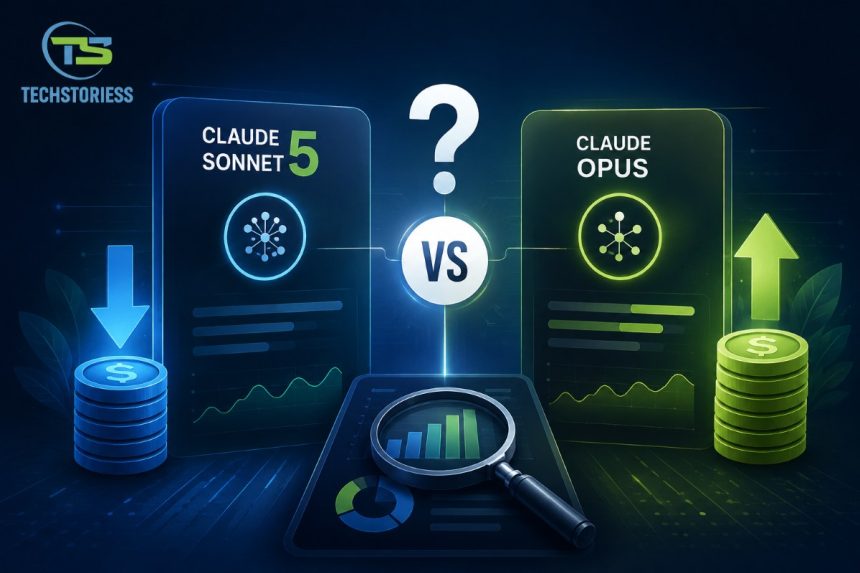
When Anthropic launched a new model on June 30, it delivered a pricing shift that was hard to digest. The launch priced Claude Sonnet 5 at $2 per million input tokens and $10 per million output tokens up till August 31, 2026, before moving to a standard rate of $3 and $15.
This makes it 40% cheaper than the standard price of Anthropic’s own flagship Opus 4.8 ($5/$25 at standard rates), and about 60% cheaper during the introductory window, while coming close to, though not fully matching, Opus-class performance on reasoning, coding, and agentic tool use – on one agentic coding benchmark, Sonnet 5 scored 63.2% against Opus 4.8’s 69.2%, though it edged ahead of Opus on at least one knowledge-work benchmark.
For CTOs and CFOs who have watched AI infrastructure line items inflate for months, this is the headline that matters more than any benchmark chart: with near-flagship intelligence now available at mid-tier prices, cost pressure is finally easing – though one caveat is worth flagging: Sonnet 5 uses a new tokenizer that can produce up to ~30–35% more tokens for the same text, so per-token savings don’t automatically translate into equivalent per-task savings. Every major lab will possibly chase this new pricing standard to stay competitive.
The Backdrop: A Budget Crisis Hiding in Plain Sight
The timing is strategic: enterprises rushed to deploy autonomous AI agents in 2025 and early 2026, then recoiled when the bills arrived. Unlike a single prompt-response exchange, agents loop, call tools, retry failed steps, and burn tokens continuously during long-running tasks. That behavior pattern can turn a modest pilot project into an unpredictable line item. It happens fast, and it happens quietly.
This is the exact pain point that Anthropic’s Sonnet 5 was built to address. The company specifically built it for sustained autonomous work – planning multi-step tasks, driving browsers and terminals, and executing end-to-end workflows without halfway interruptions, a common failure mode of earlier-generation models.
How to Audit Your AI Spend Before the Price Jump
This is the part that is often overlooked, and it’s the part that actually protects your budget.
Re-run your token math with the new tokenizer. The cost-per-task numbers you budgeted last quarter may no longer hold this quarter. Pull a real sample of prompts and outputs from your production traffic, and measure real token counts under Sonnet 5 rather than estimating from Sonnet 4.6 figures.
Rather than routing every task to your most capable model by default, segment workloads by task complexity. Defaulting everything to a top-tier model is the single most common source of avoidable spend. Route routine tasks – customer-facing chat, standard content generation, straightforward data extraction – to Sonnet 5, and reserve Opus 4.8 or higher tiers strictly for tasks where accuracy failures carry real cost (legal review, financial modeling, security-sensitive code). This way, you’re paying flagship prices only where flagship accuracy is actually required.
Move volume to Sonnet 5 before August 31 while introductory pricing is in effect. Introductory pricing applies to all Sonnet 5 usage through August 31, 2026 regardless of when you migrate – so the benefit of moving now isn’t “locking in” a rate, it’s maximizing how much of your workload runs at $2/$10 before the window closes. High-volume, latency-tolerant batch jobs are the easiest candidates to migrate now.
Use the Batch API for non-real-time work. Asynchronous batch requests get a flat 50% off both input and output token pricing – an easy, underused lever for reporting, summarization, and offline analysis jobs that don’t need instant responses.
For workflows that reuse the same system prompt or reference documents, caching can meaningfully cut your effective input cost. Apply prompt caching aggressively – cached tokens are billed at a fraction of the standard input rate throughout Anthropic’s lineup.
Model your total cost at scale, not per-call. A model that’s cheaper per token can still end up pricier overall if it requires more tool calls or longer reasoning chains to finish a task. Benchmark actual task-completion cost, not sticker price.
Finally, list-price cuts don’t necessarily mean lower total spend. Some early benchmarking indicates that Sonnet 5’s per task token consumption is meaningfully more than its predecessor, which can offset the headline savings unless usage is actively monitored.
The Numbers That Matter
Here are some of the key numbers that matter:
- Sonnet 5 introductory pricing: Through August 31, 2026, Sonnet 5 is priced at $2 / $10 per million input/output tokens; after that date, it moves to standard pricing of $3 / $15.
- Opus 4.8 pricing for comparison: Opus 4.8 is priced at $5 / $25 per million tokens – meaning Sonnet 5 runs at roughly 40–60% of flagship cost depending on the pricing window.
- Tokenizer change: Anthropic’s new tokenizer generates up to 1.35x more tokens [upper-bound estimate – see note below] for equivalent text versus the previous generation. This is a detail enterprise finance teams should build into any migration cost model.
- Batch API discount: The Batch API provides a flat 50% off both input and output tokens for asynchronous workloads.
- Competitive position: Sonnet 5 undercuts OpenAI’s GPT-5.5 on price at both introductory and standard rates, runs close to parity with Google’s Gemini 3.1 Pro depending on the pricing window, and is more expensive than Google’s lighter-weight Gemini 3.5 Flash – positioning it as the mid-tier workhorse option across the current model landscape.
What This Means for the Next Six to Twelve Months
Sonnet 5 is a signal of where the entire foundation model market is headed: the fight is no longer purely about raw capability, it’s about who can deliver near-frontier performance at a price enterprises can actually scale. Anthropic is also reportedly preparing for a public listing, and a model that is both good enough to rival its own flagship and cheap enough to run continuously strengthens the revenue story investors will scrutinize.
Takeaway for the enterprise buyers
For enterprise buyers, the takeaway is straightforward: the “premium tax” for agentic AI is shrinking fast, and vendor lock-in based on capability alone is becoming harder to justify.
One point is worth noting here: list-price cuts don’t automatically translate into lower total spend – some early benchmarking suggests Sonnet 5 consumes meaningfully more tokens per task than its predecessor, which can offset the headline savings unless usage is actively monitored.
OpenAI and Google are likely to respond with further price cuts of their own, more granular routing tools that automatically match tasks to the cheapest sufficient model, and growing pressure on finance teams to treat AI spend with the same rigor as cloud infrastructure cost management.
Companies that build disciplined, workload-aware cost models now – rather than reacting after the next price hike – stand to actually capture the savings this generation of models is designed to deliver.