


Here is a truth, though it may be unpopular, that most boardrooms won’t say publicly: there are a large number of companies that are investing more in technology today than they ever have and that are using technology in ways that have become more inefficient.
This is not a failing of technology. This is a failing of strategy, disguised as a problem with technology.
In the last ten years, digital transformation has dominated enterprise management. This has resulted in increased budgets, more vendor options, and an explosion of dashboards. With the stacks of platforms, integrations, and automation, the original question was buried: what is the business problem and how will we know when we have solved it?
The Fragmentation Tax
The first cost of many is what I call the fragmentation tax. This is the cost of adding point solutions to an enterprise stack without any coherent logic. This creates inefficient drag. Teams work in silos as do their tools. Data exists in systems that are unable to communicate with one another. Marketing is unable to see what Sales is doing. Supply Chain is unable to see what Sales is doing. Leadership is forced to make decisions from dashboards that reflect how technologies interact with one another instead of how the business operates.
The fragmentation tax will never show up on any statement of profit and loss. However, it manifests as poor decisions, duplicate work, and, ultimately, the most damaging inability to determine which technology investments will positively impact the business.
Successful organizations have shown restraint by horizontally assessing technology before vertically utilizing it. It is imperative to evaluate if added technology will assist with job completion. Organizations that prevent this trap ask the added questions if the technology will disrupt workflow or facilitate data accessibility.
ROI Is Not a Post-Launch Metric
In this failure pattern, return on investment is considered measured solely after deployment, instead of being defined before it.
Technology vendors are good at demonstrating capability. However, they have very little willingness to speak of the baseline conditions that must exist in order for their capability to achieve market value. Consequently, organizations end up signing contracts based on a promise of transformation, only to spend the next eighteen months learning that the promise of transformation was true, but only after they delivered a parallel data cleansing, process re-engineering, and change management program that had not been included in the original budget.
As part of an investment critique, a more balanced approach asks the following three questions before a purchase is sanctioned: first, what specific metric changes, and by how much, if this is successful? Second, what will the business look like at months six, twelve, and twenty-four, with and without this investment? Third, who is responsible for the outcome and not the implementation?
This distinction between outcome and implementation is important, given that implementation can be the responsibility of either a vendor or an internal technology team, whereas outcome is the responsibility of the business. If no business leader has made a stake in the outcome of the investment, it is very unlikely that the investment will realize any measurable return.
AI, Automation, and the Attribution Challenge
AI and Automation add another layer of challenges to this issue. Admittedly, there are potential upsides: improved demand sensing, more exact targeting, faster decisions, and less manual work across the whole revenue chain. However, there is also a potential risk, and that is optimizing for the wrong signals at scale.
With automated systems that make hundreds of decisions every single day, the wrong or right encapsulation of the logic in the system is exponentially more dangerous. Without a meaningful attribution system that links automated decisions to the desired business outcomes, organizations can invest a lot of time and resources optimizing a machine that is focusing on a proxy business metric that is not actually aligned with the goal of the organization, which is revenue that generates profit.
Attribution is not a marketing technology challenge that can be built and forgotten. It is a framework for strategic thinking. It is a responsibility of the business leaders to define which metrics actually cause growth and which metrics are simply growing in tandem with the former. If organizations are unable to recognize the difference between the two, they will experience great levels of customer or employee engagement, and at the same time, very low revenue.
AI and automation, when used effectively, can bring a lot of great business value. The most effective framework allows for every automated task to be aligned to a desired business outcome, with a human person having the responsibility for that alignment. The technology does the work. The reasoning of what work should be done is left to people.
The Principle That Changes Everything
The sophistication and quantity of technology used during a digital transformation is not the most important consideration. Rather, successful digital transformation is demonstrated through the ability of the used technology to affect the key business metrics that determine the business’ long-term sustainability and success. These metrics include revenue quality, margin integrity, customer lifetime value, and operational leverage.
Over the next decade, the organizations that are able to create the most sustainable competitive advantage are not necessarily the organizations that can afford the most technology. Rather, it is the organizations that ask, before any expenditure, whether the expenditure makes us more effective at doing the thing that creates sustainable value, or would the expenditure increase our overall complexity in what we do.
The focus should not be on how much you spend on technology. Rather, it should be about whether you would know the difference if it stopped working tomorrow.
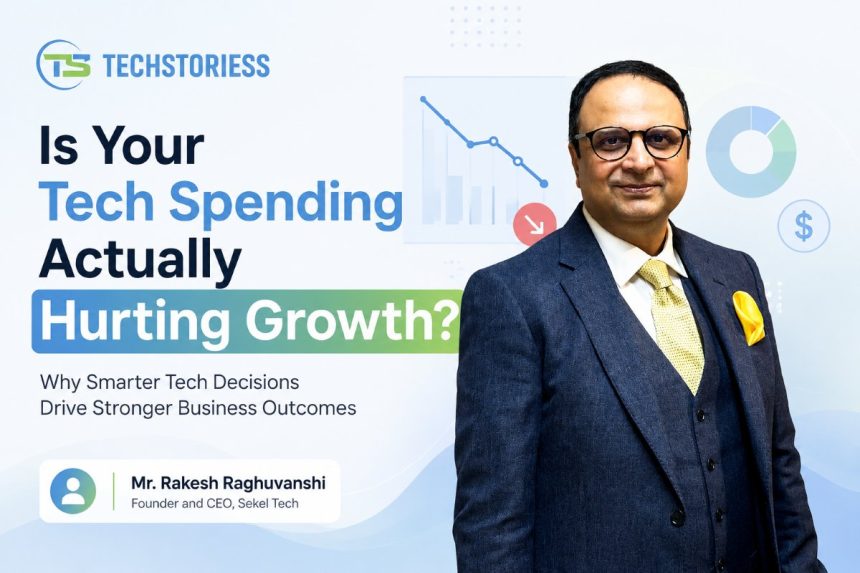
Article Contributed Rakesh Raghuvanshi, Founder and CEO, Sekel Tech