


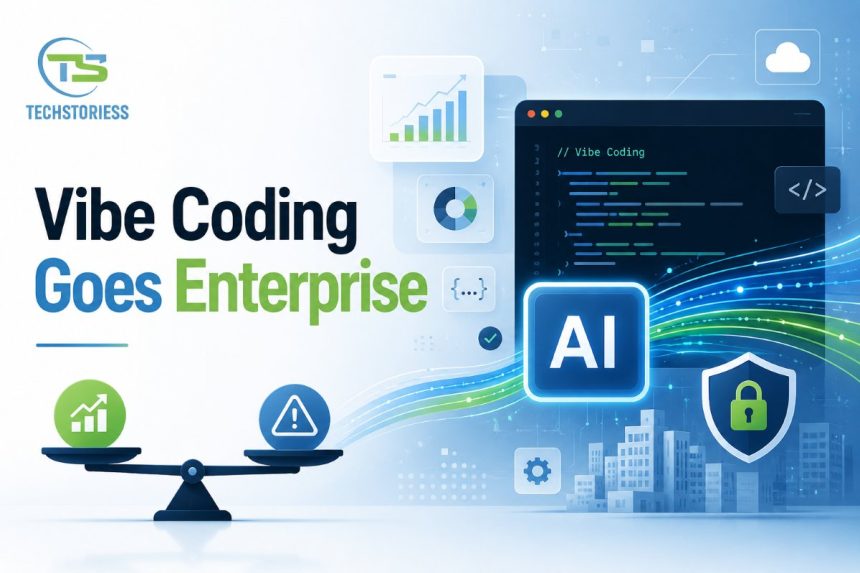
For a term that arrived only in early 2025, “vibe coding” has moved remarkably fast. Coined by AI researcher Andrej Karpathy, it describes generating software by describing what you want in plain English and letting an AI write the code. It took just a year and a half to evolve from meme to methodology to a multi-billion-dollar category.
By early 2026, fully 92% of U.S. developers were routinely using AI coding tools in their daily work, and GitHub – the platform hosting the largest share of the world’s code – reported that nearly half, 46% to be precise, of all new code committed was generated by AI, a jump of roughly 36 percentage points from around 10% just three years earlier.
Cursor, one of the category’s breakout products to capture the global spotlight, has reportedly penetrated 70% of Fortune 1000 companies. This has moved from a developer-forum curiosity to a genuinely meaningful share of enterprise software.
The case for the hype
The vibe coding narrative isn’t only about adoption; it also comes with genuinely impressive productivity numbers. According to IBM, AI assistance in coding has helped cut development time by 60% for internal enterprise applications. Likewise, Microsoft’s internal data reports a 40% improvement in sprint completion for AI-assisted teams.
These gains are also visible at respected venues: in Y Combinator’s Winter 2025 cohort, over 90% of startups had codebases generated largely through AI – a degree of leverage that would have been unthinkable for a two-person founding team five years ago.
Gartner estimates that 90% of enterprise software engineers will use AI code assistants by 2028, up from under 14% in early 2024, and predicts that vibe coding will help build 40% of new enterprise production software by that same year.
For prototyping, internal tooling, and greenfield MVPs, the case is almost settled: teams validate ideas faster, throw away what doesn’t work, and rebuild what does. Up to this point, vibe coding earns its reputation – a real, durable shift in how software gets started.
Where the Story Turns
The trouble starts, however, when “prototype” becomes “production.” The same body of research documenting near-universal adoption also documents a sharp and broadening trust gap. Despite rising daily use, developer favorability toward AI-generated code has fallen from roughly 77% in 2023 to about 60% in 2026. Only around a third of developers say they trust AI-written code’s accuracy – down from over 40% two years earlier. Usage keeps rising anyway, which is its own kind of warning sign: adoption has outpaced confidence.
It’s difficult to ignore the security data. Veracode’s testing across more than 100 language models found that AI-generated code carries an OWASP Top 10 vulnerability roughly 45% of the time – a pass rate that has not meaningfully improved across testing cycles even as coding benchmarks kept climbing.
Georgia Tech’s Vibe Security Radar, which traces CVEs directly back to AI-generated code, logged 35 confirmed cases in March 2026 alone, up from six in January – and its researchers believe the true figure across the open-source ecosystem is five to ten times higher, since most flaws never accumulate a formal CVE. A CodeRabbit review of 470 open-source pull requests found AI-authored code carried 1.7 times more major issues than human-written code. IBM’s Cost of a Data Breach Report found that one in five organizations had experienced a breach traced to AI-generated or shadow AI code.
These aren’t simply abstractions. In April 2026, the AI app-building platform Lovable – valued near $6.6 billion with roughly 8 million users – left thousands of projects’ source code, credentials, and AI chat histories exposed for 48 days through a basic access-control flaw, a bug the company initially, and incorrectly, described as intentional behavior before walking that back.
In January, an AI-built social platform called Moltbook was breached within three days of launch, when researchers found a database key sitting in public client-side code with no row-level security enabled, exposing roughly 1.5 million authentication tokens. A separate CVE (2025-48757) documented the same underlying flaw – disabled row-level security in AI-generated database configurations – across more than 170 other production applications.
A scan of 5,600 live vibe-coded apps by security firm Escape.tech turned up more than 2,000 critical vulnerabilities, 400-plus exposed API keys, and 175 instances of exposed personal data, including medical records – in systems already serving real users. They were production software, in the wild, doing exactly what they were built to do – insecurely.
Forrester’s numbers add a financial dimension to the caution: despite software development being tipped as 2026’s leading AI use case, only 15% of AI decision-makers have actually reported an EBITDA lift from it so far. And Keyhole Software’s enterprise data aggregation found that by roughly twelve weeks into unmanaged AI-assisted development, teams were spending 20–30% of their sprint capacity fixing bugs traced back to AI-generated code – productivity gained on the front end, quietly spent on the back end.
Where SaaS Still Wins
This is the part that deserves close attention but is often skipped by enterprise buyers. A freshly vibe-coded internal tool may ship fast, but it lacks what a mature SaaS platform carries – years of adversarial testing, dedicated security teams, compliance certifications like SOC 2 and ISO 27001, contractual liability, and, most importantly, a vendor whose entire business depends on not leaking your customer data.
Where Lovable and Moltbook failed, the failure was structural – access control logic the AI never implemented because nobody explicitly asked for it – in categories (row-level security, secrets management, authentication boundaries) that established SaaS vendors have solved, audited, and re-audited for years.
The economics reinforce this point. Custom, AI-generated software avoids license fees, but it comes with a hidden cost – the security review, ongoing maintenance, and incident response that a SaaS subscription already bundles into its price.
Compared to human-reviewed code, AI-assisted code is currently producing security findings at a far higher rate, and only a small fraction of enterprises are yet reporting a financial return on their AI coding investment. So generating the code faster does not automatically make it cheaper.
Especially for commodity workflows – the fortieth company to need an applicant tracking system doesn’t need to write one – buying still beats building. Vibe coding generates the software, but you still owe it maintenance, security, and support. When you buy SaaS, you don’t only get a product – you get that upkeep bundled in.
The Middle Ground
This doesn’t mean AI coding tools should be avoided; adoption at this scale can’t be reversed, and the productivity gains in the right contexts are real. The more useful framing – the one a growing number of enterprise engineering teams are converging on – treats vibe coding not as one thing, but as three distinct tiers:
- Unsupervised prompt-to-app work, suitable for disposable prototypes.
- AI-accelerated development, where experienced engineers direct the tool inside real architecture and test gates.
- Full agentic engineering pipelines, with review, scanning, and audit trails built in from the start.
ISACA’s 2026 framework study reports that organizations that adopted this kind of layered governance were able to reduce remediation time by roughly 36% without giving up meaningful development speed.
The same pattern holds across every credible dataset: the problem is not adoption or the technology itself. It is ungoverned deployment that causes the damage. Enterprises that let AI write disposable prototypes and internal tools quickly, buy proven SaaS for commodity and compliance-sensitive workflows, and mandate senior review, security scanning, and test gates before anything AI-generated reaches production, are capturing the productivity upside without inheriting the failure modes documented above.
So, coming back to the title: productivity win or governance nightmare isn’t a yes/no question. Vibe coding is a powerful tool operating well ahead of the governance built to contain it. To get real value from it, enterprises need to close that gap themselves, rather than waiting for the tools to close it for them.