


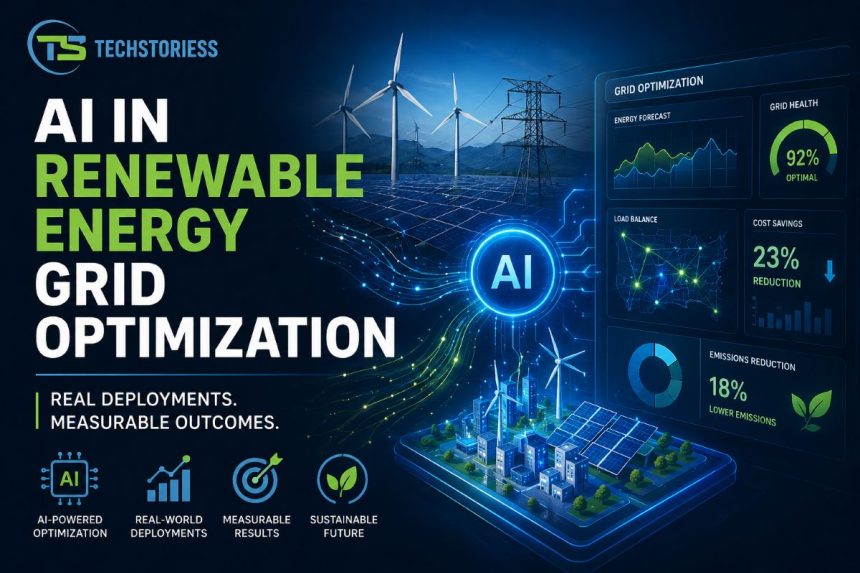
For a long time, discussions around energy conservation have continued, yet they remain far from producing significant outcomes. A majority of narratives mainly reflect either academic promise or vendor-led optimism – far from operational reality. However, with renewable penetration crossing critical thresholds in many regions, grid operators have started deploying AI-driven solutions in production environments instead of only experimenting. This is where the real question arises-what measurable outcomes AI is already delivering in production environments.
- Why Grid Optimization Is Breaking Traditional Systems
- Where AI Actually Fits – Cutting Through the Noise
- Real-World Deployments: Where AI Is Delivering Measurable Outcomes
- Key Use Cases with Proven Impact
- ROI and Operational Impact
- Tools and Technologies in Practice
- What Still Doesn’t Work Well
- Strategic Takeaways for Leaders
- Conclusion
In this article, we discuss AI renewable energy grid optimization real world results, not just projections. It highlights deployments where machine learning models actively optimize grid behavior by improving forecasting precision, minimizing curtailment, and stabilizing increasing system volatility.
Why Grid Optimization Is Breaking Traditional Systems
Conventional electric systems were engineered for predictable, dispatchable generation-coal, gas, nuclear-to operate in an environment where supply could be adjusted to match demand with reasonable accuracy. This design paradigm was not built for variability. Renewable energy sources, particularly solar and wind, break the very structural assumptions of that model.
Intermittency not only adds volatility to generation, but also affects grid frequency, voltage stability, and reserve margins. In high-renewable grids, supply can fluctuate significantly within minutes due to external factors such as cloud cover or wind variability. It becomes challenging for traditional, deterministic control systems to respond at this speed and complexity, as they are rule-based and often manually tuned.
This leads to disruptions such as:
- Rising renewable curtailment despite capacity growth
- Frequency instability in high-penetration zones
- Inefficient dispatch of backup generation
- Escalating balancing costs
This does not mean that traditional systems are becoming obsolete in the near term, but it indicates that they are approaching their operational limits. In this context, optimization is not just about efficiency-it is about maintaining grid reliability under new constraints.
Where AI Actually Fits – Cutting Through the Noise
AI’s role in grid systems is often vaguely described. However, from a practical perspective, it plays a highly specific role with clearly defined operational functions. In practice, AI operates in three core layers of grid optimization:
Forecasting
Machine learning models forecast short-term and long-term generation and demand with higher precision than conventional statistical methods.
Real-time Control and Balancing
Equipped with high-frequency data processing capabilities, AI systems can process real-time grid data streams. This enables dynamic load balancing, frequency regulation, and improved dispatch decisions.
Asset and Storage Optimization
With optimization algorithms and predictive analytics, AI determines optimal charge/discharge cycles for batteries and coordinates distributed energy resources to maximize efficiency and grid stability.
This distinction holds significant operational importance, as each optimization layer generates a different type of value. Forecasting increases certainty, while control improves stability. At the same time, optimization enhances efficiency. Without this clarity, expectations often become overstated and return on investment (ROI) remains unclear.
Real-World Deployments: Where AI Is Delivering Measurable Outcomes
To understand it more clearly, let us take some real world deployments along with the results delivered:
United Kingdom – National Grid ESO
The UK operates a highly advanced renewable-integrated grid, with over 40% electricity generation from wind. Managing this variability required significant improvements in forecasting and balancing capabilities.
To address this challenge, the grid operator implemented machine learning-powered wind forecasting systems integrated into control room operations.
Measured outcomes:
- Forecasting error reduced by ~20-30% compared to legacy models
- Lower reserve requirements and reduced balancing costs
- Improved scheduling of backup generation
From an operational perspective, this resulted in fewer last-minute interventions and more predictable system behavior. Rather than just a technical improvement, its impact translated directly into cost savings in balancing markets.
Germany – Transmission System Operators (TSOs)
Germany’s Energiewende pushed renewable penetration to levels where curtailment had a direct economic impact. Challenges such as grid congestion and demand-generation mismatches led to frequent wind power shutdowns.
To address this issue, German TSOs deployed AI-based congestion management and forecasting tools.
Measured outcomes:
- Curtailment reduced in targeted regions by up to 15-20%
- Improved grid utilization without immediate need for new infrastructure expansion
- Better alignment between generation forecasts and transmission capacity
A key operational shift is evident here: the system moved from reacting to congestion to anticipating it. This predictive approach enabled pre-emptive adjustments, reducing both energy waste and compensation costs.
California ISO (CAISO) – United States
California’s grid faced the “duck curve,” a unique load profile caused by high solar generation during the day followed by steep evening ramps.
To address this challenge, CAISO enhanced its demand and solar forecasting systems by integrating machine learning models.
Measured outcomes:
- Day-ahead solar forecasting error reduced by ~30%
- Improved ramp prediction accuracy during evening transitions
- Reduced reliance on fast-ramping fossil fuel plants
This had a direct impact on operational stability. Better ramp forecasting reduced emergency interventions and enabled more efficient resource dispatch.
China – State Grid Corporation
As the operator of the world’s largest power grid with rapidly growing renewable capacity, China faced challenges in managing both scale and variability. Traditional approaches proved insufficient.
It deployed AI-based systems for load forecasting and grid dispatch optimization.
Measured outcomes:
- Load forecasting accuracy improved by 10-15%
- Enhanced real-time dispatch efficiency across regions
- Reduced operational costs in high-demand zones
At this scale, even marginal improvements translate into significant economic impact.
Australia – South Australia Grid
With one of the highest shares of wind and solar globally, South Australia serves as a testing ground for grid innovation.
Here, AI-driven battery optimization systems have been deployed alongside large-scale storage assets to improve frequency control and optimize energy market participation.
Measured outcomes:
- Faster response times for frequency control (milliseconds vs seconds)
- Reduced frequency deviation events
- Increased revenue from energy storage participation in energy markets
This is a clear example of energy storage AI optimization delivering not just stability but tangible financial returns.
Key Use Cases with Proven Impact
Instead of broad capabilities, the practical value of AI in grids emerges through specific, repeatable use cases.
AI power grid balancing use cases demonstrate immediate value. AI systems analyze real-time load, generation, and network conditions to recommend or automate balancing actions, reducing frequency deviations and improving reliability.
Machine learning energy forecasting has significantly matured in recent years. Modern models integrate weather data, historical generation patterns, and real-time sensor inputs to produce highly granular predictions that improve operational planning and reduce uncertainty. Even a 10-20% improvement in accuracy can lower reserve margins and associated costs.
Another high-impact area is energy storage AI optimization. Batteries are expensive assets, and their value depends on how intelligently they are used. By optimizing charge/discharge cycles based on price signals, demand forecasts, and grid conditions, AI maximizes both operational and financial outcomes.
ROI and Operational Impact
Overgeneralization is a major issue in discussions around smart grid AI deployment ROI. In reality, ROI depends on specific use cases and therefore varies significantly across deployments.
Forecasting improvements deliver clear, measurable ROI:
- Reduced reserve requirements
- Lower imbalance penalties
- Improved market participation
Balancing and control systems offer indirect ROI through improved reliability and reduced operational risk.
Storage optimization offers hybrid ROI:
- Direct revenue from energy markets
- Indirect value through grid stabilization
Across deployments, one thing is clear-rather than replacing infrastructure investment, AI amplifies its efficiency. The strongest financial cases emerge where AI reduces existing inefficiencies rather than attempting to create entirely new value streams.
Tools and Technologies in Practice
It is more useful to think in categories rather than products when discussing renewable integration AI tools.
- Forecasting platforms: Predict demand and generation
- Grid analytics systems: Real-time monitoring and anomaly detection
- Optimization engines: Support dispatch and storage decisions
- Edge AI systems: Deployed at substations and distributed assets
These tools rely on a combination of techniques such as supervised learning, time-series modeling, and reinforcement learning for decision optimization.
Rather than model sophistication, what matters operationally is integration with grid control systems. Many technically sound models fail because they cannot be embedded into real-time decision workflows.
What Still Doesn’t Work Well
Despite positive outcomes, several limitations persist that restrict large-scale adoption.
- Data quality remains inconsistent
- Model drift introduces ongoing operational risk
- Integration complexity is often underestimated
- Regulatory constraints slow deployment
These challenges highlight a critical point: AI in energy is not just a technical problem-it is an operational and institutional one.
Strategic Takeaways for Leaders
Rather than being purely visionary in nature, this shift has clear pragmatic implications for CTOs, operators, and policymakers.
To maximize value, AI must be applied to specific, well-defined problems-particularly forecasting and storage optimization. Large, platform-level AI initiatives often struggle without clear operational anchors.
Investment should prioritize:
- High-quality data pipelines
- Integration with control systems
- Continuous model monitoring
At the same time, it is important to recognize what to avoid. Extremely ambitious AI deployments aimed at overhauling entire grid operations rarely succeed. Incremental, use-case-driven adoption proves far more effective.
Instead of disrupting grid optimization, AI is enabling precision improvements at scale, each contributing to a more stable and efficient system.
Conclusion
Treating AI as a silver bullet for renewable integration is the most common misconception. AI is not a replacement for physical infrastructure; instead, it is a decision-support capability that improves outcomes but does not eliminate constraints like transmission capacity or storage limits.
Another frequent error is overemphasizing model sophistication. In practice, simpler, well-integrated models often outperform complex systems that cannot operate reliably in real-time environments.
Many narratives also ignore the operational reality of grid systems. Deployment involves regulatory approval, system integration, and risk management-factors that often determine success more than the technology itself.
As the shift toward renewable energy accelerates, grid optimization has become significantly more complex. AI has emerged as a valuable tool in managing that complexity-but only when applied with precision, grounded in real-world constraints, and measured through tangible outcomes.
Here lies the real story-not in what AI promises, but in what it has already delivered.