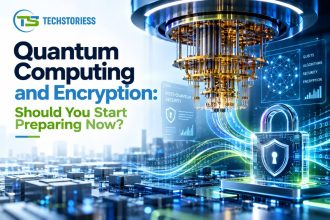



The quantum threat to encryption is not an emergency that every company needs to solve overnight. But for organisations responsible for protecting sensitive information over many years, waiting for quantum computers to become powerful enough could be a costly mistake.
Imagine a company that has spent years building its cybersecurity around industry-standard encryption. Its customer records are protected. Its financial transactions are secured. Its internal communications use established cryptographic protocols.
The security team has done its job.
Yet some of the information being protected today could still be valuable to an attacker ten or fifteen years from now. And the attacker may not need to break the encryption today. They may simply need to collect the data, store it and wait.
That possibility sits at the centre of one of cybersecurity’s most important long-term challenges: quantum computing.
The question facing business leaders is not whether quantum computers will replace conventional computers. It is whether the arrival of sufficiently powerful quantum machines could undermine some of the cryptographic systems on which modern business depends.
The answer is significant enough to deserve attention now.
The encryption problem hiding in quantum computing
Most people encounter encryption without thinking about the mathematics behind it.
When a customer logs into a banking application, a business exchanges confidential documents, or a website establishes a secure connection, cryptographic systems help protect information from unauthorised access and manipulation.
Much of today’s public-key cryptography relies on mathematical problems that are extremely difficult for conventional computers to solve at scale.
Quantum computers operate on different principles. By exploiting quantum-mechanical effects, they can approach certain computational problems in ways that conventional machines cannot efficiently replicate.
The distinction matters because a sufficiently capable, fault-tolerant quantum computer could use Shor’s algorithm to break widely deployed public-key cryptographic systems based on integer factorisation and discrete logarithms. These underpin technologies associated with RSA and elliptic-curve cryptography.
That does not mean every form of encryption becomes useless.
Symmetric encryption, such as AES, faces a different kind of quantum threat. Grover’s algorithm could theoretically reduce the effective security of brute-force searches, but the implications differ from the threat to public-key systems. Appropriate key sizes and sound implementation remain important.
The real issue is therefore not that quantum computers will instantly unlock every digital secret. It is that some widely used cryptographic foundations may eventually become unsafe.
And businesses cannot afford to treat all cryptography as if it faces the same risk.
Is the threat real today?
There is an important distinction between a credible future threat and a demonstrated present-day capability.
As of October 2026, organisations should not assume that a quantum computer capable of breaking today’s widely deployed public-key encryption at practical scale is available. Building a sufficiently powerful, fault-tolerant machine remains a substantial engineering challenge.
The number of qubits alone does not settle the question. Their quality, error rates, connectivity, error correction and the resources needed to execute a useful computation all matter.
Forecasts about when a cryptographically relevant quantum computer might arrive vary. No responsible security strategy should depend on a single predicted year.
But waiting for a definitive arrival date misses the point.
The US National Institute of Standards and Technology (NIST) has already finalised three post-quantum cryptography standards. Published in August 2024, they establish practical foundations for cryptographic systems designed to resist attacks from future quantum computers.
These standards are:
- FIPS 203 (ML-KEM): A mechanism for establishing shared secret keys securely.
- FIPS 204 (ML-DSA): A digital signature standard used to authenticate data and detect unauthorised changes.
- FIPS 205 (SLH-DSA): Another digital signature standard, based on hash functions.
The existence of these standards changes the business conversation. Quantum-resistant cryptography is no longer simply a research topic to revisit when the hardware matures. There are standards organisations can begin evaluating and implementing today.
NIST itself recommends beginning the transition rather than waiting for a quantum computer to demonstrate the threat.
That is a preparedness decision, not a prediction that the cryptographic deadline has already arrived.
The danger of data that outlives its encryption
Consider two hypothetical businesses.
The first operates a consumer-facing service that handles relatively short-lived information. Some of its data loses much of its value after a few days or months.
The second manages long-term intellectual property, sensitive medical records, government-related contracts, financial records or confidential industrial designs. Information stolen today might remain useful to an adversary for years.
Both organisations use encryption. But their exposure is not necessarily the same.
This is where the concept of harvest now, decrypt later becomes important.
An attacker can collect encrypted information today and retain it in the hope that future advances will make it possible to decrypt some of that information. Whether this is economically attractive depends on the data’s value, its useful lifespan and the resources available to the attacker.
The risk is particularly relevant when information must remain confidential for a long time.
A pharmaceutical company might need to protect research and manufacturing knowledge long after a particular project has ended. A financial institution may hold records subject to lengthy confidentiality obligations. A manufacturer may have product designs that remain commercially valuable for decades.
If that information is captured today, replacing the encryption next year cannot erase copies already stolen.
The appropriate question for a security leader is therefore not simply, “How long until quantum computers can break encryption?”
It is also, “How long must our most sensitive information remain secure?”
That second question can make the case for preparation even when the arrival date of the technology remains uncertain.
Why changing encryption is harder than it sounds
A business cannot solve this problem by purchasing a new security product and switching it on across the organisation.
Cryptography is embedded throughout enterprise technology. It appears in secure network connections, identity systems, digital certificates, software updates, cloud services, databases, backup systems, payment infrastructure, hardware devices and third-party applications.
Some implementations are visible to IT teams. Others sit inside vendor products or legacy systems that have been running for years.
An organisation may not even have a complete inventory of where public-key cryptography is used, which algorithms are deployed or who controls the relevant keys and certificates.
That creates a discovery problem before it creates a replacement problem.
Post-quantum algorithms also bring engineering considerations. They can differ from existing algorithms in key sizes, signature sizes, performance and implementation requirements. These differences may affect network protocols, constrained devices, application compatibility and system capacity.
Conclusion
Start by auditing where your organisation uses encryption, identifying data that must remain confidential for years, and asking technology vendors about their post-quantum migration plans. Then prioritise critical systems and build a phased transition roadmap around established NIST standards.
You don’t need to predict when quantum computers will break today’s encryption. You need to know what must change, who is responsible, and how long the transition will take.
The best time to prepare is before the threat becomes an emergency.