


For twenty years, search marketing had a simple scoreboard: rank on page one, earn the click. That scoreboard is breaking. An Ahrefs analysis of 300,000 keywords found that when an AI Overview appears, the top-ranking page earns 58% fewer clicks. Pew Research found users click a link just 8% of the time when an AI summary is shown, versus 15% when it isn’t.
Buyers haven’t stopped searching. They’ve started asking, and they’re getting answers instead of links. For marketers, visibility now runs on three layers: SEO, AEO and GEO.
Three Acronyms, One Question
Each discipline answers the same question (where does a buyer first meet your brand?) at a different layer.
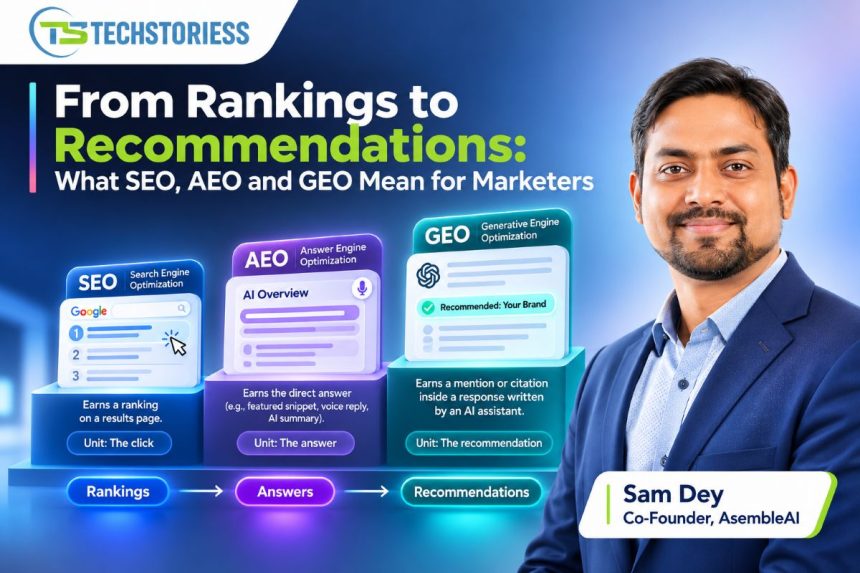
- SEO (Search Engine Optimization) earns a ranking on a results page. The unit of success is the click.
- AEO (Answer Engine Optimization) earns the direct answer: the featured snippet, the voice-assistant reply, the AI summary at the top of the page. The unit is the answer.
- GEO (Generative Engine Optimization) earns a mention or citation inside a response written by an AI assistant. The unit is the recommendation.
Picture a buyer asking for “the best project management software for remote teams.” SEO decides whether your comparison page ranks. AEO decides whether your explanation becomes the summary. GEO decides whether an assistant names you in its shortlist of three, often the only list the buyer reads.
These are layers, not replacements. AI systems still draw on the indexed web, so technical SEO remains the foundation
The Playbook: Write to Be Cited
Four habits move all three layers at once.
- Lead with the answer. Open key pages with a 40–60 word direct response, then add depth. Phrase subheads the way customers actually ask questions.
- Bring evidence. Original data, specific numbers and clear definitions are easy for AI systems to lift and attribute. The original GEO research paper found that adding statistics raised visibility in generative answers by roughly 30–40%.
- Structure for machines. Use schema markup (FAQ, Product, Organization), descriptive headings, comparison tables and consistent naming of your brand and products.
- Earn mentions off your site. Assistants synthesize from reviews, trade press, analyst reports and forums. A B2B firm that publishes an annual benchmark report gets quoted by journalists, and those articles become the sources assistants cite. GEO is now as much a PR discipline as a content one.
Measure Visibility, Not Just Traffic
If your dashboard tracks only rankings and sessions, you’re measuring a shrinking slice of influence. Add three metrics:
- Share of answer: Build a panel of 50–100 questions your buyers ask. Run them monthly across the major AI assistants and log whether your brand appears, where, and which sources are cited. A spreadsheet is enough to start.
- Answer accuracy: Record whether the AI describes your product, pricing and positioning correctly.
- AI referral quality: Tag assistant referrals in your analytics and compare their conversion with organic search.
The business case is real. Seer Interactive found that brands cited in AI Overviews earned 35% more organic clicks and 91% more paid clicks than uncited brands. Zero-click doesn’t mean zero value, but you need new evidence to prove it to leadership.
Organize the Team Around Discoverability
Most organizations split this work across SEO, content, PR and product marketing, each with its own KPIs. AI answers ignore those boundaries. Assign one owner for discoverability, with a shared question panel and a shared scorecard.
Regulated industries need an extra step. In pharmaceutical marketing, an assistant that misstates an indication or omits safety information is a compliance risk, not just a missed impression. Monitor how assistants describe your brand, publish clear authoritative content to correct the record, and route fixes through medical, legal and regulatory review.
The Takeaway
Rankings earned the click. Answers earn the decision. SEO keeps you discoverable, AEO makes you the answer, and GEO makes you the recommendation. The question is no longer “Where do we rank?” but “When a buyer asks AI about our category, are we in the answer, and is it right?”
Start this quarter: pick 25 buyer questions, audit your presence, and fix the five pages that matter most.
By Sam Dey, Co-Founder of AsembleAI, Host of DataScienceWithSam, Associate Director at CMI Media Group(WPP)