


Quantum computing is able to solve problems that cannot be solved with classical machines. It can introduce a paradigm shift across multiple domains—right from cryptography and material science to drug discovery and complex optimization. However, it is extremely challenging to convert theoretical quantum models into practical systems due to physical limitations and engineering constraints.
- Overcoming the Limits of Manual Control in Quantum Hardware
- Scaling Quantum Systems Starts with Smarter Calibration
- Learning to Live with Noise Instead of Eliminating It
- Bridging the Gap Between Ideal Algorithms and Real Machines
- Letting AI Discover Quantum Algorithms Humans Wouldn’t Find
- Orchestrating Quantum and Classical Systems as One Workflow
- Lowering the Barrier to Entry for Quantum Innovation
- When AI and Quantum Hardware Learn Together in Real Time
- From Qubit Counts to Intelligent Quantum Platforms
- Conclusion
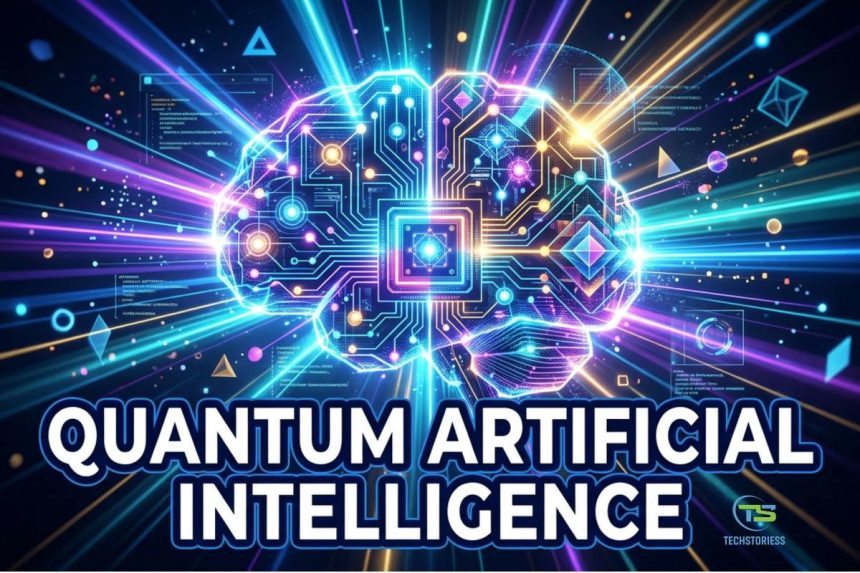
In the real world, quantum adoption is limited by factors like hardware fragility, environmental sensitivity, limited scalability, and complicated control mechanisms. Instead of waiting for ideal quantum hardware, experts are rapidly leveraging AIpl to turn today’s imperfect systems into usable and reliable platforms.
Adding an artificial intelligence layer over quantum systems helps in tasks like stabilizing qubits, optimizing control parameters, and compensating for noise and errors.
Overcoming the Limits of Manual Control in Quantum Hardware
One of the most critical bottlenecks in practical quantum computing is hardware fragility. Qubits, the fundamental units of quantum computation, are extremely sensitive to even minor disturbances such as temperature fluctuations, electromagnetic interference, environmental noise, or minute manufacturing imperfections. Managing this level of complexity in real time is extremely difficult for conventional control models built purely on physics-based formulations.
Machine learning models play a vital role by selecting optimal pulse sequences and control parameters through continuous analysis of experimental feedback. Using neural networks and reinforcement learning, AI enhances quantum control and system stability. Rather than relying exclusively on analytical quantum models, AI adapts to imperfections that cannot be modeled with precision. Instead of controlling quantum hardware purely through equations—which is highly challenging—AI systems learn the behavior of quantum hardware directly from data.
• To function ideally, qubits need precisely stable temperature, electromagnetic conditions, and microscopic structural consistency
• The real-life adaptation of quantum systems is challenging because of fundamental laws of physics that limit deterministic control
• AI solves this challenge through adaptive, data-driven control that goes beyond analytical limits
Scaling Quantum Systems Starts with Smarter Calibration
One of the major challenges in scaling quantum computers is calibration. As the number of qubits increases, the number of parameters that must be tuned grows exponentially, making manual or rule-based calibration impractical beyond small systems. Experimental evidence increasingly shows that AI is emerging as the only viable approach for continuous, large-scale calibration.
Using supervised and unsupervised learning models, researchers can detect system drift, optimize gate fidelities, and autonomously recalibrate quantum devices without shutting them down. These AI-driven calibration systems continuously evolve over time, learning correlations between qubits and forecasting failure modes before performance degradation becomes visible.
Learning to Live with Noise Instead of Eliminating It
• Lack of required resources makes it almost impossible to fully correct quantum error
• The best alternative is to learn and model device-specific noise patterns
• Here, AI enables predictive inference to mitigate errors and recover useful outputs
Quantum error correction is an extremely resource-intensive process. Encoding a single logical qubit often requires a very large number of physical qubits, making full error correction impractical on today’s hardware. AI offers a powerful alternative by enabling error mitigation rather than complete correction.
By learning device-specific noise patterns, AI systems analyze noisy measurement data and infer corrected outputs using predictive techniques. This reduces effective error rates without incurring the heavy overhead of traditional error-correction schemes. These adaptive approaches often outperform generic correction methods under real-world operating conditions, enabling useful quantum results despite imperfect hardware.
• Qubit count can exponentially add to calibration complexity
• Feasibility of manual tuning is limited to small systems only
• AI helps in continuous, large-scale calibration by learning optimal parameter adjustments dynamically
Bridging the Gap Between Ideal Algorithms and Real Machines
Many quantum algorithms are designed for theoretical machines, creating a disconnect between algorithm design and hardware execution. When deployed on real systems, connectivity limits, gate errors, and coherence constraints significantly alter performance.
AI-driven compilers and circuit optimizers help close this gap. Instead of rigid, rule-based compilation, machine learning models learn to map abstract circuits onto specific hardware architectures in ways that reduce error accumulation and speed up execution. Compilation becomes a hardware-aware optimization process guided by empirical data.
• We don’t yet have the hypothetical hardware on which quantum algorithms are based
• Algorithm performance is distorted by real-world constraints
• With the help of AI-driven compilation, algorithms can be adapted to actual devices
Letting AI Discover Quantum Algorithms Humans Wouldn’t Find
AI is not limited to optimization—it actively contributes to discovery. Reinforcement learning agents have identified novel quantum circuits that outperform human-designed counterparts for tasks such as state preparation and entanglement generation.
Instead of encoding human intuition directly into algorithms, researchers allow AI systems to explore design spaces that are otherwise inaccessible. Some AI-generated solutions lack clear analytical interpretation yet demonstrably work, raising important questions about discovery, validation, and trust in AI-driven quantum research.
• Reinforcement learning helps in discovering vast circuit design spaces
• By leveraging AI potential, we can discover non-intuitive solutions that actually work in practice
• This approach shifts algorithm design from intuition to performance-driven search
Orchestrating Quantum and Classical Systems as One Workflow
Quantum computers are embedded within broader classical workflows that handle scheduling, resource allocation, and result interpretation. AI acts as the orchestration layer for these hybrid systems.
Using predictive and optimization capabilities, AI models forecast queue times, allocate resources efficiently, and determine whether problems should follow quantum-first, classical-first, or hybrid strategies. This ensures limited quantum resources are used only where they provide maximum value.
• Quantum systems operate within classical computing pipelines
• Due to resource scarcity, we need to intelligently schedule quantum workloads
• AI presents a simplified, effective solution by coordinating hybrid execution strategies
Lowering the Barrier to Entry for Quantum Innovation
Quantum computing has historically required deep specialization in physics and hardware engineering. AI-driven tools reduce this barrier by hiding complexity behind intelligent interfaces.
Automated systems can optimize circuits, mitigate errors, and diagnose performance issues, allowing researchers to focus on higher-level problem formulation. This mirrors how high-level programming languages accelerated classical computing adoption and ecosystem growth.
• Presently, adoption is limited by the need for deep domain expertise
• AI abstracts hardware complexity behind intelligent tools
• Rather than control, the focus shifts to problem solving, allowing more researchers to participate
When AI and Quantum Hardware Learn Together in Real Time
Recent research highlights closed feedback loops between AI models and quantum experiments. Instead of static deployment, AI systems interact directly with quantum hardware in real time.
AI continuously updates strategies based on live experimental data, while hardware configurations are dynamically adjusted based on AI recommendations. This co-evolution accelerates discovery and minimizes the gap between hypothesis and validation.
• Hardware variability makes static control models needed for limited adaptability
• With closed feedback loops, it becomes easier to continuously adapt control strategies
• Discovery cycles become shorter and make them highly efficient
From Qubit Counts to Intelligent Quantum Platforms
These developments signal a paradigm shift in quantum computing. Practical capability is no longer defined solely by qubit count, but by how effectively AI-driven software layers exploit available hardware.
This shift is reshaping funding priorities, talent requirements, and platform architecture. AI has moved from a supporting role to a foundational component of modern quantum systems.
• Capability is not defined by raw qubit numbers
• Usable performance is determined by how intelligent the software is
• AI-driven layers are being increasingly prioritized by platform designs
Conclusion
AI plays a critical role in abstracting quantum complexity and making imperfect systems useful today. Through intelligent control, calibration, error mitigation, compilation, and orchestration, AI bridges the gap between theory and reality.
By embedding AI deeply into quantum platforms, physical constraints can be softened or bypassed, accelerating progress without waiting for ideal hardware to emerge.