


In cybersecurity, the most dangerous shifts rarely announce themselves. They emerge quietly — disguised as routine activity, embedded inside trusted workflows, and operating through the everyday tools we rely on without hesitation.
In 2026, that shift arrived in an unexpected form. It fused social engineering with native Linux functionality. It blurred the boundary between document and executable. And it converged with a troubling industry statistic: nearly 45% of AI-generated code contains security flaws.
A PDF that isn’t actually a PDF.
A Linux shortcut masquerading as a document.
And production-ready-looking AI code carrying hidden weaknesses.
Individually, each trend appears manageable. Together, they define a new malware surface.
PDF security vulnerabilities
PDFs have long been associated with phishing and malware delivery. Security teams typically think of embedded JavaScript document exploits, malicious attachments, or weaponized documents targeting Windows systems. For years, attackers abused PDF readers through embedded scripting engines, triggering memory corruption or silently downloading payloads.
But the landscape has evolved.
Recent cyber-espionage campaigns attributed to APT36 — also known as Transparent Tribe, Mythic Leopard, EarthKarkaddan, or Operation C-Major — demonstrate a strategic pivot toward Linux environments. Active since at least 2013, this Pakistan-linked advanced persistent threat group has historically targeted Indian government and defense entities through credential harvesting and persistent phishing operations.
What makes the newer infection chain notable is that it doesn’t rely on exploiting a Linux vulnerability. It exploits perception.
Victims receive a ZIP archive containing a file that appears to be a procurement-related PDF:
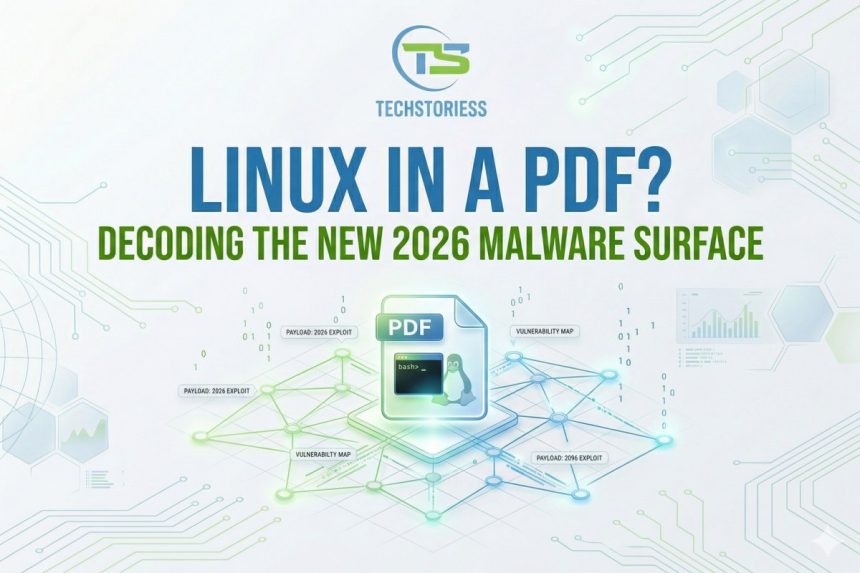
PROCUREMENT_OF_MANPORTABLE_&_COMPAC.pdf.desktop
To the human eye, it looks like a document. To the Linux operating system, it is a .desktop launcher file — effectively executable code.
When launched, the file opens a decoy PDF in Firefox. The user sees a legitimate-looking document, immediately reducing suspicion.
Behind the scenes, however, the loader retrieves a hex-encoded dropper hosted on Google Drive. It decodes the payload, writes it into /tmp/ using a timestamped filename, executes it, establishes persistence on the system, performs anti-debugging and anti-sandbox checks, and attempts to connect to its command-and-control infrastructure via WebSockets.
No kernel exploit.
No zero-day vulnerability.
No memory corruption trick.
Just operational deception.
The malware surface here is not a technical flaw — it is a misplaced trust in how files are perceived.
When Documents Become Execution Environments
The evolution of document-based attacks is not limited to phishing attachments or JavaScript abuse. Security researchers have demonstrated experimental concepts such as embedding a RISC-V emulator in a PDF, effectively allowing processor instructions to be simulated within a document’s rendering environment.
While largely seen in research and proof-of-concept scenarios, the implication is significant: a document can theoretically act as a miniature execution environment rather than a passive file. This represents a conceptual expansion of the same trajectory that began with JavaScript document exploits years ago.
In that broader context, a Linux .desktop file disguised as a PDF is part of a continuum. Documents are no longer just carriers of malicious code — they can become platforms for logic execution, redirection, or staged payload delivery.
The line between “file” and “application” continues to blur.
The Expanding Role of Linux
For years, Linux endpoints have been viewed as inherently more secure. Organizations rely heavily on Linux across cloud infrastructure, container platforms, developer environments, and production servers. In many enterprises, Linux dominates cloud ecosystems and backend workloads.
Historically, security programs often prioritized Windows endpoints for user-level monitoring, while Linux desktops received comparatively less scrutiny.
APT36’s approach challenges that assumption.
The attack leverages native Linux functionality — .desktop files — which are legitimate components of graphical desktop environments. These files define how applications are launched. They are not exploits. They are standard OS behavior.
But when disguised and delivered through phishing, they become malware carriers without exploiting any underlying operating system weakness.
This marks a structural shift: modern malware does not need to break the system. It only needs to operate within expected behavior.
And that shift is being accelerated by another force.
The 45% Reality of AI-Generated Code
A 2025 industry study analyzing more than 100 large language models across 80 coding tasks revealed a concerning statistic: approximately 45% of AI-generated code contained security flaws.
More strikingly, larger and newer models did not show meaningful improvement in secure coding practices. Functional accuracy improved. Security resilience did not.
Java exhibited the highest failure rates, exceeding 70% in some secure coding evaluations. Python, C#, and JavaScript also showed significant weakness, ranging between 38% and 45%.
The issue was not that AI cannot write working code — it clearly can. The issue was that it frequently failed to prioritize secure patterns.
Cross-site scripting protections were often missing.
Log injection defenses were frequently ignored.
Input validation was inconsistently implemented.
Safer APIs were bypassed in favor of simpler but insecure alternatives.
The code appeared polished and deployment-ready. In reality, it was often insecure beneath the surface.
“Vibe Coding” and the Automation of Assumption
An increasing number of developers now rely on what some call “vibe coding” — describing desired outcomes in natural language and allowing AI tools to generate the implementation without explicitly defining security constraints.
This represents a fundamental transformation in software development.
Instead of manually designing secure architectures, developers iterate through prompts. AI assistants handle the heavy lifting: utility scripts, automation tasks, API handlers, WebSocket clients, and even system loaders.
But if nearly half of these outputs may contain security weaknesses, the risk compounds rapidly — especially when such scripts are deployed internally, embedded into DevOps pipelines, or integrated into production environments.
Security does not just scale. Vulnerabilities scale with it.
The Convergence Point
Consider how these trends intersect.
A Linux endpoint receives a phishing ZIP file.
A disguised .desktop file is executed.
A dropper retrieves its payload from a trusted cloud platform.
The malware establishes persistence and communicates over WebSockets.
Encrypted traffic blends with legitimate web activity.
Meanwhile, internal monitoring scripts — possibly generated in part by AI — fail to flag anomalies because validation logic or network inspection routines were never hardened.
The compromise succeeds not because Linux is weak, but because the environment assumed normal behavior.
The modern malware surface is no longer defined by isolated vulnerabilities or traditional JavaScript document exploits alone. It is defined by workflows, automation pipelines, evolving document execution models, and trust boundaries.
Conclusion
The 2026 malware surface is not loud or destructive in obvious ways. It does not crash systems or cause immediate disruption. Instead, it embeds itself silently, operating within normal processes and trusted tools.
From JavaScript document exploits to research demonstrating a RISC-V emulator in a PDF, and now to Linux launchers disguised as procurement files, the document itself has become an increasingly flexible attack surface.
It thrives in environments that prioritize automation over scrutiny.
The question is no longer whether malware can hide inside a PDF-looking file on Linux.
The question is whether we are prepared for a threat landscape where deception, automation, experimental document execution techniques, and insecure AI-assisted development converge into a single, expanding attack surface.