



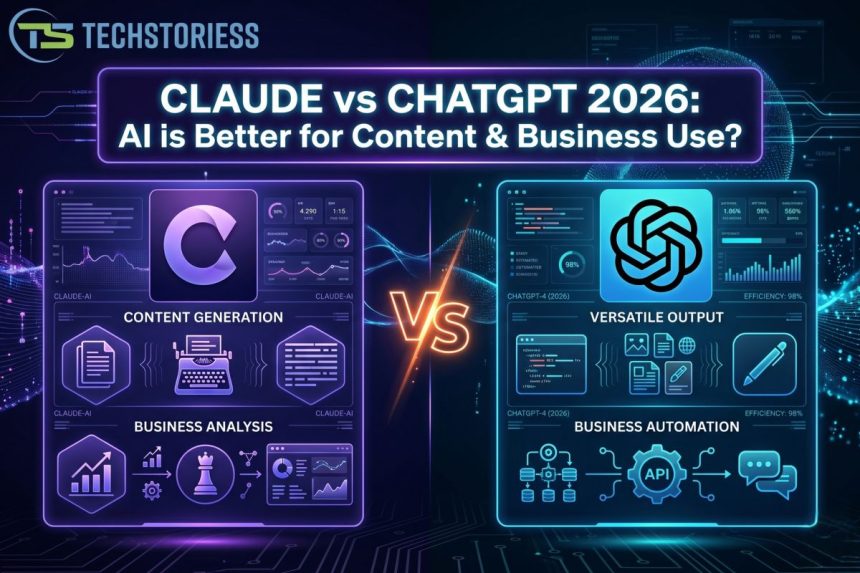
AI tools are no longer “nice to have.” It has become a component of the contemporary way of business writing, marketing, and business operations. However, choosing the right one can be very confusing, especially when two names dominate the discussion: Claude AI and ChatGPT.
- What Is Claude and ChatGPT?
- Claude vs ChatGPT 2026: Core Differences
- Head-to-Head: Core Differences That Matter for Business
- Claude vs ChatGPT for Content Creation
- Claude vs ChatGPT for Business Use 2026
- Which AI Is Better for Writing?
- Claude vs ChatGPT 2026: Pros & Cons Table
- Final Verdict: Claude vs ChatGPT 2026
- Conclusion
- FAQs: Claude vs ChatGPT 2026
- CTA:
The two have become serious business partners. Claude (of Anthropic) shines when you need something intelligent yet natural-sounding. ChatGPT (based on the GPT-5.4 family of OpenAI) is like a Swiss Army knife, with image-generating tools, real-time web access, and seamless integrations. Neither is “best” in every situation—but one usually wins for content creation and business workflows.
If you’re comparing Claude vs ChatGPT 2026, you’re likely asking a simple question:
Which one actually helps me do better work faster?
It will depend on your intended purpose for using AI. Claude leans towards reflective, essayistic writing. ChatGPT leans towards integrations, versatility, and creativity. This guide is structured to help you decide what is suitable for your workflow.
I’ve spent weeks pitting the latest models head-to-head: Claude Opus 4.6 and Sonnet 4.6 versus GPT-5.4 Thinking and Pro. Here’s the clear-eyed breakdown you actually need.
What Is Claude and ChatGPT?
Claude AI (Anthropic) : Claude is an AI assistant designed for safe, structured, and context-heavy tasks.
Claude comes from Anthropic and follows a “Constitutional AI” approach that prioritises safety, nuance, and helpfulness without unnecessary fluff.The main design features of their flagships, known as Opus 4.6 (released in February 2026), the faster Sonnet 4.6, and the larger context windows (200K tokens by default, 1 million on the high-end models), are their distinctive features. This is what predisposes them to handling whole documents or even long projects simultaneously.
Anthropic developed Claude to emphasise clarity, reasoning, and long-form understanding. Its most recent model, Claude 3.5 Sonnet, is recognised for handling large-scale documentation and delicate written assignments.
What it does best:
- Long-form content writing
- Research summaries
- Thoughtful, structured responses
- Handling large context inputs
ChatGPT (OpenAI) – ChatGPT is a versatile AI assistant that is flexible and creative in approach and integrations. ChatGPT is stronger for image generation integration.
ChatGPT is designed on the GPT-5.4 series of OpenAI. It’s the more versatile all-rounder with native image and video generation (via DALL·E and Sora), voice mode, custom GPTs, and built-in web browsing. Both platforms now offer similar reasoning depth, but their personalities differ: Claude seems to be a considerate editor; ChatGPT seems to be a fast and imaginative partner.
What it does best:
- Content creation + ideation
- Image generation (via DALL·E)
- Plugins and automation
- Business workflows
Claude vs ChatGPT 2026: Core Differences
1. Writing Quality and Content Creation
This is a comparison of AI writing quality across articles, blogs, and article length.
Claude is widely regarded as superior in depth and humanisation. It has a superior tone, form, and subtlety, particularly in long compositions.
ChatGPT offers improved speed and flexibility. It works well with multi-format ideas and drafts.
Key insight:
- Claude: Better for depth and clarity
- ChatGPT: Better for speed and variety
Example:
If you’re writing:
- A 1500-word SEO article → Claude feels more natural
- Social media captions or ad copy → ChatGPT is quicker
2. Accuracy and Reasoning
It is an indication of an AI’s understanding and response to complex questions.
The scores on the MMLU (Massive Multitask Language Understanding) benchmark are higher on Claude 3.5. This indicates improved reasoning and fewer logical errors.
ChatGPT is still strong, yet at times it places an emphasis on fluency over precision.
ChatGPT vs Claude accuracy comparison:
- Claude: More careful, fewer hallucinations
- ChatGPT: Faster but occasionally overconfident
Practical scenario:
- Legal or research-heavy content → Claude
- Brainstorming or quick answers → ChatGPT
3. Business Use and Automation
Definition: This compares the usefulness of each AI for real business workflows.
ChatGPT clearly leads here because of its ecosystem.
ChatGPT advantages:
- Plugins and integrations
- API flexibility
- Workflow automation
- Custom GPTs for teams
Claude is improving but is still limited in integrations.
Key takeaway:
- ChatGPT = Business execution tool
- Claude = Thinking and writing tool
4. Handling Long Context and Documents
Definition: This evaluates how much information the AI can process at once.
Claude is built for long-context tasks. You can upload large documents, contracts, or reports and get structured insights.
ChatGPT also supports long context, but Claude handles it more naturally.
Example use cases:
- Reviewing 100-page reports → Claude
- Summarising meeting notes → Both work well
5. Creativity and Multimodal Capabilities
Definition: This compares creativity, visuals, and multi-format outputs.
ChatGPT is far ahead in multimodal features.
ChatGPT strengths:
- Image generation
- Visual content ideas
- Code + design + writing in one place
Claude is mostly text-focused.
Key insight:
- ChatGPT: Creative + visual workflows
- Claude: Deep textual intelligence
6. ChatGPT vs Claude Price comparison
Both tools offer similar pricing at the Pro level. Both Pro tiers cost $20 per month and unlock their best models with generous daily limits for typical users. Both are typically subscribed to by heavy users (agencies or large teams) to avoid rate limits and to combine benefits. Enterprise plans include workspace, SSO, and administrator controls at the same price.
API pricing is biased towards the model you query most. Claude is economical for long-context work; Shopping ChatGPT usually wins for high-volume short tasks.
- Claude Pro: ~$20/month
- ChatGPT Plus: ~$20/month
Head-to-Head: Core Differences That Matter for Business
| Feature | Claude (Opus/Sonnet 4.6) | ChatGPT (GPT-5.4) | Winner for Most Users |
| Context window | 200K standard (1M available) | 128K standard (1M on higher tiers) | Claude |
| Writing style | Natural, nuanced, professional | Versatile but sometimes formulaic | Claude |
| Image & video generation | None | Excellent (DALL·E + Sora) | ChatGPT |
| Real-time web access | Available | Strong and seamless | ChatGPT |
| Custom tools/ecosystem | Claude Code, Projects, Cowork agents | Custom GPTs, plugins, Tasks | ChatGPT |
| Long-form coherence | Outstanding | Very good | Claude |
| Pricing (Pro/Plus tier) | $20/month | $20/month | Tie |
Both deliver strong accuracy, but Claude edges out on benchmarks like graduate-level reasoning and long-context tasks. The ability to add their own plugins and multimodal capabilities makes ChatGPT more useful in everyday life.
Claude vs ChatGPT for Content Creation
This is specifically about blogging, SEO, and writing workflows. If you focus mainly on content creation, the decision is more straightforward.
Choose Claude if:
- You write long-form SEO articles
- You care about tone and readability
- You want fewer edits after generation
Choose ChatGPT if:
- You create multi-format content
- You need speed and volume
- You manage content across platforms
Real-world insight:
Many content teams now use both:
- Claude → Final draft
- ChatGPT → Ideation and outlines
Claude vs ChatGPT for Business Use 2026
This evaluates which AI helps businesses operate more efficiently.
ChatGPT dominates business use because of:
- Workflow automation
- CRM and tool integrations
- Custom GPT agents
- Coding support
Claude excels in:
- Internal documentation
- Research analysis
- Strategy writing
Example:
A marketing agency might:
- Use ChatGPT to automate campaigns
- Use Claude to write detailed reports
Which AI Is Better for Writing?
Claude takes the crown for most professional communication—proposals, client emails, internal reports—because the output requires less cleanup and sounds more authoritative. ChatGPT works better when you need volume or creative brainstorming sessions.
Short answer: Claude wins for writing quality. ChatGPT wins for versatility.
Why Claude stands out:
- More natural tone
- Better structure
- Handles nuance well
Why ChatGPT still matters:
- Faster output
- More adaptable
- Better for mixed tasks
Claude vs ChatGPT 2026: Pros & Cons Table
Features are not necessarily the sole deciding factor between Claude AI vs ChatGPT; both come with trade-offs. The two tools have their own strengths and weaknesses, and they each score in their own way.
This part cuts through the noise. Rather than generic claims, you will find a clear breakdown of where each AI performs and where it falls short. This is where a choice becomes practical, in case you are weighing the two options to see which tool fits your workflow.
| Category | Claude | ChatGPT |
| Writing Quality | More natural and polished | Fast but may feel generic |
| Long-form Content | Excellent coherence | Good but less consistent |
| Accuracy | More reliable in reasoning | Occasionally overconfident |
| Speed | Slower, more thoughtful | Faster output |
| Multimodal (Images/Video) | Not available | Fully supported |
| Integrations | Limited ecosystem | Extensive plugins & APIs |
| Business Automation | Basic | Advanced workflows |
| Context Handling | Strong with large documents | Good but slightly limited |
| Creativity | Structured and controlled | Highly flexible |
| Ease of Use | Simple but focused | Versatile but needs prompting |
Final Verdict: Claude vs ChatGPT 2026
There is no single winner. It depends on your goal.
Choose Claude if you want:
- High-quality writing
- Better reasoning
- Long-form content support
Choose ChatGPT if you want:
- All-in-one AI tool
- Business automation
- Creative + visual capabilities
Smart strategy:
Use both tools together. In 2026, most high-performing teams are already doing so.
Conclusion
The Claude vs ChatGPT 2026 debate is not a contest; it is a match.
Claude helps you think better.
ChatGPT helps you execute faster.
If your work revolves around writing and analysis, Claude will feel more natural. ChatGPT is difficult to rival if your job depends on the need to scale, automate, and be creative.
Both can be used to benefit in the real sense.
FAQs: Claude vs ChatGPT 2026
1. Is Claude better than ChatGPT for content creation in 2026?
Yes, for most professional and long-form work. Claude’s output needs less editing and sounds more natural.
2. Which is the best AI writing assistant for business?
Claude edges ahead for quality and brand voice. ChatGPT wins if you also need volume, images, or heavy integrations.
3. How does Claude vs ChatGPT accuracy compare?
Claude generally performs stronger on reasoning, long-context tasks, and nuanced writing. ChatGPT is very close and sometimes faster on creative or high-volume prompts.
4. Do both cost the same?
Yes—both Pro/Plus plans are $20/month. Higher enterprise tiers are comparably priced as well.
5. Should I use both Claude and ChatGPT?
Most power users do. They are a perfect match: Claude is more profound and polished, while ChatGPT is broader and faster.
CTA:
Willing to grade up your content and processes? Choose the one that aligns with your most frequent pain point of the day and begin testing today. Drop your use case in the comments—I’m happy to suggest the exact prompt strategy that works best for your industry. Your next piece of standout content is only one smart AI choice away.