


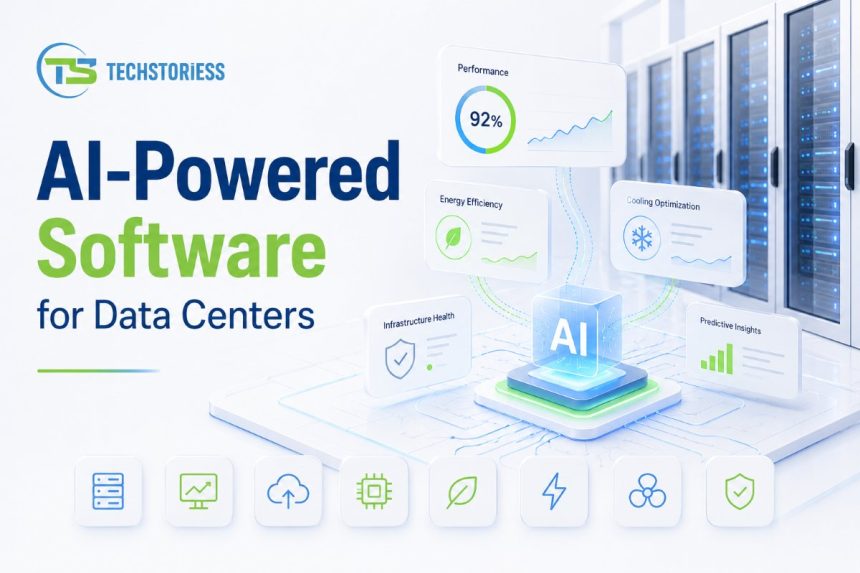
The modern data centers have evolved beyond just digital storage and computing facilities to emerge as critical infrastructure powering the global AI economy. Today, data centers account for a significant share of global energy consumption that is rapidly reaching alarming levels. With rapidly expanding AI workloads, hyperscale cloud operations, and high-density GPU clusters, energy efficiency is no longer merely an operational concern; it has turned into a strategic necessity.
- Schneider Electric EcoStruxure IT
- Vertiv Environet Alert & Trellis Platform
- Siemens Smart Infrastructure Suite
- Johnson Controls OpenBlue
- Honeywell Forge Sustainability+
- ABB Ability Energy Manager
- NVIDIA AI Infrastructure Management Stack
- Google DeepMind AI Cooling System
- Why AI Energy Management Software Is Becoming Essential
- Conclusion
The International Energy Agency notes that currently data centers consume nearly 1–2% of global electricity – a percentage that may appear moderate initially but becomes highly significant at a global scale. As an increasing number of enterprises accelerate AI adoption, this number is climbing steadily. As per industry analysts, data centers are registering a YoY growth of nearly 40% in energy demand to support increasing AI-driven workloads. It overloads cooling systems, strains power infrastructure, and complicates sustainability goals.
This shift has necessitated auditable and intelligent methods of energy optimization, leading to a remarkable demand for AI energy management software for data centers. Software platforms offering cooling automation, PUE optimization tools, carbon monitoring dashboards, and intelligent workload balancing have become the operational backbone of sustainable AI infrastructure.
The regulatory changes further amplify this urgency. Compliance frameworks across regions like the European Union are compelling enterprises to adopt stricter energy efficiency norms, including targets that encourage data centers to lower PUE levels below 1.3 by 2027. This growing regulatory pressure coincides with the explosive growth of AI computing, with data center power demand projected to potentially double by 2030 in the US alone.
Due to these rapidly evolving operational realities, AI-powered energy optimization platforms are not optional anymore; they have become mandatory for growth-oriented organizations. They not only help in cutting down operational costs, but also improve thermal efficiency, lower carbon emissions, and enable long-term scalability – thus supporting both business continuity and environmental responsibility.
One of the key questions that arises here is how to choose the right AI-powered platform that aligns with evolving infrastructure requirements. To simplify the search, we have researched a number of leading enterprise solutions and compiled the list of the top AI-powered platforms leading the next generation of green data center technology in 2026.
Schneider Electric EcoStruxure IT
Claiming a prominent position among enterprise-grade AI energy management software data centers solutions, Schneider Electric is a global leader in energy management and industrial automation. Its EcoStruxure IT platform offers a unified ecosystem strategically combining capabilities such as AI-driven monitoring, predictive analytics, real-time power visibility, and intelligent cooling optimization into a unified ecosystem.
The advanced PUE optimization tools of the platform make it highly popular among hyperscale operators. These purpose-built tools continuously analyze cooling behavior, airflow distribution, rack density, and power consumption patterns to improve overall energy efficiency.
Key Features
- AI-driven energy analytics
- Real-time PUE monitoring
- Predictive maintenance alerts
- Intelligent thermal mapping
- Hybrid cloud infrastructure support
- Sustainability reporting dashboards
Why It Stands Out
To address the growing complexity of AI infrastructure, Schneider has heavily invested in sustainable AI infrastructure solutions that are purpose engineered for high-density AI workloads like GPU clusters and AI training environments. Especially its recent focus on liquid cooling and GPU-intensive infrastructure establishes it as a highly relevant solution for modern AI data centers looking to improve energy efficiency.
Vertiv Environet Alert & Trellis Platform
Recognized as a major innovator in the space of AI cooling systems and intelligent thermal management, Vertiv offers advanced infrastructure optimization platforms that effectively reduce operational inefficiencies. Leveraging ML-powered cooling orchestration and infrastructure automation, its Environet and Trellis platforms can significantly cut down energy waste, allowing operators to maintain better thermal stability.
To manage significantly higher thermal loads generated by AI servers, Vertiv’s software enables reliable dynamic cooling optimization and power balancing.
Key Features
- AI-assisted thermal management
- Intelligent airflow optimization
- Data center infrastructure management (DCIM)
- Real-time power usage tracking
- Carbon efficiency monitoring
Why It Stands Out
Owing to its strong expertise in thermal engineering and liquid cooling technologies, Vertiv is fast emerging as a preferred choice for facilities that deploy liquid-cooled AI clusters and edge computing environments.
Siemens Smart Infrastructure Suite
Siemens introduces industrial automation expertise into the space of green data center technology. It leverages an AI-enabled infrastructure platform that enhances overall energy efficiency by employing digital twins, predictive analytics, and intelligent automation.
The software constantly evaluates facility operations and keeps recommending adjustments to lower unnecessary power consumption. Not only does it improve operational visibility but also strengthens predictive maintenance efficiency.
Key Features
- Digital twin simulations
- Smart HVAC automation
- AI-driven energy forecasting
- Automated power optimization
- Integrated sustainability analytics
Why It Stands Out
Loaded with advanced capabilities, Siemens stands out as an effective solution for large enterprise campuses and smart facilities looking for unified building and data center energy management.
Johnson Controls OpenBlue
Johnson Controls is gaining rapid market traction in AI-powered building intelligence, with its OpenBlue platform positioned as a strong contender in the data center market.
To ensure highly accurate thermal optimization, the platform optimizes cooling efficiency, improves airflow control, and monitors real-time facility energy performance by employing machine learning models to ensure high precision and consistency.
Key Features
- AI cooling optimization
- Predictive HVAC management
- Real-time occupancy and load analysis
- Automated emissions tracking
- Smart sustainability reporting
Why It Stands Out
Going beyond conventional facility automation, OpenBlue provides one of the more sophisticated approaches to carbon footprint data center monitoring, helping operators align with ESG mandates and energy disclosure regulations.
Honeywell Forge Sustainability+
Honeywell Forge combines AI analytics with operational intelligence to help enterprises reduce energy waste across critical infrastructure environments.
The platform is extensively used by operators focused on building sustainable AI infrastructure while adhering to emerging environmental standards.
Key Features
- Enterprise sustainability dashboards
- AI-powered energy benchmarking
- Predictive maintenance intelligence
- Carbon emissions monitoring
- Automated compliance reporting
Why It Stands Out
The greatest strength of Honeywell lies in integrating operational technology with sustainability-focused analytics.
ABB Ability Energy Manager
ABB excels at optimizing electrical infrastructure through its AI-powered energy management platform. It intelligently monitors critical assets like transformers, UPS systems, distribution networks, and cooling systems.
Key Features
- Smart grid integration
- AI-assisted load balancing
- Real-time electrical monitoring
- Energy efficiency diagnostics
- Automated infrastructure alerts
Why It Stands Out
If your aim is to distribute power reliably alongside improving overall energy efficiency, then ABB is a highly effective solution to consider.
NVIDIA AI Infrastructure Management Stack
With AI workloads reshaping the industry, NVIDIA is steadily transitioning from a GPU manufacturer into a full-scale AI infrastructure company. It has recently expanded its software ecosystem to include intelligent workload orchestration, thermal optimization, and energy-aware computing management.
Key Features
- GPU cluster power optimization
- AI workload balancing
- High-density cooling intelligence
- Energy-aware compute scheduling
- Liquid cooling integration support
Why It Stands Out
NVIDIA’s ecosystem is gaining fast prominence in the next generation of AI energy management software data centers, particularly for GPU-heavy facilities.
Google DeepMind AI Cooling System
For enterprises looking for a reliable partner to deploy AI cooling systems at scale, Google DeepMind remains one of the most influential innovators in this space. Its machine learning models evaluate thousands of operational variables in real time to maximize cooling efficiency across Google’s global data center infrastructure.
The breakthrough results produced by DeepMind open a new chapter in AI-driven sustainability.
Key Features
- Reinforcement learning-based cooling control
- Predictive thermal optimization
- Autonomous energy management
- Dynamic airflow adjustment
- Real-time infrastructure learning
Why It Stands Out
By employing DeepMind’s AI optimization models, Google reported nearly 40% reductions in cooling energy consumption. It proves the real-world impact of intelligent automation in hyperscale environments.
Why AI Energy Management Software Is Becoming Essential
The AI infrastructure economics are rapidly changing. Conventional cooling architectures and static power management systems cannot keep pace with modern GPU-intensive workloads.
Several major industry trends are accelerating adoption:
Rising Energy Consumption
Data centers already consume approximately 1–2% of global electricity, with AI expansion expected to push that figure even higher.
Explosive AI Workload Growth
AI model training and inference workloads are significantly increasing data center power density, with some industry reports estimating nearly 40% annual growth in energy demand.
Regulatory Pressure
Governments across the globe are tightening efficiency regulations. With the EU mainly focusing on lower PUE thresholds and sustainability disclosure standards, operators are being compelled to adopt smarter optimization technologies.
Carbon Reduction Goals
Due to their significant environmental impact, large enterprises are under pressure to reduce the carbon footprint of data center operations and demonstrate measurable sustainability progress.
Conclusion
The future of data center operations will be defined not just by compute power, but by energy intelligence.
With global AI adoption scaling rapidly, the demand for advanced AI energy management software data centers solutions will continue to increase. By taking proactive measures early, organizations can gain long-term operational resilience and sustainability advantages. They need to invest early in predictive cooling, intelligent automation, PUE optimization tools, and carbon monitoring platforms. Such enterprises will be better positioned to control operational costs while meeting aggressive sustainability targets.
Environmental responsibility is not the sole driver behind green data center technology. In an AI-powered economy, it is increasingly becoming a business survival strategy.