


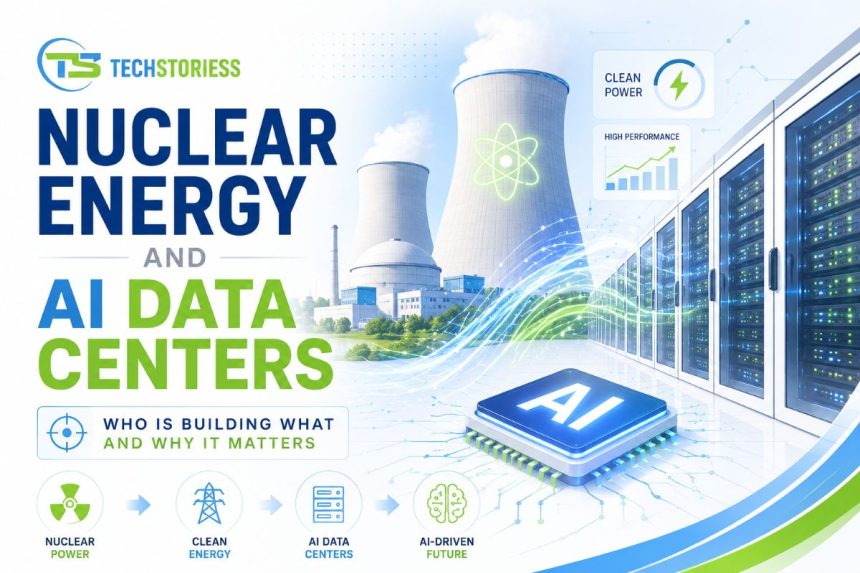
For the better part of a decade, the artificial intelligence conversation has been centered on compute-chips, models, architectures, and scaling laws. But in 2026, that framing has become incomplete. More than just computational capability, the real constraint is energy. More precisely, it is the ability to sustainably power hyperscale infrastructure without overloading existing power grids, inflating costs, or triggering regulatory constraints around energy usage and emissions. At this point, the narrative around nuclear energy AI data centers power demand 2026 shifts from a niche topic to a strategic priority.
- The Energy Problem AI Can’t Optimize Away
- Why Nuclear Is Back on the Table-And This Time It’s Different
- Mapping the Hyperscaler Moves: Who Is Building What
- What the Capacity Numbers Quietly Reveal
- The Policy Layer: Quiet but Decisive
- Strategic Implications Most People Are Missing
- Why This Moment Matters More Than It Appears
- Conclusion
It is not just the scale of AI workloads, but their persistence, that defines this energy challenge. Contrary to conventional cloud usage patterns that fluctuate, AI training and inference-especially at frontier model scale-create sustained, high-density energy demand. This leads to structural strain on existing electricity systems. Rather than viewing it as a theoretical AI power crisis data center energy scenario, it must be treated as an emerging operational reality for hyperscalers planning capacity over the next decade.
The Energy Problem AI Can’t Optimize Away
AI’s electricity demands are both predictable and compounding. Training large models requires massive volumes of power, but the real challenge emerges at large-scale inference-real-time processing, millions of continuous queries, and always-on systems. This drives a steady rise in data center electricity consumption AI, far beyond what legacy infrastructure was originally designed to support.
In many regions, grid operators are already signaling capacity constraints. Renewable energy introduces intermittency challenges that do not align well with the constant, high-load demand profiles of AI data centers, thereby limiting reliability as a sole energy source. While natural gas offers flexibility, it also brings long-term cost volatility and emissions concerns. In this context, nuclear energy-once considered a complex energy option due to financial and regulatory barriers-is being re-evaluated through a purely operational lens, with focus on ensuring reliability, energy density, and long-term cost stability.
This is where economics begins to take center stage. Moving beyond a secondary consideration, AI infrastructure energy cost has become a defining factor in where and how AI systems are built. Energy is no longer just an input-it is a competitive differentiator.
Why Nuclear Is Back on the Table-And This Time It’s Different
Nuclear energy provides carbon-free baseload power-something no other source can simultaneously guarantee continuously and at scale. However, the current wave of interest is not centered on conventional large-scale reactors that require long construction timelines and high capital investment. Instead, the focus has shifted toward small modular reactors tech companies are increasingly aligning with.
Small modular reactors (SMRs) not only promise faster deployment but also reduced upfront capital risk. They are designed to enable co-location of power generation directly with data center campuses. These capabilities fundamentally change the design and energy strategy of digital infrastructure. Future AI data centers may effectively generate their own power instead of relying entirely on grid supply-a model that improves reliability and reduces transmission constraints.
This shift is driven by operational certainty. Hyperscalers are investing in nuclear energy not for purely idealistic sustainability goals, but for predictable, long-term energy availability and cost stability.
Mapping the Hyperscaler Moves: Who Is Building What
In this space, the most telling signal is capital allocation. Global technology giants have already begun adopting-quietly but decisively-nuclear-backed energy strategies.
One of the most visible steps has been taken by Microsoft, which has explored partnerships with nuclear energy providers to secure long-term clean energy for its data center operations. The company’s strategy signals a broader intent to decouple AI growth from grid dependency, particularly in regions with power capacity constraints.
For the better part of a decade, Google has been a leader in renewable energy procurement. Now, the company is expanding its approach to include firm, always-on power sources. Its increasing interest in nuclear partnerships indicates that renewables alone cannot sustain next-generation AI workloads without complementary baseload solutions.
Amazon, through a diversified energy strategy across its cloud infrastructure arm, increasingly includes nuclear as a hedge against both cost volatility and supply uncertainty. Due to its enormous scale, even incremental shifts toward nuclear-backed capacity represent massive absolute demand.
The exact structures of these hyperscaler nuclear power deals may vary-ranging from power purchase agreements to direct investment in reactor development-but they all reflect a consistent underlying pattern: long-term, high-confidence energy sourcing that aligns with AI expansion timelines.
What the Capacity Numbers Quietly Reveal
Digging deeper into the headlines, we begin to see a more revealing picture of capacity planning. Instead of being designed in tens of megawatts, hyperscale AI data centers are scaling into hundreds-even gigawatts-across multi-site deployments. This scale becomes critically significant when mapped against available grid capacity.
Particularly in its modular form, nuclear begins to make sense as a necessity, not just an alternative. It enables companies to:
- Lock in multi-decade energy pricing with minimal volatility
- Ensure uninterrupted power for continuous AI workloads
- Reduce exposure to grid congestion and regulatory delays
- Align sustainability goals with operational realities
These benefits go beyond marginal gains-they directly affect cost structure, deployment speed, and overall competitive positioning.
The Policy Layer: Quiet but Decisive
Governments are increasingly linking AI leadership to national energy strategy. This is shaping regulatory environments in subtle but important ways. To encourage data center operators to adopt clean and firm energy sources, policy incentives and regulatory support mechanisms are being introduced. For example, licensing processes for advanced reactors are being streamlined in certain regions.
Geopolitical considerations are also emerging as a critical factor. Countries capable of offering both advanced digital infrastructure and stable energy ecosystems will gain a disproportionate advantage in attracting AI investments, with clear implications for economic growth and technological leadership. This elevates nuclear energy from a purely operational decision to a lever of national competitiveness.
Strategic Implications Most People Are Missing
Once we move beyond the immediate question of how much AI power is required, a deeper shift becomes visible. Beyond supply constraints, the integration of nuclear energy into AI infrastructure is fundamentally about control over critical resources.
To fully understand this, we need to expand our perspective beyond conventional infrastructure planning models to uncover several non-obvious but equally critical implications:
- Vertical integration of compute and power: Tech companies are moving closer to owning or directly controlling their energy sources
- Geographic redistribution of data centers: Locations will increasingly be chosen based on energy availability, not just connectivity
- Barrier to entry for smaller players: As energy becomes a core constraint, the scale advantage of hyperscalers will widen further
- Shift in cost structures: Long-term energy contracts will redefine how AI services are priced and delivered
Collectively, these shifts point toward a future where energy strategy and AI strategy are deeply interconnected and increasingly inseparable.
Why This Moment Matters More Than It Appears
There is a unique dynamic in the current landscape: the asymmetry between activity and analysis. The nuclear-for-data-centers narrative is rapidly gaining traction in industry circles, but most detailed insights remain confined to specialized energy publications that are often paywalled. This creates a visibility gap where many organizations are making large-scale decisions, but only a narrow segment of stakeholders fully understand the underlying trade-offs, risks, and long-term implications.
To address this gap, we must view the issue through a broader strategic lens – as the implications are not limited to infrastructure teams. They extend across business strategy and technology planning-impacting adoption timelines, regulatory frameworks, cloud pricing models, and even global AI competitiveness.
Conclusion
It is clear that the trajectory is accelerating. As AI models continue to grow in capability and embed deeper into business operations, their energy footprint is expanding continuously. This raises a fundamental question: which energy sources can scale reliably and economically to support this growth?
Renewable energy often seems like the best choice at first glance, but it alone cannot consistently meet the economics and reliability requirements of always-on AI workloads. What is required is a careful balance between environmental sustainability and AI scalability. Nuclear energy – particularly through modular innovation-is quietly positioning itself as a foundational layer for next-generation AI infrastructure. It is poised to become the stabilizing force that enables large-scale AI deployment while minimizing energy volatility and supply constraints.
For CISOs, CTOs, founders, and executives, this is not just a technological consideration. It is an early signal of how infrastructure decisions made today will shape competitive advantage tomorrow. To ensure long-term competitiveness and sustainable growth, organizations must understand where energy strategy and AI infrastructure intersect.