


SpaceX’s blockbuster IPO was still a week out when Elon Musk did something most companies avoid this early in a program: he publicly showed actual hardware and shared its design details. On June 8, 2026, Musk posted a video on X in which he, alongside SpaceX engineer Ian Dahl, walked through what is regarded as the company’s most ambitious project yet – its first orbital data pcenter satellite. The idea, and the craft itself, sounds almost like science fiction: a wingspan exceeding that of a Boeing 747, an interchangeable AI chip payload, and a simple job description – take a rack of Nvidia GPUs, the kind that normally sits in a conventional, grid-dependent data center drawing massive power, and put it in orbit instead.
The video’s timing was no accident. SpaceX was preparing to price shares for a public offering expected to value the company at roughly $1.75 trillion as per the bbc reports, with orbital compute positioned as a central piece of the pitch to investors. In its S-1 filing, the company put its total addressable market at $28.5 trillion, with $26.5 trillion of that attributed to AI infrastructure alone. AI1 is the hardware meant to make that number plausible.
What Musk actually revealed About SpaceX’s AI1 Satellite
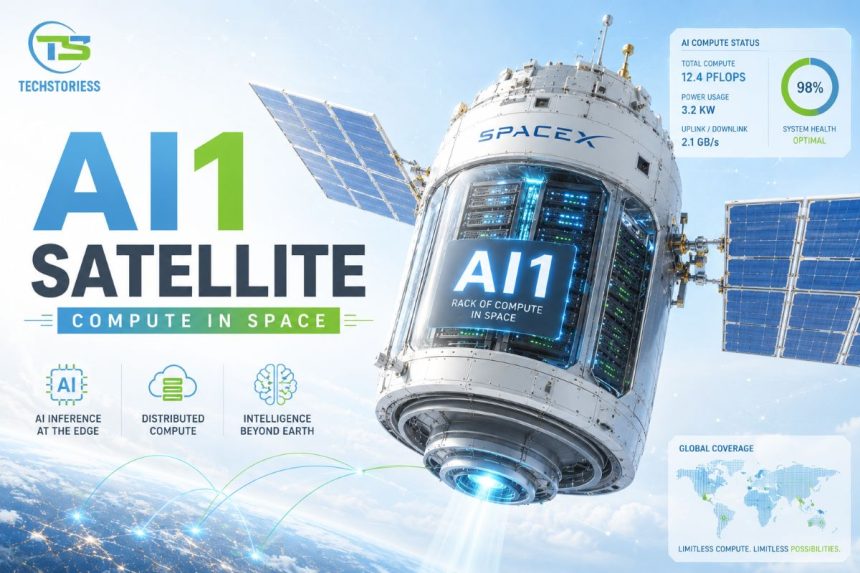
On paper, the specs are striking. With a deployed wingspan of about 70 meters – slightly wider than the 68.4-meter span of a Boeing 747-8 – AI1 Satellite stands roughly 20 meters tall, making it the largest satellite SpaceX has ever built. Its average compute payload draws 120 kilowatts of sustained power with a 150-kilowatt peak, operating in orbit at around 600 kilometers above Earth, with a stated power density of 70 kilowatts per ton.
Musk framed the numbers in a way meant to make them instantly relatable: at peak, a single Nvidia GB300 server rack draws around 140 kilowatts on the ground, so AI1 is, in his framing, approximately one entire server rack’s worth of compute moved into orbit. That comparison does a lot of work for the pitch – it translates an unfamiliar piece of space hardware into a unit any AI infrastructure buyer already understands.
Alongside the power figures, the chip strategy is equally notable. SpaceX did not build AI1 around a fixed set of processors; instead, it designed the payload to be interchangeable. That lets the satellite fly with chips from whichever vendor is currently offering the most competitive AI silicon, rather than locking the platform to a single supplier. Dahl also noted that, unlike Starlink, AI1 doesn’t need large phased-array antennas for broadband communication, making it mechanically far less complex. Most of the rest of the platform – including the solar arrays and thermal-management hardware – borrows directly from the Starlink V3 design already in production.
Good to know
- SpaceX disclosed three core specs together: 120 kW average compute draw, 150 kW peak, and a power density of 70 kW per ton.
- AI1’s 70-meter wingspan formally makes it the largest satellite SpaceX has ever constructed, well beyond its Starlink units.
- SpaceX CFO Bret Johnson separately confirmed the satellites’ AI compute payload will run on Nvidia GPUs, tying the program to Nvidia’s GB300 generation rather than a custom in-house chip at launch.
- AI1 operates at roughly 600 km altitude – low Earth orbit – rather than the higher geostationary belt used by many traditional communications satellites.
Why “interchangeable” matters more than it sounds
The interchangeable chip design isn’t just about flexibility – it’s also a hedge against a problem SpaceX has openly admitted it hasn’t yet solved: the inability to guarantee a sufficient supply of chips for its orbital data center ambitions, an acknowledgment that appears in the company’s own IPO filing. For a company asking investors to back a $1.75 trillion valuation partly on a space-based AI compute business, that’s a notable admission.
To close this gap, SpaceX is building Terafab, a chip manufacturing joint venture with Tesla and, according to Reuters, Intel as well. The facility is expected to span around 10 million square feet – roughly ten times the size of Tesla’s large Austin factory – and will eventually produce radiation-hardened chips purpose-built for the orbital environment. Until that comes online, AI1’s interchangeable design lets SpaceX buy compute capacity from the open market, helping ensure an uninterrupted supply rather than full dependence on a single chip vendor.
Key data points
Terafab spreads manufacturing risk across three companies – SpaceX, Tesla, and reportedly Intel – rather than relying on a single chip supplier.
- At roughly 10 million square feet, the planned Terafab facility would be about ten times larger than Tesla’s existing Austin Gigafactory.
- SpaceX’s S-1 explicitly lists chip supply as an investor risk factor, an unusually candid disclosure this close to a $1.75 trillion IPO.
The cooling problem nobody can shortcut
The single biggest engineering challenge with AI1 isn’t power generation – solar panels in orbit are a comparatively well-understood problem – it’s the heat produced by 120 to 150 kilowatts of continuously running silicon. A data center on Earth sheds heat into moving air and circulating water, and neither option exists in space. The only way to shed heat in orbit is by radiating it away as infrared, a far less efficient process that demands a large physical surface area.
AI1 is engineered around that constraint. SpaceX has equipped it with up to 110 square meters of deployable liquid radiators, backed by redundant pumping loops in case one fails, plus shielding against micrometeoroid impacts that could puncture the cooling system. To appreciate the scale of the challenge, compare it with existing spaceflight hardware: the International Space Station’s external thermal control system rejects only about 70 kilowatts of heat – roughly half of what a single 140-kilowatt GB300 rack generates on Earth – using 422 square meters of radiator, at a cost industry analysts have estimated as high as $500 million. AI1 is attempting to manage a comparable or larger heat load with a fraction of that radiator area, which is precisely the detail independent engineers are watching most closely.
This may sound like cause for concern, but Musk has dismissed it before, pointing to SpaceX’s operational experience with more than 10,000 Starlink satellites as evidence of the company’s understanding of heat rejection in space. Critics counter that Starlink satellites typically run on just one to three kilowatts of solar power – far below the scale AI1’s compute payload requires – meaning the thermal challenge here isn’t simply Starlink at a bigger size, but a genuinely new regime for the company.
Key factors
- The ISS’s thermal system is formally called EATCS (External Active Thermal Control System), a detail often mislabeled in early coverage of the AI1 comparison.
- That ISS system manages roughly 70 kW of heat rejection using 422 m² of radiator surface, built at a cost estimated as high as $500 million – for less than half the thermal load AI1 is targeting.
- Existing Starlink satellites run on only 1–3 kW of solar power each, several orders of magnitude below AI1’s compute payload – a gap independent commentators have flagged directly against Musk’s heat-rejection comparison.
- AI1’s 110 m² of radiators is roughly a quarter of the ISS’s radiator area, despite needing to manage a comparable or larger heat load – the central engineering bet of the entire program.
Betting big on manufacturing before the market exists
AI1’s economics rest largely on SpaceX’s ability to manufacture these satellites, and the components inside them, at a scale never before attempted in the space industry. The company is building a new factory in Bastrop, Texas – nicknamed “Gigasat” – spanning more than 11 million square feet and designed to mass-produce the solar arrays and other components AI1 needs. SpaceX says it expects the facility to reach meaningful production volume by the end of 2027.
That manufacturing ambition is matched by an equally aggressive regulatory push: in January 2026, SpaceX filed with the FCC for permission to launch as many as one million orbital data center satellites. The company has already secured real commercial commitments against that vision, including a reported $920 million-per-month compute deal with Google, and separate reporting suggests Google is in discussions about launching its own orbital data centers using similar infrastructure. None of this works, however, without Starship reaching reliable operational status – the rocket SpaceX is counting on to launch the volume of solar panels, radiators, and chips its plans require.
Key factors:
- SpaceX’s January 2026 FCC filing requests authorization for up to one million orbital data center satellites – far beyond its existing roughly 10,000-satellite Starlink constellation.
- The $920 million-per-month Google compute deal is already signed, separate from reports that Google is also negotiating its own dedicated orbital data centers via SpaceX.
- The Gigasat factory’s target of meaningful production by the end of 2027 gives the program roughly 18 months from the AI1 reveal to hit that milestone.
- SpaceX is also renting compute from its existing Colossus supercomputer – 220,000 Nvidia GPUs and 300 MW of capacity – to rival AI lab Anthropic, showing the company is already monetizing terrestrial AI infrastructure while orbital capacity comes online.
The skeptics aren’t quiet
The scale of the ambition behind AI1 hasn’t stopped substantial doubts from surfacing. A major critique centers on the fact that once these satellites reach orbit, their hardware becomes effectively permanent – it can’t be repaired, upgraded, or refreshed the way a terrestrial data center can be. Many critics also point out that the financial model depends heavily on Starship achieving reliable, low-cost reusability, which hasn’t yet been proven at the scale this plan requires. They also note that growing radiation exposure will gradually degrade solar panel efficiency, eroding the projected energy-generation figures over time.
Underneath all this sits a simpler, more structural question: orbital compute sidesteps the permitting fights, water-usage disputes, and local power-grid strain that have made terrestrial AI data centers politically contentious in recent years – the water-usage controversy surrounding Project Jupiter in New Mexico being one recent example. That regulatory escape hatch may turn out to be AI1’s real value proposition, separate from whatever performance numbers SpaceX eventually proves out in orbit.
OpenAI’s Sam Altman has publicly called orbital data centers “ridiculous,” making him one of the most prominent named skeptics of the entire approach.
SpaceX isn’t alone in this space
Though the concept is novel, SpaceX isn’t pursuing it without competition. Jeff Bezos’s Blue Origin has floated its own competing vision, Project Sunrise, reportedly involving plans for more than 50,000 satellites built around the same basic premise: move power-hungry AI compute off a strained terrestrial grid and into an environment with effectively unlimited solar exposure and no neighbors to object to noise, water use, or transmission lines. That two of the most resourced space companies on the planet are independently arriving at the same bet doesn’t guarantee the orbital approach will work, but it does suggest the magnitude and urgency of the underlying problem – AI’s voracious and ever-growing appetite for electricity.
Back on Earth, the ground reality explains the urgency. Industry analysts warn that fast-growing AI demand could significantly increase data center energy consumption in the next few years, further straining power grids in regions already struggling to add capacity fast enough. Building a data center in orbit sidesteps that bottleneck entirely: in low Earth orbit there’s no utility interconnection queue, no local opposition to a new substation, and round-the-clock sunlight access for solar panels, unobstructed by atmosphere, clouds, or the day-night cycle that limits ground-based solar farms to a fraction of their rated output. Whether that theoretical benefit survives contact with the real costs of launch, radiation-hardened hardware, and unrepairable orbital assets is the question the next few years will answer.
Another factor worth noting is how unusually exposed this part of SpaceX’s business now is to public scrutiny. Historically, SpaceX has avoided this level of public disclosure; this is the first time the company has laid out its AI infrastructure ambitions in public, specifically because of the IPO process. That openness cuts both ways – it has given outside engineers genuine technical detail to evaluate rather than just marketing claims, while also handing skeptics concrete numbers to test Musk’s assertions against, including the comparative heat-rejection figures against the International Space Station, which has quickly become the most discussed technical detail in the announcement.
Key factors
- Blue Origin’s Project Sunrise reportedly involves as many as 51,600 satellites – an even larger raw count than the figures circulating for SpaceX’s own constellation ambitions.
- Industry forecasts, including from Gartner, have projected data center energy demand could rise by roughly a quarter in the next few years as AI workloads scale – a key driver behind both companies’ orbital pitches.
- Unlike SpaceX’s AI1 reveal, Blue Origin’s plan remains largely conceptual, without the detailed public hardware specs SpaceX disclosed.
- Two heavily capitalized space companies independently pursuing near-identical strategies suggests the terrestrial power constraint, not just marketing, is a genuine driver of this trend.
Conclusion
As Musk himself put it, SpaceX’s AI1 Satellite is still an early draft rather than a finished product. The spec sheet released during IPO week won’t be the real test – that will come when the first units actually reach orbit, survive the thermal and micrometeoroid environment over a multi-year operational life, and generate compute at a cost that beats simply building another data center on the ground. Amid these uncertainties, SpaceX makes a credible argument that most of the underlying hardware, from solar arrays to radiators, is already mature technology borrowed from a decade of Starlink production. Whether that translates into a viable AI infrastructure business, rather than just an expensive proof of concept timed for a record-breaking IPO, is a question only the next few launches can answer.