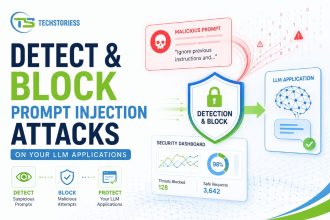



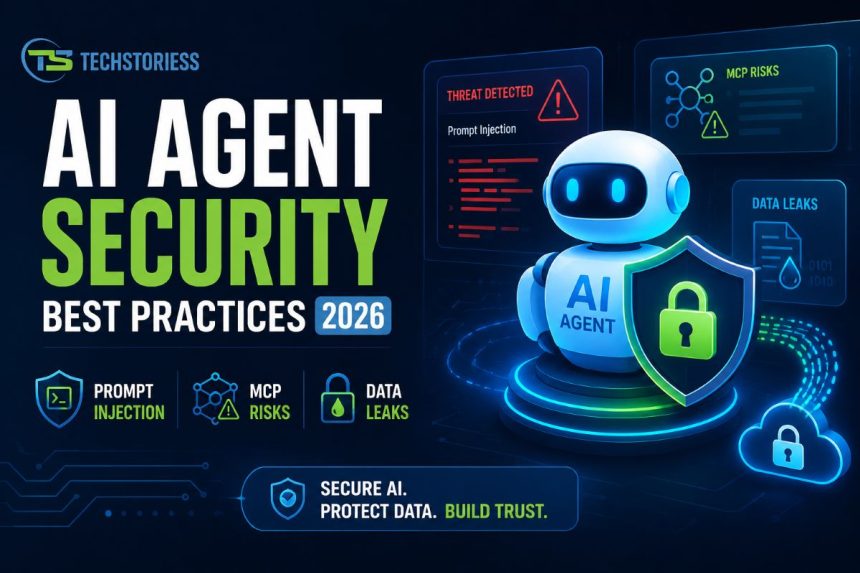
AI agent security in 2026 requires an entirely different threat model from conventional enterprise security. Unlike attacks that exploit code vulnerabilities or stolen credentials, AI agents can be compromised through the content they are designed to process — a single sentence embedded in a retrieved document, webpage, or code comment can redirect an agent’s behavior, exfiltrate data, or trigger unauthorized system actions, with no malware and no stolen credentials involved.
- The Scale of the Problem – AI Agent Security Practices
- Prompt Injection: Still the Top Risk, Now at Production Scale
- MCP: The Infrastructure Layer That Expanded the Attack Surface
- Data Leakage: The Shadow AI Exposure No One Is Measuring
- AI Agent Attack Vector Reference Table
- The Regulatory Clock
- Conclusion
A 2026 enterprise security survey found that 88% of organizations reported confirmed or suspected AI agent security incidents in the past year. In a separate survey by Beam AI, 82% of executives said they believed their existing policies already protected them from unauthorized agent actions. Both figures describe the same population of organizations. That gap — 82% confidence against 88% incidents — is where the current AI security crisis lives.
Enterprises are not failing because they lack awareness of AI risk. They are failing because the tooling, governance frameworks, and architectural assumptions that protect conventional software do not map cleanly onto how AI agents work. A firewall can block a malicious connection, but it cannot stop a sentence. An access control list can restrict a file path, but it cannot recognize a poisoned document. Most incident response playbooks were written before anyone had to consider that an AI system could be manipulated through data it retrieved, rather than commands it was given directly.
Security teams have spent years learning to think in terms of network perimeters, credential theft, and malware signatures. Now they face a threat model where the exploit is written in plain English. Detecting a SQL injection attempt is a different skill from detecting a sentence engineered to manipulate a language model’s behavior.
This article covers the three risk categories defining enterprise AI agent security in 2026 — prompt injection, MCP-layer vulnerabilities, and data leakage through shadow AI — along with the controls that measurably reduce exposure.
The Scale of the Problem – AI Agent Security Practices
The deployment context matters before examining attack mechanics. The average organization now manages 37 deployed AI agents, a number that grows every quarter as individual teams spin up automation without central review. According to Gartner, by year-end 2026, 40% of enterprise applications will be integrated with task-specific AI agents — up from less than 5% in 2025.
The financial consequences are measurable. According to Deep Inspect, shadow AI breaches cost organizations $670,000 more than standard incidents on average, take longer to detect (247 days versus 241), and disproportionately expose customer PII (65% of incidents) and intellectual property (40%). That IP figure matters most for research-intensive industries where a single incident — a leaked model, codebase, or research dataset — can erase years of competitive advantage.
According to Adversa AI’s 2025 threat report, 70% of organizations with documented AI security incidents involved GenAI models. Among the broader set were agentic incidents including unauthorized cryptocurrency transfers, API abuse, and legal liability events. Notably, 35% of real-world incidents were triggered solely by simple prompts, with some causing damages exceeding $100,000 — without any traditional exploit code. A significant share involved no malware and no stolen credentials. Just a cleverly constructed sentence.
Prompt Injection: Still the Top Risk, Now at Production Scale
For two consecutive editions, prompt injection has ranked first in the OWASP Top 10 for LLM Applications. Its persistence at the top is not a failure of awareness — it reflects an architectural constraint that cannot be patched away.
Why prompt injection cannot be patched
Large language models process a single stream of tokens containing system instructions, user input, conversation history, and retrieved external data — with no hardware-enforced boundary between trusted instruction and untrusted content. When a retrieved document contains an instruction disguised as data, the model has no reliable mechanism to distinguish between the two. This is not a bug in a specific implementation; it is a property of how transformer-based language models process input. Until models develop more robust architectural separation between instruction and data contexts, this category of risk remains structural.
2025 CVE evidence: prompt injection at production scale
Two 2025 CVEs illustrate that this is no longer a theoretical concern:
CVE-2025-32711 (“EchoLeak”, CVSS 9.3) — A hidden prompt embedded in PowerPoint speaker notes enabled zero-click exfiltration from Microsoft 365 Copilot. No user interaction was required; the agent processed the document as part of its normal summarization workflow and exfiltrated content to an attacker-controlled endpoint.
CVE-2025-53773 (GitHub Copilot, CVSS 9.6) — An injection payload embedded in source code caused the agent to execute arbitrary terminal commands. The exploit required no elevated permissions — the agent’s normal code-reading behavior was sufficient to trigger it.
Neither vulnerability involved traditional software flaws. Both exploited content the agent was designed to process: summarizing a document, reading code.
Five controls that reduce prompt injection exposure
- OWASP acknowledges that prompt injection cannot be fully eliminated. Enterprises should implement overlapping controls to limit the blast radius of any successful injection
- Input/output sandboxing. Isolate the agent’s execution environment so that even a successful injection cannot reach credentials, memory, or network endpoints outside the agent’s designated operational scope.
- Semantic filtering on retrieved content. Apply classifiers that flag instruction-like patterns in documents, web pages, and tool outputs before they enter the agent’s context window. This will not catch all injections, but it reduces the volume of successful attempts reaching the model.
- Output monitoring for anomalous behavior. Deploy behavioral baselines that detect sudden changes in agent output — unexpected API calls, unusual data encoding, or external HTTP requests that deviate from the agent’s normal pattern.
- Strict privilege minimization. Enforce least-privilege access for every agent. According to Teleport research, organizations that enforced least-privilege access for AI agents saw a 17% incident rate versus 76% for those without it — a single architectural choice with the greatest measured impact of any control.
MCP: The Infrastructure Layer That Expanded the Attack Surface
When Anthropic released the Model Context Protocol in late 2024, it solved a genuine problem: connecting AI agents to enterprise systems previously required custom integration code for every connection. MCP standardized the connector format, enabling rapid ecosystem growth — tens of thousands of MCP servers deployed within twelve months.
That rapid adoption created the exposure. The original specification lacked mandatory authentication, and its implicit trust model assumed MCP servers and their tools were inherently safe. Adversaries recognized and exploited that assumption immediately.
The original design flaw: implicit trust
The MCP 1.0 specification had no mandatory authentication requirement for server connections and no mechanism for granular, per-operation permission scoping. Any agent connecting to an MCP server received the full capability set that server exposed. This all-or-nothing access model mirrors early OAuth before scoped permissions — and it created the same class of privilege escalation risks.
The 2026 MCP specification update addresses this directly, introducing incremental scope consent that allows clients to request only the minimum access needed per operation. Deployments that have not upgraded to the 2026 spec remain exposed to the full original attack surface.
Active attack patterns in the wild
Three distinct MCP-specific attack patterns have emerged:
Tool poisoning: An attacker modifies a tool’s description or behavior metadata to cause an agent to misuse it. Because agents rely on tool descriptions to select and invoke capabilities, a tampered description can redirect the agent toward unintended actions without any change to the agent’s own code.
CVE-2025-49596 (CVSS 9.4): Unauthenticated MCP Inspector instances allowed arbitrary command execution. The first confirmed malicious MCP package appeared in the wild in September 2025, establishing that the threat ecosystem has matured beyond proof-of-concept exploits.
The Supabase incident (mid-2025): A Cursor agent with privileged service-role access processed support tickets containing user-supplied SQL instructions. The combination of excessive privilege and untrusted input caused integration tokens to be exfiltrated into a public thread. This incident exemplifies the recurring pattern across MCP compromises: privileged access + untrusted input + an external output channel.
Six baseline controls for any MCP deployment
- Third-party MCP package vetting. Treat external MCP packages with the same scrutiny as third-party code libraries. The September 2025 malicious package confirms the threat is production-ready, not theoretical.
- Mandatory authentication for all remote MCP servers. No server connection should be permitted without verified identity. Apply this retroactively to any existing deployment that uses the original 1.0 spec.
- Upgrade to the 2026 MCP specification. Enable incremental scope consent so agents request only the permissions required per operation — not blanket, server-wide access.
- Tool-level permission annotation for sensitive operations. Tag tools that perform write operations, external API calls, or data transmission with explicit approval requirements before invocation.
- Network segmentation. Isolate MCP server instances behind internal network controls. External-facing MCP servers represent an unnecessary attack surface for most enterprise use cases.
- Infrastructure-layer logging of all tool invocations. Log every tool call with full input/output context at the infrastructure layer, not the application layer — a compromised agent can influence its own application-layer logs.
Data Leakage: The Shadow AI Exposure No One Is Measuring
Data Leakage: The Shadow AI Exposure No One Is Measuring
Data leakage from AI agent environments falls into two distinct categories requiring different control strategies: intentional exfiltration through compromised agents, and unintentional exposure through unsanctioned AI use. Most organizations are under-prepared for both.
Intentional exfiltration via compromised agents
When a successful prompt injection or MCP exploit redirects an agent’s behavior, data exfiltration is frequently the goal. Cisco’s 2025 AI security research found that 46% of organizations have experienced internal data leaks through GenAI tools, while 83% lack even basic controls to prevent exposure.
Shadow AI breaches carry a measurable cost premium. According to Deep Inspect, the average shadow AI breach costs $670,000 more than a standard security incident, takes 247 days to detect versus 241 for conventional breaches, and disproportionately exposes customer PII (65% of cases) and intellectual property (40%). For research-intensive industries — technology, pharmaceuticals, financial services — a single IP-category breach can erase years of competitive advantage.
Shadow AI: the unmonitored exposure surface
The more prevalent — and harder to measure — threat is passive. Employees regularly upload sensitive data to unsanctioned AI tools without recognizing the risk. According to Netskope’s threat research, the average enterprise now uploads 8.2 GB of data per month to AI applications, representing a 30x increase from 250 MB the prior year.
The scale of unsanctioned AI use compounds this exposure. Netskope found that 98% of organizations report unsanctioned AI use, and over 1,550 distinct GenAI SaaS applications are now in enterprise circulation — each representing a potential exfiltration channel that most security programs have no visibility into. Unlike conventional shadow IT, agents operate continuously, make autonomous data-handling decisions, and chain tool calls into data flows that are difficult to trace retrospectively. Over 50% of deployed agents operate without dedicated security review or logging.
Five data governance controls to implement now
- Conduct quarterly shadow AI discovery scans. Use CASB or SSPM tooling to detect new AI application usage. The 1,550-application figure grows continuously — a point-in-time inventory becomes stale within weeks.
- Deploy a GenAI-aware DLP solution. Standard DLP tools do not inspect HTTP traffic to AI APIs. Configure policies to detect and block uploads of PII, source code, financial data, or confidential documents to unapproved AI endpoints.
- Establish an approved AI tool registry. Publish and enforce a list of sanctioned AI tools with per-tool data classification rules. Unapproved tools default to deny, not allow-until-flagged.
- Implement immutable agent output logging. Every agent should log full output — not just final results — to an audit trail controlled by the security team, not the application owner. Over half of current deployments have no such logging.
- Apply data classification before agent deployment. Agents should operate under explicit access policies scoped to their function. A customer support agent has no legitimate reason to access HR or financial data, even if those systems share an MCP server with customer data.
AI Agent Attack Vector Reference Table
| Attack Type | Entry Point | Mechanism | Real-World Example | Key Controls | EU AI Act |
|---|---|---|---|---|---|
| Direct prompt injection | User input | Malicious instruction in user message overrides system prompt | Customer support ticket redirects agent to exfiltrate data | Input validation, output monitoring | Article 15 |
| Indirect prompt injection | Retrieved content | Hidden instruction embedded in document, webpage, or email | CVE-2025-32711 (EchoLeak, CVSS 9.3) — PowerPoint speaker notes exfiltrate M365 Copilot | Semantic content filtering, sandboxing | Article 15 |
| Tool poisoning (MCP) | MCP tool metadata | Modified tool description redirects agent behavior | CVE-2025-49596 (CVSS 9.4) — unauthenticated MCP Inspector → arbitrary command execution | Tool-level permission annotation, package vetting | Article 13 |
| Privilege escalation via MCP | Excessive MCP access | Privileged agent processes untrusted user input | Supabase/Cursor incident — integration tokens exfiltrated to public thread | Least-privilege access, 2026 spec scope consent | Article 15 |
| Shadow AI data upload | Employee behavior | Sensitive data voluntarily uploaded to unsanctioned AI tools | 8.2 GB/month per org uploaded to AI apps (Netskope) | GenAI-aware DLP, approved tool registry | Article 13 |
| Agent output exfiltration | Compromised agent output | Successful injection routes sensitive output to attacker endpoint | CVE-2025-53773 GitHub Copilot (CVSS 9.6) — arbitrary terminal command execution | Output monitoring, behavioral baselines | Article 15 |
The Regulatory Clock
The compliance timeline is getting more costly due to the EU AI Act’s August 2026 enforcement deadline. Article 15 demands that high-risk systems resist unauthorized manipulation of their use, outputs, or behavior; Article 13 requires transparency and human oversight. For high-risk systems in HR, financial services, infrastructure, and healthcare, the mandate requires documented evidence of resilience, not just a policy statement.
Conclusion
As AI agent deployments scale across enterprise environments, the gap between executive confidence and operational reality is costing organizations real money and measurable time. The 88% incident rate against an 82% confidence rate is not a coincidence — it reflects the specific mismatch between how conventional security controls work and how AI agents can actually be compromised.
The most actionable data point in this landscape is also the most straightforward. According to Teleport research, organizations that enforced least-privilege access for AI agents saw a 17% incident rate versus 76% for those without it. That single architectural decision — minimum access, scoped per operation — reduces exposure across all three risk categories simultaneously, at lower cost than any purpose-built security tool.
The broader program does not require exotic technology. It requires applying the same discipline enterprises already extend to any privileged system: mandatory authentication, complete auditability, security review before deployment rather than retrofitted after the first incident. The EU AI Act’s August 2026 enforcement deadline adds a compliance mandate to the operational case: Article 15 demands documented evidence of resilience to unauthorized manipulation, not just a policy statement.
The organizations that close the confidence-incident gap first will not necessarily be the largest or the best-resourced. They will be the ones that treat agent governance as an immediate operational priority — the ones that stop asking whether their existing security stack covers AI agents, and start assuming it does not.