


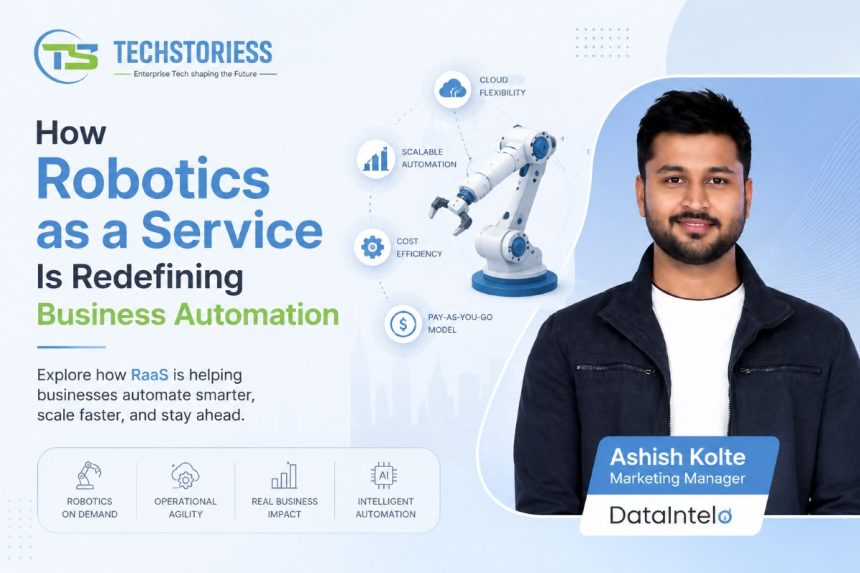
Automation used to be seen as something only the big boys can afford. They had to budget money for robots with a large investment, hire full-time maintenance employees, and forecast return on investment (ROI) in advance. Today, however, something is changing; Small businesses are now using Robotics as a Service (RaaS)—which is a subscription service that is providing companies with robot capabilities without them having to buy them outright or hire a full-time staff—around the world to help them automate their business operations because of the flexibility and financial benefits of RaaS.
- What Is Robotics as a Service?
- The Financial Shift: From Capital Expense to Operational Expense
- In Demand and Capacity of Real Operations
- Avoiding Obsolescence with Robotics Technology Access
- Maintenance and Support Built In
- Workforce Implications: Automation Without Displacement Anxiety
- Adoption of Robotics as a Service by Region
- Challenges and Considerations
- To summarize:
What Is Robotics as a Service?
Robotics as a Service (RaaS) allows companies to pay for robots through a subscription instead of having to buy them outright; similar to how you would rent cloud based computing resources instead of owning the physical computers in your office. With RaaS, you will typically pay for robot service on a monthly or per-use basis for the deployment of robots, maintenance, software upgrades, and remote diagnostic capabilities.
The RaaS (Robotics as a Service) markets are both expected to see significant growth over the next several years; according to estimates, the market size will increase from $32.08 billion by 2026 and reach $67.85 billion by 2030 (20.6% compound annual growth rate) while another forecast projects that by 2025 the market will be valued at $1.89 billion, rising to $4.37 billion by 2031 (14.9% compound annual growth rate).
The Financial Shift: From Capital Expense to Operational Expense
RaaS has made a dramatic financial impact because traditional robot purchases require significant upfront investments, typically between $50,000 – $250,000 per unit; including costs associated with installation and training. By contrast, with RaaS, the robot becomes an operational expense that is generally charged a monthly fee based on the robot’s complexity ($1,000 – $5,000 per robot monthly).
This shift matters for three reasons:
- No cash required: Small to mid-size businesses can replace employees with automation and not exhaust their operating budgets for more than three months. Approximately 67% of small to mid-size businesses previously unable to afford buying Robots are now using Robotics as a Service.
- Predictable budgeting: Monthly subscriptions make costs predictable. Companies report up to 30% better budget control compared to traditional ownership models.
- Faster ROI: Without heavy upfront costs, businesses see return on investment within 6–12 months instead of 2–3 years.
In Demand and Capacity of Real Operations
RaaS solves a significant issue confronting businesses: automation requirements vary throughout the year. A warehouse may need 20 robots at Christmas time and just 8 robots in February, but traditional equipment ownership requires businesses to commit to the capacity needs of their equipment long term. RaaS enables companies to quickly and easily expand and contract their level of robot usage.
With the use of RaaS, clients report that they can modify their robotic capacities by 40–60% more quickly than they can with owned systems. On average, business increase their robotic fleets by 35% during peak seasons and then return to their original sizes without selling their equipment or incurring costs for idle assets.
This flexibility is particularly valuable for industries with fluctuating demand:
| Industry | Typical RaaS Adoption Rate | Scaling Frequency | Primary Use Case |
| Manufacturing | 28% market share | Seasonal (3–4 times/year) | Assembly, inspection, material handling |
| Healthcare | 22% market share | Monthly adjustments | Patient transport, Logistics |
| Logistics / Warehousing | 20% market share | Weekly fluctuations | Pick-and-pack, sorting, Inventory |
| Professional Services | 67.8% of revenue | Ad-hoc scaling | Autonomous mobile robots(37% of sector) |
Manufacturing dominates with 28% market share, led by automotive facilities deploying up to 7.5 robots per 1,000 workers—the highest density globally. Electronics manufacturing follows at 15% of robot deployment, while healthcare and logistics round out the top three.
Avoiding Obsolescence with Robotics Technology Access
Robotic technologies are changing at a really fast pace; a robot you buy in 2023 could be obsolete in 2026 due to sensory development, the improvement of artificial intelligence, and new functions coming out on the market. Under traditional ownership models, many companies could experience technological obsolescence within 3–4 years and have to spend a great deal of money to upgrade or replace their robots.
RaaS providers handle this burden. They maintain fleets with current software, swap in newer hardware models periodically, and ensure robots receive continuous AI updates. Businesses stay current without managing upgrades themselves. Studies show RaaS users access 2–3 generations of technology improvements within the same contract period that owned systems would remain static.
This matters because modern robotics now integrate advanced AI, with 73% of RaaS robots featuring machine learning capabilities for adaptive task performance. Older owned robots often lack these features unless upgraded separately.
Maintenance and Support Built In
One hidden cost of owning robots is maintenance. Traditional robotics require dedicated technicians, spare parts inventory, and emergency repair budgets. Companies spend 15–25% of their robot’s purchase price annually on maintenance alone.
RaaS includes maintenance in the subscription. Providers handle:
- Routine servicing
- Remote monitoring (98% of RaaS contracts include this)
- Repair replacements (typically within 4–8 hours)
- Software updates
This reduces downtime significantly. RaaS users report 40% fewer operational interruptions compared to owned robotics. For a factory running 24/7, that difference translates to thousands of dollars in preserved production time monthly.
Workforce Implications: Automation Without Displacement Anxiety
RaaS changes how businesses think about workforce planning. When robots are subscription-based rather than permanent capital, companies test automation more carefully and integrate it thoughtfully. This approach reduces the fear that automation means mass layoffs.
Analyzed data indicates that most RaaS deployments concentrate on repetitive, routine, and hazardous tasks, including warehousing functions, lifting heavy items, performing in extreme heat or cold; and handling hazardous materials. As these types of jobs are automated, employees will transition into positions requiring cognitive capabilities (e.g., critical thinking), responsibility to solve problems, creative solutions; and the ability to collaborate with others.
Facilities implementing RaaS have experienced an increase in employee satisfaction (22%) due to their ability to work on more significant and less repetitious duties. Additionally, Raffa believes that the use of RaaS requires less internal company expertise (as opposed to having to hire technical ‘robots’ immediately).
Adoption of Robotics as a Service by Region
North America is leading worldwide in RaaS with an expected share of 42.1% of the world RaaS market in 2024 due to this region’s early adoption of technology, advanced manufacturing capabilities, and significant amounts of capital investment in robotic startups.
By comparison, Europe is the second-largest market for RaaS with approximately 28%, matched by its robust manufacturing economy and particularly Germany, Italy, and France leading the way.
Although projected to grow at a Compound Annual Growth Rate (CAGR) of 25% between 2024 and 2030, RaaS usage in Asia-Pacific will increase most rapidly, driven primarily by growth in the manufacturing sectors of China, Japan, and South Korea.
RaaS represents an attractive option for developing nations because they can take advantage of remote access to global networks of robotics providers, avoiding local lack of technical expertise and infrastructure to maintain robots.
Challenges and Considerations
There are a number of considerations and challenges with RaaS that should be considered prior to determining if this is best for your business or organization:
Dependency on Provider: More than half (60%) of RaaS contracts are for multi-year commitments (3–5 years), which means you will have long-term vendor relationships. If your provider changes prices or lowers service levels, your ability to change providers may come at a large cost.
Data Security: RaaS robots often connect to cloud-based servers and servers for remote monitoring. Approximately 45% of respondents cited data privacy as their number one concern when implementing RaaS. Businesses need to clearly define the security credentials that your provider has.
Integration Complexity: While RaaS facilitates less complexity with the hardware side of robotics, the integration of RaaS robots into your existing software systems (ERP, WMS, inventory, etc.) can still be complicated and require adequate technical resources. 35% of implementations report delays in integration averaging 2–3 months.
To summarize:
Robotics as a Service isn’t just about the payment method for robotic systems; it’s an entirely different way of looking at how companies can use and access automation. The shift from capital expenditures on robotic systems to the use of RaaS (Robotic As A Service) allows companies to have:
- 32% lower upfront costs compared to ownership
- 20.6% annual market growth, proving mainstream adoption
- 6–12 month ROI versus 2–3 years for owned systems
- 40% faster scaling during demand fluctuations
- 40% fewer operational interruptions from maintenance issues
Manufacturing leads with 28% market share, but healthcare (22%) and logistics (20%) are rapidly adopting. North America controls 42.1% of the market, while Asia-Pacific grows at 25% CAGR.
Companies can now obtain advanced automated technologies without having to make large capital expenditures upfront. Robotics as a Service offers flexibility in scaling, lowers maintenance costs, and provides access to the newest cutting-edge technology, making automation both more available and practical than ever before.
Article Contributed by Ashish Kolte, Marketing Manager at DataIntelo.