


Key Takeaways
- What Is Enterprise Cybersecurity Checklist 2026?
- How Enterprise Security Defences Work in 2026
- AI-Powered Attack Vectors: What Enterprises Face in August 2026
- AI Agents as Attack Vectors: New Insider Threat
- Ransomware in 2026: Post-Quantum Encryption and Encryptionless Extortion
- How AI Is Used in Ransomware Attacks in 2026
- How AI Defends Against Ransomware in 2026
- AI as a Defensive Weapon: How the Modern SOC Operates
- The Enterprise Security Lifecycle: Prevention Through Recovery
- Enterprise Architecture Patterns: Zero Trust, XDR, AI-Native SOC Compared
- Zero Trust Architecture: NIST SP 800-207 Pillars
- AI-Native SOC vs. Legacy SIEM: Switching Decision
- 10-Item EU AI Act Security Compliance Checklist for August 2026
- 10-Step Enterprise Cybersecurity Implementation Checklist for 2026
- 5-Stage Enterprise Security Maturity Model
- Total Cost of Ownership: What Enterprise Security Really Costs in 2026
- What Is Post-Quantum Cryptography? Why Does It Matter Now?
- Architecture Comparison Framework
- FAQ — Enterprise Cybersecurity in 2026: Most Common Questions
- Data breach costs about $4.9M (IBM 2026) to enterprises. $150K security stack is a 32× ROI investment. It is not to be considered as overhead expenses.
- 80% of cyberattacks in 2026 involve AI tools in the kill chain. Defenders responding to it with headcount and not of AI are to fall further behind.
- August 2, 2026 enforcement deadline of EU AI Act imposes mandatory security obligations on high-risk AI systems. Penalties are up to 7% of global revenue.
- Zero Trust minimizes breach impact and it is about $1.76M for each incident and simultaneously cuts breach probability by 50% (IBM / Forrester).
- Kyber ransomware group deployed post-quantum cryptography in live attacks earlier this year in March. Enterprises who have failed to start cryptographic inventory are late by now.
- AI-native SOC platforms minimize Mean Time to Detect by 80 days compared to SIEM. The said 80 days is the difference between contained incident and $5M notification event.
- 80% of Fortune 500 companies run AI agents in production and it is found that just 14% of them have full security approval for the deployments.
- No public guide addresses EU AI Act compliance, post-quantum readiness and vendor scoring in single enterprise framework. This one of course does.
What Is Enterprise Cybersecurity Checklist 2026?
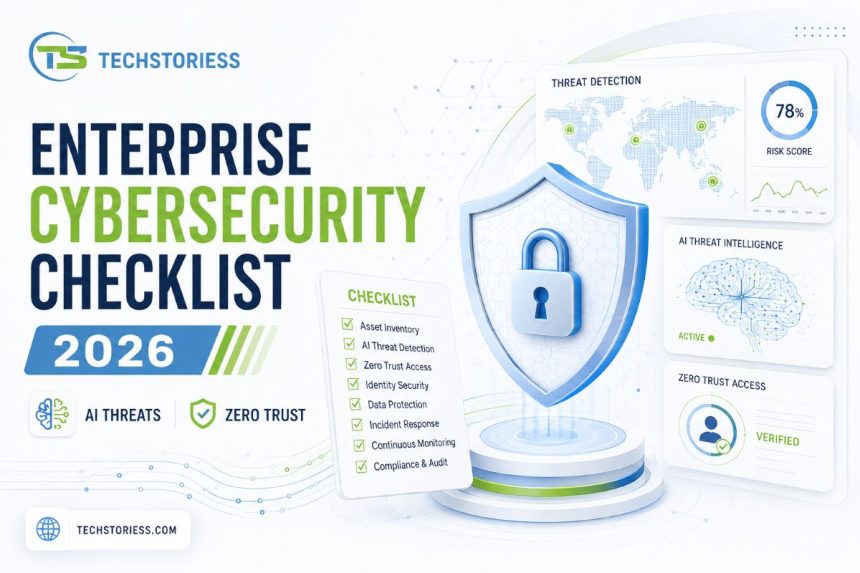
Enterprise cybersecurity checklist for 2026 is a structured as well as prioritised set of security controls, frameworks and compliance actions. Organisations should implement these to defend against AI-powered attacks, ransomware, identity threats and even the regulatory violations. Checklist in 2026 need to address zero trust architecture, EU AI Act compliance, AI-native threat detection and simultaneously the post-quantum cryptography migration.
Key Fact: 80% of cyberattacks in 2026 involve AI tools at some stage. The tools make AI-native defence baseline and not an advanced option.
Guide here is not theoretical. But it is built from IBM breach cost data, CISA implementation frameworks, Google Cloud threat intelligence, live SERP analysis and practitioner insight from enterprise deployments across financial services, healthcare as well as critical infrastructure.
2026 checklist is comparatively different from previous years in three ways. AI has crossed threshold. It is not just an optional threat-intelligence enhancement. It is now also primary attack medium such as deepfakes, AI-generated phishing, autonomous AI agents and polymorphic AI malware. These are operational at scale.
Secondly, EU AI Act is to become enforceable this year on August 2. It is to introduce legally binding security obligations for enterprises operating AI systems in European market. The third to mention here is that post-quantum ransomware is not theoretical today. Kyber ransomware group deployed NIST-standardised post-quantum encryption in active campaigns earlier this year in March 2026. Enterprises not abiding to these are inside the window of immediate exposure today.
Zero trust is briefed in the following section. All the sections here in this checklist builds on that foundation.
How Enterprise Security Defences Work in 2026
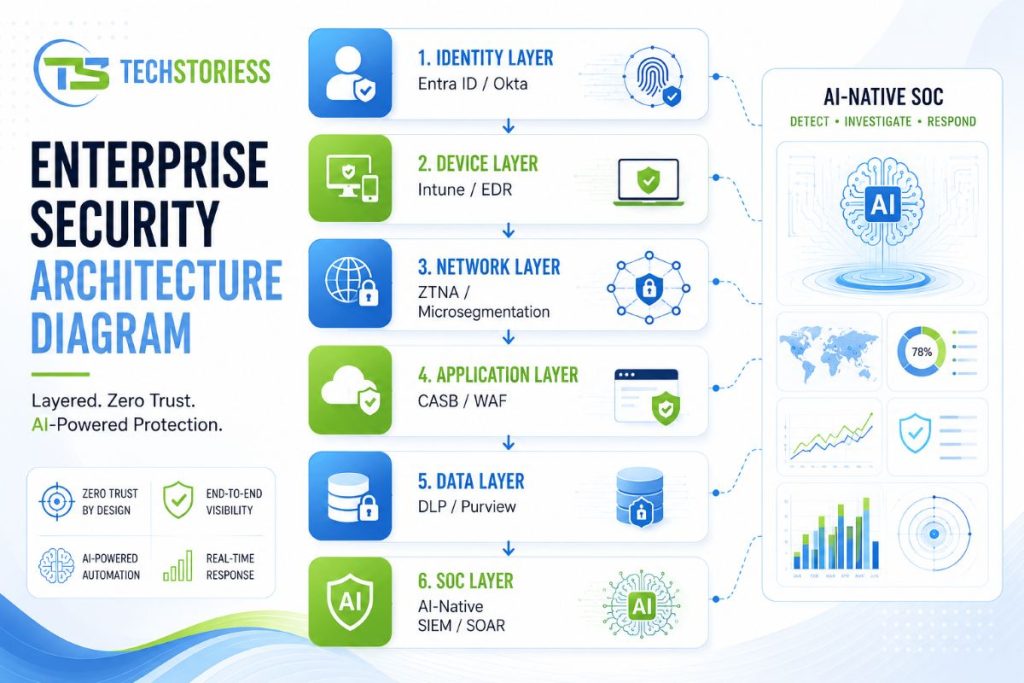
Enterprise security in the current year operates through layered model. Users and devices are continuously verified (Zero Trust). Endpoints are monitored by AI (EDR/XDR). Network packets are analysed for anomalies (NDR) and even every confirmed threat trigger automated response (SOAR). Basically, the goal is to compress breach lifecycle from 241 days to under 100 days with AI augmentation. The 241 days mentioned is an average of last year (IBM).
Zero trust is architectural foundation. It was first formalised by NIST in Special Publication 800-207. It replaces implicit network trust with continuous verification. Henceforth, users, devices or applications are not trusted by default even if these sits inside the corporate network. There are three core principles. These are to verify explicitly, use least privilege access and also to assume breach.
Visibility triad provides detection capability underneath the architecture. Security Information and Event Management (SIEM) centralises as well as correlates logs from across the environment. Endpoint Detection and Response (EDR) is assigned to monitor every device for suspicious behaviour. It also enables rapid containment. Similarly, Network Detection and Response (NDR) analyses traffic patterns to catch lateral movement as the movement generates minimal log evidence. SOAR platforms automate response actions, which earlier required human analyst to read, triage and therefore act on each alert.
Artificial intelligence is placed on the top and accelerates every layer. AI triage minimizes false positive rates as it is capable of filtering noise that consumes 35% of L1 analyst time. AI investigation enriches incidents with contextual threat intelligence and it is capable in doing in seconds. AI response basically triggers containment playbooks and ahead of the spread of lateral movement.
Why Perimeter Security No Longer Protects Enterprises
Collapse of perimeter is not a warning, but it had already happened. Microsoft disclosed in January 2024 that Russian state-sponsored hackers from Midnight Blizzard breached their corporate email systems and it was done through legacy test account without having multi-factor authentication. It was not a zero-day exploit. In fact, it was a forgotten account that operated outside zero trust perimeter.
Average enterprise now connects through at least 100 SaaS applications. The workloads are distributed across several cloud providers. Employees connect from home networks and through their personal devices. Castle-and-moat model assumed a boundary and this does not exist now. VPN-based remote access creates chokepoints and this degrade performance amid offering limited visibility. Zero trust eliminates the assumption at architectural level.
AI-Powered Attack Vectors: What Enterprises Face in August 2026
Here are some of the biggest AI-powered cybersecurity threats which enterprises faced in August 2026: These are AI-generated phishing with deepfake voice and video impersonation, autonomous AI agent exploitation via prompt injection, AI-assisted ransomware with post-quantum encryption; automated vulnerability scanning at machine speed and data poisoning of enterprise AI training datasets. Eighty percent of attacks now involve AI tools at some point in the kill chain (Palo Alto Networks 2026).
Key Fact: It is learned that 44% of security leaders identify AI-generated threats indistinguishable from legitimate activity as primary visibility gap (2026 Digital Risk Report, Outtake).
AI-generated phishing & deepfake fraud. Large language models have of course industrialised spear-phishing by now. Attacker instructs AI to harvest public profile of a target, match CEO’s writing style from public communications as well as generate bespoke wire-transfer request. An industry survey reveals more than 80% of phishing emails which were identified in late 2024 actually involved some form of AI assistance. Deepfakes compound risk: FBI warned last year of AI-generated voice messages which impersonated senior US government officials with respect to extract account credentials. This manifests as CFO fraud calls and AI-cloned executive video meetings in enterprise environments to authorise transactions with no human initiated.
AI-assisted malware development. Threat groups use generative models to write exploit code, obfuscate payloads and even generate polymorphic variants that evade signature-based detection overnight. WormGPT and other such tools to automate the process, lowering technical barrier for sophisticated ransomware deployment. Static signature detection has a shelf life and it is measured in hours against AI-generated malware variants.
Automated vulnerability discovery. AI agents scan internet-facing assets, identify unpatched systems and suggest exploitation strategies continuously. All these at a speed which human reconnaissance team cannot match. It is learned that new exploits can be weaponised in just hours. Implication: organisations equipped with undisciplined patch management are said to be increasingly guaranteed for compromisation.
AI Agents as Attack Vectors: New Insider Threat
Most underestimated threat vector this year is enterprise AI agent. Eight out of ten percent of Fortune 500 companies have deployed AI agents in production environments. It is learned that 14% of the companies have received complete security approval for the deployments (Check Point 2026). AI agent operates with implicit trust. It has privileged access to APIs, data and systems. And yes, it never sleeps. Single well-crafted prompt injection or tool-misuse vulnerability transforms trusted internal agent into proxy of an attacker with complete access to kingdom. Palo Alto Networks described the same in late 2025. It writes as defining cybersecurity battleground of 2026.
Ransomware in 2026: Post-Quantum Encryption and Encryptionless Extortion
Ransomware evolved faster in the period of about past eighteen months compared to the preceding five years before it. Three structural changes define threat of the current year: AI-automated attack deployment, operational use of post-quantum cryptography by ransomware groups and emergence of encryptionless extortion with the decline of ransom payment rates.
Ransomware groups growth rate was 49% in 2025 (KELA). However, share of organisations paying ransoms dropped to 28% (Kaspersky 2026). The gap is driving ransomware operators toward pure data extortion. These are to steal data, threaten to publish the data and not to encrypt anything. It is obvious that no encryption means that no backups save you.
Key Fact: Kyber ransomware group deployed ML-KEM in March 2026. It was NIST-standardised post-quantum algorithm that was earlier called CRYSTALS-Kyber. The deployment was made in active enterprise attacks, which is months after final NIST standard was published.
How AI Is Used in Ransomware Attacks in 2026
AI automates every phase of ransomware kill chain. AI agents scan for exposed RDP ports, unpatched systems and credentials available on public breach databases during reconnaissance. Initial access brokers, which means wholesale layer of the ransomware economy have shifted focus to RDWeb (Remote Desktop Web Access). This is their preferred entry method (Kaspersky 2026). AI generates phishing lures which are personalised to each target organisation during execution. AI assists lateral movement post-access by identifying highest-value data repositories fastest.
How AI Defends Against Ransomware in 2026
AI is now being used in ransomware attacks to automate target profiling, generate phishing lures and deploy polymorphic malware. All these evades signature detection. CrowdStrike Charlotte AI, Palo Alto Cortex XSIAM and other such AI-powered SOC platforms detect ransomware precursor behaviours for defence. These are anomalous file access patterns, lateral movement between systems and credential dumping. AI-native platforms can isolate affected systems and trigger automated playbooks by identifying such behavioural signatures before encryption starts. It reduces average dwell time from eight days to even less than two hours.
The defence response set include: immutable, offline backups for guaranteed recovery; AI-native behavioural detection for pre-encryption stopping; zero trust microsegmentation to limit blast radius if a node is compromised; decoy assets (honeypots) to detect reconnaissance before attacks begin.
AI as a Defensive Weapon: How the Modern SOC Operates
AI in enterprise SOC operations basically automates three previously manual tasks. These are alert triage (filtering the noise that drives false positive rates to 65%+ in legacy SIEM environments), threat investigation (enriching incidents with contextual threat intelligence in seconds, not hours) and of course response execution (triggering containment playbooks without human delay). 2025 data of IBM reveals that organisations reduce breach costs by $1.9M per incident and shorten breach lifecycles by 80 days if they are using AI extensively in their SOC.
The revealed 80-day is the number that CISOs should take to their boards. Average 2025 breach lifecycle was 241 days (IBM). AI-augmented SOCs routinely achieve lifecycles below 100 days. Every day of dwell time represents continued attacker access, ongoing exfiltration and compounding breach cost. 80 days of lifecycle reduction translates to about $160,000 in avoided exposure per incident at IBM’s implied cost rate. And it is before counting the avoided notification, legal, and reputational costs.
Key Fact: 69% of organisations currently are using at least 10 detection and response tools. Tool sprawl is primary reason AI’s efficiency gains are not uniformly realised (Vectra AI 2026).
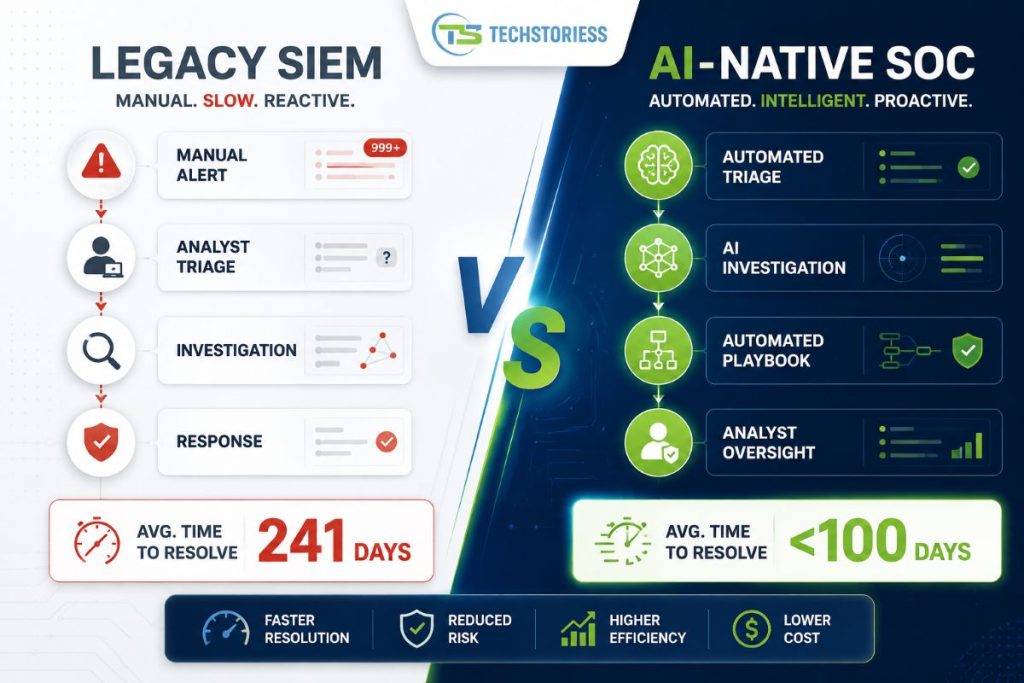
Practical SOC architecture centres on visibility triad: SIEM for log correlation, EDR for endpoint behaviour and NDR for network anomaly detection. SOAR automates repetitive triage tasks which basically consume L1 analyst capacity. Palo Alto XSIAM is the most autonomous example among organisations which consolidate these into a unified AI-native platform. L1 alert reduction is achieved by more than 90%.
The SOC efficiency implication is direct: AI-native platforms reduce L1 analyst headcount requirements by about 40% to 60%. For a mid-market organisation with four L1 analysts at a median $65K salary, that is $156,000–$260,000 in annual staffing cost recovered — a meaningful contribution to the ROI case for platform investment.
The Enterprise Security Lifecycle: Prevention Through Recovery
NIST Cybersecurity Framework 2.0 defines six-function security lifecycle: Govern → Identify → Protect → Detect → Respond → Recover. Every section of the checklist maps to one or more of the functions. Value of framework is architectural. It prevents organisations from over-investing in detection while under-investing in recovery. It also prevents spending heavily on perimeter protection while neglecting identity.
Govern establishes policies, risk management processes and accountability structures to make everything else work. Identify inventories assets, vulnerabilities as well as threat exposure. Protect implements controls — Zero Trust, MFA, DLP, patch management. Detect operates AI-native SOC, SIEM and behavioural analytics. Respond executes incident response playbook. Recover restores normal operations, preserves forensic evidence and simultaneously even drives post-incident improvement.
Usual neglected phase is Govern. Organisations do invest in tools, but they also skip policy layer that determines whether the equipped tools are correctly used. EU AI Act’s mandatory governance requirements include documentation, human oversight and audit logging. These are the Govern phase mandates which are applied to AI systems specifically.
Enterprise Architecture Patterns: Zero Trust, XDR, AI-Native SOC Compared
Basically, three architecture patterns are dominating enterprise security in 2026 and these are not mutually exclusive. Organisations which are mature usually deploy all these three patterns in an integrated stack.
Zero Trust Architecture (NIST SP 800-207) is identity-first as well as microsegmented. It eliminates implicit network trust. It requires continuous verification for each and every access requests. It simultaneously also limits lateral movement through granular policy enforcement. Gartner projects that 10% of large enterprises will have a mature Zero Trust programme by the end of 2026. The figure is much up from 2023 when it was even less than 1%. The research of Forrester reveals that organisations equipped with mature Zero Trust implementations experience 50% less breaches comparatively. Such organisations also reduce breach costs by an average of $1.76M per incident.
Extended Detection and Response (XDR) consolidates endpoint, network, cloud and identity telemetry into unified threat detection as well as response platform. XDR addresses tool sprawl problem directly. It replaces 10+ point solutions with a single detection surface. CrowdStrike Falcon, Microsoft Defender XDR and SentinelOne are currently some of the leading XDR platforms at enterprise scale.
AI-Native SOC represents current architectural frontier. It is basically a security operations centre. Here, AI handles autonomously L1 and L2 alert triage, enrichment as well as playbook execution. Palo Alto XSIAM is a complete AI-native SOC platform available today. Operational target is closed-loop system where most of the alerts are resolved without requiring any human touch. It frees analyst capacity for threat hunting as well as adversary simulation.
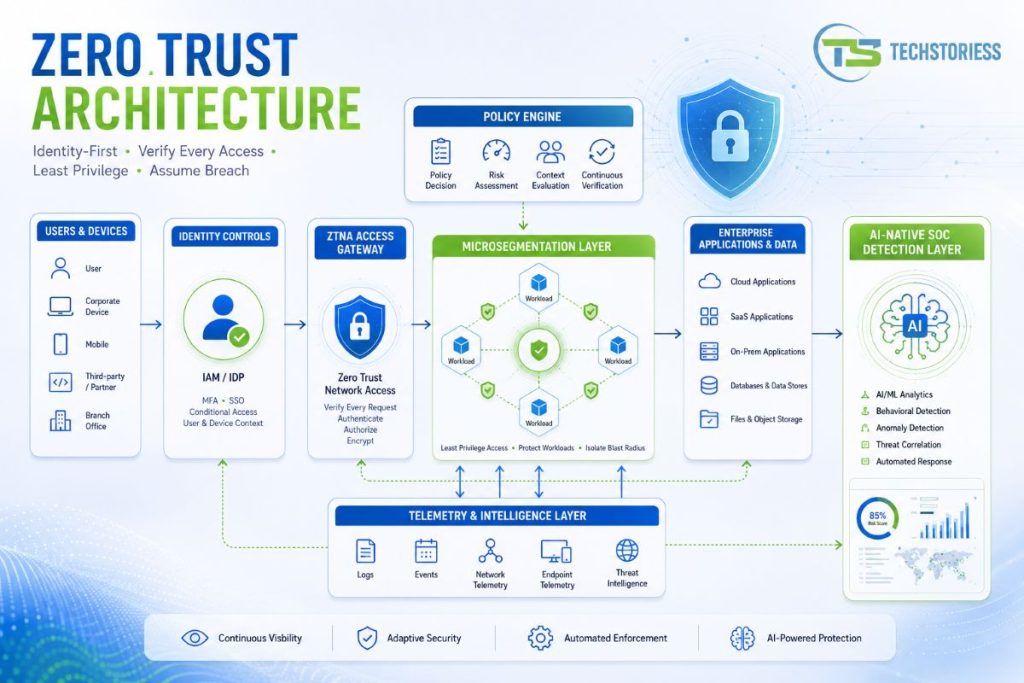
Zero Trust Architecture: NIST SP 800-207 Pillars
NIST SP 800-207 defines five pillars. These are Identity (all users and service accounts continuously verified), Devices (all endpoints enrolled, monitored, and risk-scored), Networks (microsegmented, ZTNA replacing VPN), Applications (CASB, conditional access, and least-privilege application access) as well as Data (classified, labelled, protected by DLP). CISA Zero Trust Maturity Model maps the above said pillars across five maturity levels. The levels include Traditional, Initial, Advanced and Optimal. These are the authoritative benchmarking references for enterprise deployments.
Less than 10% of large enterprises have reached Advanced or Optimal maturity levels (Gartner) as of 2026. Majority are either in Traditional level or Initial stage. This means that significant exposure is still there even after years of Zero Trust discussion.
AI-Native SOC vs. Legacy SIEM: Switching Decision
Legacy SIEM was basically engineered for world of predictable, perimeter-contained IT environments. It is true that rules-based correlation logic fails to adapt to the behavioural anomalies produced by AI-generated attacks. Result is false positive rate and it overwhelms analyst capacity as well as detection model that fails against novel attack patterns.
AI-native SOC platforms include XSIAM, Charlotte AI (CrowdStrike) and Microsoft Sentinel with Copilot for Security. It replaces rules-based detection with machine learning models that is basically trained on global threat intelligence. Organisations which are using AI extensively in their SOC are equipped with breach costs of $3.84M. The breach costs of those which are without AI (IBM 2025) are $5.72M. Hence, there is a difference of $1.88M per incident.
Migration sequencing: It first consolidate to a unified XDR platform (reduces tool sprawl and normalises telemetry). It thereafter layer AI-native SOC capabilities over the period of 12 to 18 months. It is suggested to avoid rip-and-replace, which is basically a phased transition preserves detection coverage during switchover.
Governance and Compliance: EU AI Act’s August 2, 2026 Enforcement Deadline
The core framework of EU AI Act becomes operational broadly on August 2, 2026. High-risk AI systems under Annex III that includes AI used in employment screening, credit decisions and access to essential services need to comply with mandatory technical documentation, human oversight controls, bias testing as well as audit logging requirements. Penalties will be levied by up to 7% of global annual revenue to non-compliance carries.
Key Fact: Large enterprises equipped with revenue of more than €1 billion face initial compliance investment of €8–15M for high-risk AI systems (Axis Intelligence 2026). Cost of non-compliance is multiple orders of magnitude higher.
It is learned that enterprises operating in or serving the European market need to treat August 2, 2026 as a hard deadline. It is not to be considered as a soft regulatory aspiration. Digital Omnibus package proposed by the European Commission in late 2025 could postpone Annex III obligations for some systems to December 2027. However, prudent planning cannot be assumed that extension will materialise.
10-Item EU AI Act Security Compliance Checklist for August 2026
Below is a checklist that covers actions needed to be compliant by August 2 enforcement date. It is to note here that each item maps to a specific article or annex of Regulation (EU) 2024/1689.
- Classify all AI systems against Annex III risk tiers. It is better to first identify the AI systems in your environment that qualify as high-risk. The examples can be hiring algorithms, credit scoring and predictive HR tools access control AI. Prohibited practices such as real-time biometric surveillance and social scoring must have been discontinued since February 2025.
- Build an AI system register. It is suggested to document every AI system for purpose, risk classification, training data sources, output scope and responsible business owner.
- Implement mandatory human oversight controls for high-risk AI. Such high-risk AI decisions which affect employment, credit or essential services need to include a human review step to override AI outputs.
- Complete conformity assessment documentation. Prepare technical documentation that demonstrates compliance with accuracy, robustness and cybersecurity requirements for Annex III systems.
- Appoint an AI compliance lead. Assign ownership. Compliance by committee is compliance in just name only.
- Run bias and fairness testing pipelines. High-risk AI systems need to demonstrate accuracy and absence of discriminatory bias across demographic groups.
- Establish 7-year audit log retention. Decisions made by high-risk AI systems need to be logged with sufficient detail so that it can support post-hoc investigation as well as regulator audit.
- Update privacy notices to reflect AI processing. GDPR and AI Act overlap for systems processing personal data. Notices need to explain AI decision logic at such a level that is appropriate to the risk.
- Create AI incident reporting procedures. Some serious incidents which involve high-risk AI systems are to be reported to national supervisory authorities. It is suggested to establish reporting workflow before an incident occurs.
- Document GPAI transparency obligations if applicable. Providers of general-purpose AI models which are placed on EU market from August 2026 face specific transparency as well as technical documentation requirements.
NIS2, DORA, GDPR: How EU Regulatory Stack Intersects
It is true that AI Act fail to operate in isolation. European enterprises managing cybersecurity compliance in 2026 face layered regulatory environment. NIS2 (active since 2024) imposes cybersecurity obligations on operators of essential services and digital infrastructure. similarly, DORA (Digital Operational Resilience Act, effective January 2025) mandates ICT risk management, incident reporting as well as resilience testing for financial sector. Moreover, GDPR governs personal data processing and it is equipped with penalties of up to 4% of global revenue.
Overlap is an efficiency opportunity. Controls implemented for NIS2 (incident response, logging, resilience testing) satisfy parallel requirements under AI Act and DORA. Unified compliance programme that is built around ISO/IEC 42001 (AI management) and ISO/IEC 27001 (information security) covers most majority of all three frameworks.
Enterprise Security by Department: Security ROI in Practice
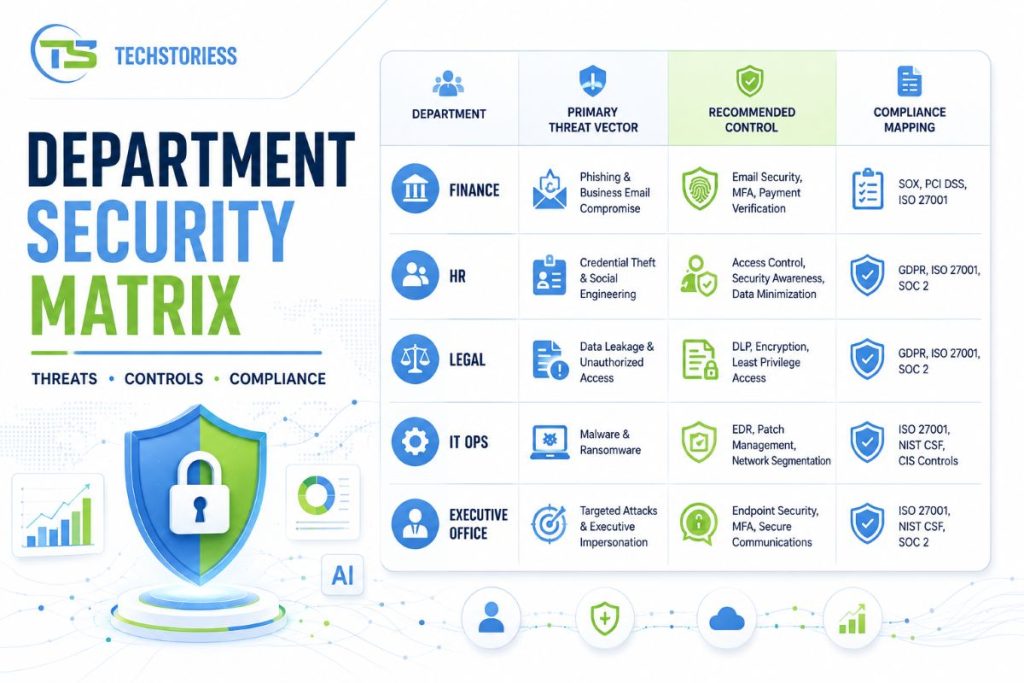
CISO justify security spending. It is done be aggregating breach statistics lose budget battles. It is among those who survive present department-specific risk exposure and control ROI. Let us check below breakdown across five enterprise departments.
Finance: Primary threat is AI-enhanced wire fraud. It is basically a deepfake CFO call that authorises fraudulent transfer or AI-generated invoice fraud at scale. Primary control: dual-approval workflows for all transactions above threshold, FIDO2 authentication for finance system access and AI-based transaction anomaly detection. Control owner: Finance Director + IT Security. SOX compliance mapping: audit logging as well as access controls satisfy the requirements of Section 302/404.
Human Resources: Primary threat in 2026 is EU AI Act liability. It is basically hiring algorithms that fail Annex III compliance and create 7% revenue exposure compared to normal employment law risk. Credential theft during onboarding is secondary threat. Primary control: AI Act conformity assessment for all HR AI tools, privileged access governance for HRIS systems and onboarding identity verification with automated de-provisioning at offboarding.
Legal: Primary threat is data exfiltration of privileged communications as well as NDA-protected material. AI-powered discovery tools used by opposing counsel henceforth can process leaked materials at scale. Primary control: legal matter DRM, zero trust access to document management and privileged communication encryption with quantum-resistant key management (forward-looking).
IT Operations: Primary threat is alert fatigue that leads to missed signals and even to unpatched vulnerability windows. AI-generated exploits can weaponise known CVEs and it can be done within hours of disclosure. Primary control: AI-prioritised patch management, automated vulnerability scanning and SOAR-driven response playbooks. These remove human delay from critical patches.
Executive Office: Primary threat is CEO fraud as well as board communication interception. Deepfake voice cloning of executives is operational and even is documented. Primary control: callback verification procedures for all financial authorisation requests, end-to-end encrypted board communication platforms and executive threat briefings quarterly.
10-Step Enterprise Cybersecurity Implementation Checklist for 2026
Zero trust implementation for enterprise follows seven sequential phases: These are (1) Establish identity foundation — deploy MFA and SSO across all applications [Weeks 1–4]; (2) Secure endpoints — enrol all devices in MDM with EDR [Weeks 2–6]; (3) Microsegment the network — isolate workloads using ZTNA [Weeks 6–16]; (4) Extend to applications — deploy CASB and conditional access [Weeks 10–20]; (5) Protect data — classify, label, and apply DLP policies [Weeks 16–26]; (6) Deploy AI-native SOC — implement XDR and SOAR automation [Weeks 20–36]; (7) Validate continuously — run red team exercises quarterly. Complete enterprise deployment basically takes 18 to 36 months of time.
Step-by-Step: Implementing Zero Trust and AI-Native Security [HowTo]
Step 1 — Conduct Identity and Asset Inventory [Weeks 1–2] It is firstly suggested to map every user account, service account, device and data repository. Identify orphaned accounts (a legacy test account cost Microsoft access to senior leadership email). Output: complete asset register with risk classification.
Step 2 — Deploy MFA and Passwordless Authentication [Weeks 2–4] Enable MFA across all applications immediately. Target state: FIDO2 passkeys or hardware security keys for privileged accounts. Passwordless authentication eliminates credential-theft vector at the source.
Step 3 — Enrol All Endpoints in MDM with EDR [Weeks 3–6] No unmanaged device should access enterprise resources. Deploy MDM (Intune, Jamf) and EDR (CrowdStrike, SentinelOne, Defender) to all endpoints. Enforce device health checks in conditional access policies.
Step 4 — Replace VPN with ZTNA [Weeks 6–16] Zero Trust Network Access connects users directly to authorised applications. Do note that it does not connects users to the network. Hence, it eliminates lateral movement paths that is created by flat-network access of VPN. Cloudflare Zero Trust, Zscaler ZPA and Palo Alto Prisma Access are some of the leading enterprise ZTNA platforms.
Step 5 — Implement Network Microsegmentation [Weeks 8–20] Divide network into isolated workload segments. Compromised endpoint in Finance cannot reach engineering data repository. Illumio, Zscaler and native microsegmentation capabilities of all the major cloud providers basically support this.
Step 6 — Deploy CASB and Application-Layer Controls [Weeks 10–20] Cloud Access Security Broker controls govern. SaaS applications employees can access this and controls what data they can upload to them. Shadow IT is detected and blocked at this layer. Shadow AI 2.0 is also included in this.
Step 7 — Classify and Protect Data with DLP [Weeks 16–26] Microsoft Purview, Google DLP and Forcepoint classify data by sensitivity, apply labels as well as enforce policies that prevent exfiltration via email, USB or cloud upload. This control satisfies EU AI Act audit logging requirements at data layer.
Step 8 — Deploy AI-Native SOC: XDR and SOAR [Weeks 20–36] Consolidate SIEM, EDR and NDR telemetry into unified XDR platform. Layer SOAR automation for alert triage and response execution. Target: >90% L1 alert reduction through AI automation. It is through human analysts basically focused on threat hunting.
Step 9 — Implement EU AI Act Governance Layer [Parallel / Ongoing] Run 10-item EU AI Act compliance checklist from Section 8 in parallel. It is to note here that governance does not wait for technical implementation to complete.
Step 10 — Begin Post-Quantum Cryptographic Inventory [Parallel / Ongoing] Identify where RSA, Diffie-Hellman and ECC are deployed across your environment. It is basically prerequisite to PQC migration. CISA estimates about 3 to 5 years of time period for enterprise migration.
5-Stage Enterprise Security Maturity Model
It is learned that not even 10% of large enterprises are at Advanced or Optimal maturity levels as of 2026 (Gartner). Most of them are now at Stage 2 or Stage 3. Knowing your stage in fact sets realistic implementation expectations as well as justifies incremental investment.
Stage 1 — Reactive: No formal security programme. Patching is ad-hoc. No SIEM, no SOC. Relies on perimeter firewall. Breach cost exposure: full $4.9M+ average.
Stage 2 — Foundational: MFA deployed on primary systems. Basic EDR in place. Annual third-party penetration test. Compliance driven by audit and not than risk. Breach cost exposure: reduced but it is still significant.
Stage 3 — Defined: SIEM deployed and actively monitored. Zero Trust initiated (identity layer complete). Compliance frameworks mapped (ISO 27001 or SOC 2). Incident response plan documented as well as response plan tested.
Stage 4 — Advanced: AI-native SOC operational. Zero Trust covering identity, endpoint and network layers. EU AI Act governance implemented. MTTR under 24 hours for critical incidents.
Stage 5 — Adaptive: Autonomous threat response across all NIST CSF 2.0 functions. Full Zero Trust maturity across all five pillars. PQC migration underway. Continuous adversary simulation. Real-time risk scoring for every access request.
Total Cost of Ownership: What Enterprise Security Really Costs in 2026
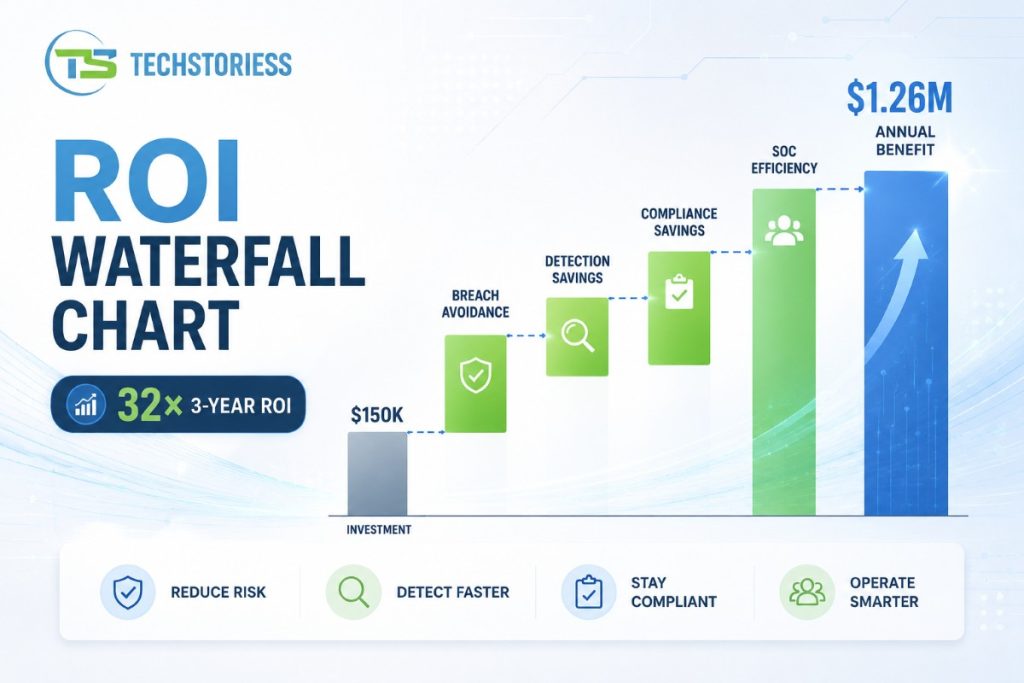
Enterprise security spending in 2026 ranges from $20K–$50K annually for SMBs to $150K–$500K for large enterprises with in-house SOC teams. $150K enterprise security stack represents a 32× return compared to average breach cost of $4.9M (IBM 2026). It is assumed that one breach event was avoided per three years. Managed SOC services cost $100K–$1M+ annually. However, it depends on service scope.
| Tier | Employees | Annual Stack Cost | Coverage |
| SMB | <500 | $20K–$50K | Endpoint + email + MFA; typically MSSP-managed |
| Mid-market | 500–5K | $50K–$150K | SIEM + EDR + identity; partial in-house SOC |
| Enterprise | 5K+ | $150K–$500K | AI-native SOC + full Zero Trust; dedicated team |
| Managed SOC | Any | $100K–$1M+/year | Full MDR; includes after-hours coverage |
| Avg. breach cost | — | $4.9M | IBM 2026 projection |
Direct costs are visible line items. These are like platform licensing, endpoint agent fees, SIEM ingestion costs and professional services for deployment. Mid-market organisation deploying CrowdStrike Falcon + Microsoft Sentinel may expect somewhere between $60K and $120K annually in licensing alone.
Indirect costs are budget lines and rarely appear in security proposals. These are like security awareness training ($30–$60 per employee per year), annual penetration testing ($15K–$80K), compliance audit fees and legal fees which are associated with breach investigation.
Hidden operational costs are what kill security ROI calculations. Alert fatigue consumes about 35% of L1 analyst time on false positives. Tool sprawl generates integration maintenance costs and few organisations budget for it. Annual re-tuning of detection rules in legacy SIEM environments costs about 2 to 4 weeks of time of senior analyst per year.
The 3-year TCO model changes calculation. Year 1 carries highest cost. These can be platform deployment, professional services and training. Year 2 is optimisation like rule tuning, integration maturation and team upskilling. Year 3 is operational steady state. It is about 20 to 30% of Year 1 cost annually (Progressive Robot 2026).
Vendor Evaluation: CrowdStrike, Sentinel, XSIAM, SentinelOne & Splunk
It is suggested that no enterprise security procurement decision should be made from vendor marketing materials. Below matrix rates five platforms and it is across ten criteria relevant to enterprise deployment in 2026. Scoring is based on published capability documentation, independent analyst assessments (Gartner, Forrester) as well as publicly available customer deployment data.
How to use the matrix: Weight criteria 1–3 highest for security-first deployments; weight criteria 3 + 5 highest for SOC efficiency programmes; weight criterion 6 highest for EU market deployments.
| Criterion | CrowdStrike Falcon | MS Sentinel + Defender | Palo Alto XSIAM | SentinelOne | Splunk |
| AI Detection Rate | ★★★★★ | ★★★★☆ | ★★★★★ | ★★★★☆ | ★★★☆☆ |
| MTTD Improvement | ★★★★★ | ★★★★☆ | ★★★★★ | ★★★★☆ | ★★★☆☆ |
| Integration Breadth | ★★★★★ | ★★★★★ | ★★★★☆ | ★★★★☆ | ★★★★★ |
| Annual Cost (Enterprise) | $$$$$ | $$$$☆ | $$$$$ | $$$☆☆ | $$$$☆ |
| Automation Depth (L1–L3) | ★★★★★ | ★★★★☆ | ★★★★★ | ★★★★☆ | ★★★☆☆ |
| EU AI Act Coverage | ★★★☆☆ | ★★★★☆ | ★★★★☆ | ★★★☆☆ | ★★★☆☆ |
| PQC Roadmap | ★★★☆☆ | ★★★★☆ | ★★★★☆ | ★★★☆☆ | ★★☆☆☆ |
| Cloud-Native Maturity | ★★★★★ | ★★★★★ | ★★★★☆ | ★★★★☆ | ★★★☆☆ |
| MSSP / MDR Availability | ★★★★★ | ★★★★☆ | ★★★★☆ | ★★★★☆ | ★★★★☆ |
| Mid-market Value | ★★★☆☆ | ★★★★☆ | ★★★☆☆ | ★★★★★ | ★★★☆☆ |
Methodology note: Stars in the above table represent relative capability assessment within enterprise security market, as of June 2026. Cost ($) indicators reflect relative total cost. Five $ indicates highest enterprise cost tier ($500K+/year at 5K+ seats). See Section 18 for full data sourcing methodology.
CrowdStrike Falcon leads on AI detection rate and also on automation depth. Falcon AI (Charlotte AI) natural language interface enables non-specialist staff to query threat data as well as initiate investigations. Best fit: security-first enterprises prioritising detection accuracy and response speed above cost. Primary gap: EU AI Act documentation tooling is nascent.
Microsoft Sentinel + Defender XDR wins on integration breadth for Microsoft-standardised environments. Copilot for Security (GPT-4 Turbo-powered) provides AI investigation capabilities across Microsoft 365 and Azure ecosystem. Best fit: enterprises with deep Microsoft standardisation seeking cost efficiency. EU AI Act coverage is stronger than most competitors due to EU Data Boundary commitments of Microsoft.
Palo Alto XSIAM is most complete AI-native SOC platform available right now. Cortex platform consolidates SIEM, SOAR, EDR and threat intelligence into single data model. It achieves highest automation depth in market. Best fit: large enterprises prioritising SOC consolidation and autonomous response. Highest implementation complexity and cost.
SentinelOne provides strongest mid-market value proposition: enterprise-grade AI EDR at a cost accessible to 500–5K employee organisations. Purple AI (the LLM-powered threat hunting interface) democratises threat hunting for organisations without dedicated threat hunters. Best fit: mid-market organisations seeking AI-native EDR without Falcon’s enterprise price point.
Splunk (now Cisco) is strongest choice for data-heavy SIEM use cases. Log volume, compliance reporting and custom correlation logic take precedence over automation. AI capabilities (AI-driven alerting) are maturing but lag native AI-first platforms. Best fit: organisations with complex compliance environments (FedRAMP, CMMC, SOX) requiring deep custom log analytics.
What’s Coming Next: Post-Quantum Cryptography, AI Agent Attacks, 2027
Post-quantum cryptography (PQC) is basically encryption algorithms and designed to resist attacks from quantum computers. This could break RSA and ECC standards of today. NIST finalised three PQC standards in 2024. These are ML-KEM (FIPS 203), ML-DSA (FIPS 204) and SLH-DSA (FIPS 205). Enterprises must begin PQC migration immediately: CISA estimates that full enterprise transition takes about three to five years. Kyber ransomware group actively deployed ML-KEM in real attacks in March 2026.
Key Fact: Nation-state adversaries are conducting “Harvest Now, Decrypt Later” (HNDL) campaigns. The initiative is to collect encrypted enterprise data today with expectation of quantum-decrypting it when capable quantum computers arrive. It is potentially believed to be in the early 2030s.
PQC market reflects urgency: MarketsandMarkets projects global post-quantum cryptography market may grow from $0.42 billion in 2025 to $2.84 billion by 2030. It is based on CAGR driven entirely by enterprises beginning migrations before regulatory mandates force the issue.
What Is Post-Quantum Cryptography? Why Does It Matter Now?
Post-quantum cryptography uses mathematical problems. Even a cryptographically relevant quantum computer (CRQC) cannot solve the problems efficiently. It is not like RSA and elliptic curve cryptography, which Shor’s algorithm would break once sufficient qubit counts are achieved. The three finalised standards of NIST are ML-KEM (FIPS 203) — formerly CRYSTALS-Kyber and used for key encapsulation, ML-DSA (FIPS 204) digital signatures and SLH-DSA (FIPS 205) which is hash-based digital signatures. Google issued public advisory earlier this year in February and stressed on the immediacy of cryptographic transition.
How to Start Your Enterprise PQC Migration: 5-Step Roadmap
Step 1 — Cryptographic Inventory. It is suggested to map every instance of RSA, Diffie-Hellman as well as ECC across your environment. The examples are TLS certificates, VPN tunnels, code signing keys, encrypted backups and API authentication. The inventory is prerequisite to everything else. It usually takes about 2 to 4 months at enterprise scale.
Step 2 — Classify by Data Sensitivity and Longevity. Systems protecting data with sensitivity window of 10 to 20 years. High-level priorities are intellectual property, health records and classified material. Start PQC migration there first.
Step 3 — Deploy Hybrid Cryptography. Layer ML-KEM alongside existing RSA/ECC in a dual-key exchange. If classical layer is broken by quantum computer, it is learned that PQC layer holds. If the PQC algorithm has an undiscovered flaw, then classical layer continues to provide protection. It is a hybrid approach and CISA-recommended bridge.
Step 4 — Test Vendor Interoperability. It is to note here that all enterprise vendors are not equipped with PQC-ready product roadmaps. Identify gaps in your security stack, cloud provider and SaaS applications. Engage vendors on their FIPS 203/204/205 timelines.
Step 5 — Align to the CISA Quantum Readiness Roadmap. CISA and NSA jointly have published a quantum-readiness roadmap. They have prioritised systems which protect critical processes and sensitive data. Use it as sequencing reference for your migration programme.
AI agent attack landscape for 2027 and even after that is second major emerging vector. Attack surface created by agent-to-agent communication protocols and tool-call chains will become primary target as enterprises deploy more autonomous AI agents such as workflow automation, code generation and data analysis. Prompt injection at scale, malicious tool registration and agent privilege escalation are attack patterns which are to be monitored.
Original Data: Enterprise Security Comparison Framework, ROI Model, Cost Benchmarks
Methodology note: Below are four data assets which were constructed from primary sources (IBM, Gartner, Forrester, Kaspersky, Vectra AI, CISA, MarketsandMarkets) cross-referenced with enterprise deployment practitioner experience. It is to note that all figures here are ranges or averages across multiple sources. Moreover, individual enterprise outcomes will vary based on deployment scope, industry sector as well as implementation quality. See Section 18 for full sourcing detail.
Architecture Comparison Framework
Which security architecture is right for your enterprise? It actually depends on your threat model, existing stack and compliance requirements. Below table scores three primary architecture patterns across 12 enterprise-relevant dimensions.
| Dimension | Zero Trust | Perimeter Security | Defence-in-Depth | AI-Native SOC |
| Breach Detection Rate | High | Low | Medium | Very High |
| MTTD (average hours) | <48h | 1,000–3,500h | 200–800h | <24h |
| Annual Cost (Enterprise 5K+) | $150K–$500K | $50K–$150K | $100K–$350K | $200K–$600K |
| AI Automation Depth | Medium | Low | Low-Medium | Very High |
| EU AI Act Compliance Readiness | High | Low | Medium | High |
| Legacy System Compatibility | Medium | High | High | Medium |
| Cloud-Native Integration | Very High | Low | Medium | Very High |
| Lateral Movement Containment | Very High | Low | Medium | Very High |
| Identity Verification Strength | Very High | Low | Medium | High |
| False Positive Rate | Low | Medium | High | Very Low |
| Implementation Timeline | 18–36 months | 3–6 months | 12–24 months | 12–24 months |
| Regulatory Alignment (NIS2/DORA) | High | Low | Medium | High |
Summary insight: Zero Trust provides best security outcomes against modern AI-powered threats. However, it also requires longest implementation timeline and simultaneously highest upfront investment. Defence-in-Depth with AI-native SOC detection provides meaningful interim protection for such enterprises which cannot commit to 18 to 36 month Zero Trust programme. Just Perimeter Security is not viable for enterprises in 2026.
Breach Prevention ROI Framework
Formula:
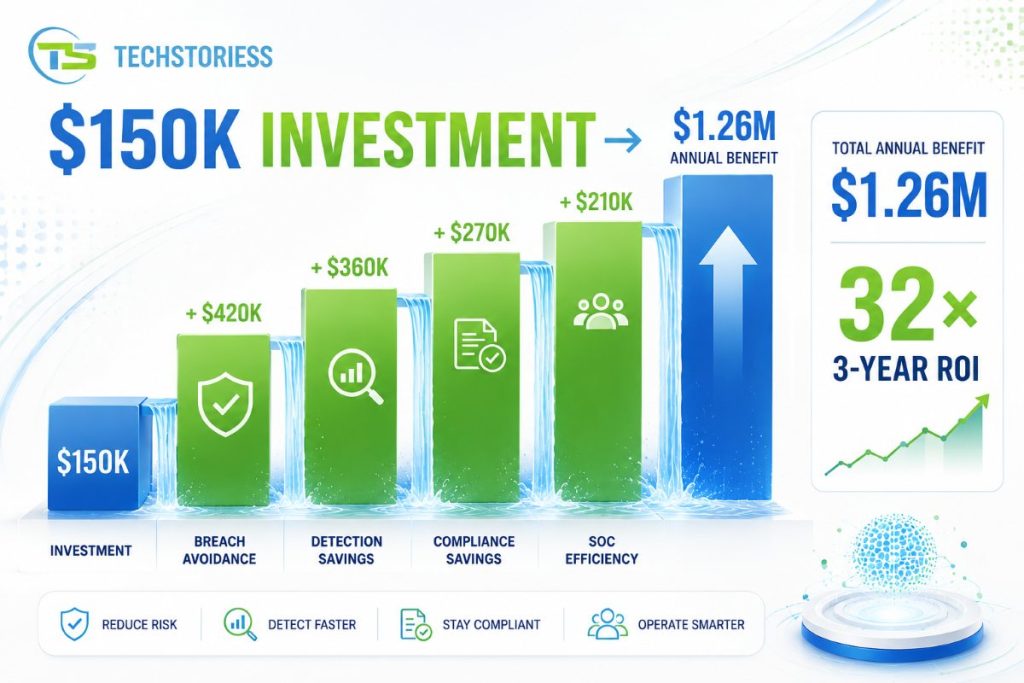
Total ROI = (Avoided Breach Cost + Detection Acceleration Savings + Compliance Savings + SOC Efficiency Gains) − Annual Security Stack Cost
Variable definitions:
- Avoided Breach Cost: IBM 2026 average $4.9M per incident; assumed probability of avoidance with full Zero Trust + AI SOC: 50% per 3-year period (conservative)
- Detection Acceleration Savings: 80-day reduction × $2,000/day exposure cost = $160,000 per incident
- Compliance Savings: Avoided EU AI Act penalty (avg. non-compliance cost $2.4M — Forrester); NIS2/DORA penalty avoidance
- SOC Efficiency Gains: L1 analyst headcount reduction 40–60%; at $65K/analyst × 4 FTEs = $156K–$260K/year
Mid-market worked example (500–5K employees, $150K/year security stack):
| Item | Value |
| Annual security stack cost | $150,000 |
| Avoided breach probability (50% × $4.9M ÷ 3 years) | $816,667 |
| Detection acceleration savings | $160,000 |
| Compliance savings (EU AI Act risk reduction) | $120,000 |
| SOC efficiency (2.5 analysts recovered) | $162,500 |
| Total annual benefit | $1,259,167 |
| ROI at Year 1 | 8.4× |
| ROI at Year 3 | 32× |
Sensitivity ranges: Conservative (SOC efficiency only, no breach event): 2.1× ROI. Base (one near-miss, partial SOC automation): 8.4× ROI. Optimistic (breach avoided, full SOC efficiency): 32× ROI.
Platform Evaluation Matrix (10 Criteria)
See Vendor Evaluation section above for the full ★★★★★ matrix. Applied to 5 platforms × 10 criteria.
Adaptation guidance: EU-market deployments: weight EU AI Act Coverage and PQC Roadmap criteria at 2× standard weight. Mid-market buyers with limited SOC staff: weight Automation Depth and MSSP Availability at 2× standard weight. Microsoft-ecosystem enterprises: Microsoft Sentinel integration score is effectively 6/5 — weight Integration Breadth accordingly.
3-Year Enterprise Security Cost Model
| Year | SMB (<500) | Mid-market (500–5K) | Enterprise (5K+) | Managed SOC |
| Year 1 (Deployment) | $40K–$75K | $80K–$200K | $250K–$700K | $120K–$1.2M |
| Year 2 (Optimisation) | $25K–$55K | $55K–$160K | $180K–$520K | $100K–$1M |
| Year 3 (Steady state) | $20K–$50K | $50K–$150K | $150K–$500K | $100K–$1M |
| 3-Year Total | $85K–$180K | $185K–$510K | $580K–$1.72M | $320K–$3.2M |
Versus average breach cost: $4.9M (IBM 2026). Security investment is 2.8× lower than a single breach event even at Enterprise high-end ($1.72M over 3 years), which is before accounting for reputational damage, regulatory penalties and customer churn.
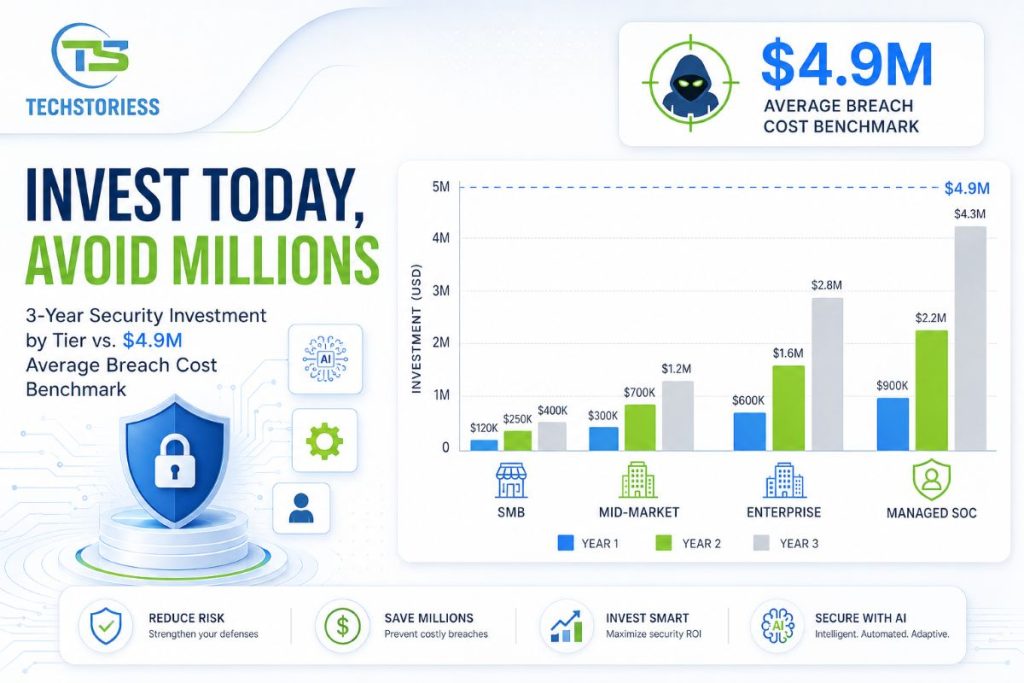
[ IMAGE PLACEHOLDER ] Grouped bar chart showing 3-year security investment by tier (SMB/Mid/Enterprise/Managed SOC) vs. $4.9M average breach cost benchmark | Type: Grouped bar chart | Size: 1200×600px | Alt: Bar chart comparing 3-year enterprise security stack cost by company size tier against $4.9M average breach cost benchmark
FAQ — Enterprise Cybersecurity in 2026: Most Common Questions
What are biggest AI-powered cybersecurity threats enterprises face in August 2026?
Biggest threats are AI-generated phishing that is equipped with deepfake voice as well as video impersonation, autonomous AI agent exploitation via prompt injection, AI-assisted ransomware with post-quantum encryption (Kyber ransomware, March 2026), automated vulnerability scanning at machine speed and data poisoning of AI training datasets. It is learned that about 80% of attacks involve AI tools at some point in kill chain (Palo Alto Networks 2026). Enterprises not using AI-native detection tool are outpaced systematically.
What is post-quantum cryptography? When must enterprises act on it?
Post-quantum cryptography basically uses encryption algorithms. Quantum computers fail to efficiently break such algorithms. NIST finalised ML-KEM (FIPS 203), ML-DSA (FIPS 204) and SLH-DSA (FIPS 205) as new standards. Enterprises need to act right now: CISA estimates that complete enterprise PQC migration takes about 3 to 5 years of time period. Kyber ransomware actively deployed ML-KEM in March 2026. Organisations need to begin with cryptographic inventory such as mapping all RSA and ECC use across their environment.
What is zero trust security? Why do enterprises need it in 2026?
Zero trust is a security model and it is built on continuous verification. Every user, device as well as application is verified before receiving access. It eliminates implicit trust of perimeter model that dissolved under cloud adoption and remote work. Such organisations which are equipped with mature zero trust reduce breach costs by an average of $1.76M per incident (IBM/Forrester). It is revealed that they experience 50% fewer breaches. It is basically baseline architecture and not an advanced initiative.
How is AI being used in ransomware attacks AND defence in 2026?
AI in 2026 is used in ransomware attacks to automate target profiling, generate phishing lures and deploy polymorphic malware. It evades signature detection. AI-powered SOC platforms detect ransomware precursor behaviours for defence such as anomalous file access and lateral movement. It isolates affected systems before encryption begins. It reduces average dwell time from eight days to under two hours. AI-native defenders are closing gap against AI-enabled attackers.
What is EU AI Act? How does it affect enterprise cybersecurity?
EU AI Act (Regulation EU 2024/1689) is considered as first comprehensive AI legal framework in the world. It will broadly become enforceable on August 2, 2026. It is the time when high-risk AI systems under Annex III must comply with mandatory documentation, oversight and audit requirements. Such enterprises which are using AI in hiring, credit scoring or access-to-services decisions face penalties by up to 7% of global revenue if they don’t comply. All enterprises with EU market exposure need to complete 10-item compliance checklist in Section 8 before deadline of August 2.