


AI filmmaking is moving from experiment to production. At this week’s Venice Film Festival, an AI-assisted documentary is using generated visuals to reconstruct moments that were never filmed. Meanwhile, researchers are increasingly examining a different problem: whether widespread use of generative AI could make creative output more homogeneous, even as it makes individual creators faster.
So the industry’s harder question may no longer be whether AI can create.
It is whether, in making creation easier, we risk making creative thinking more predictable.
How much of the creative process should we actually hand over to machines?
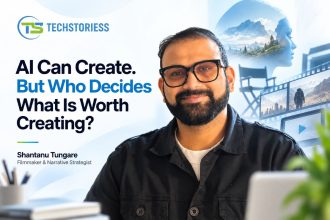
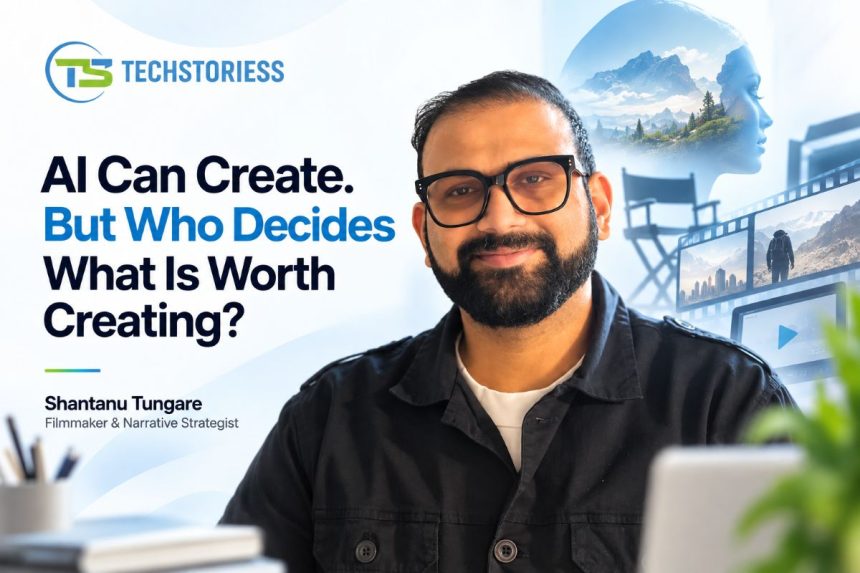
Shantanu Tungare has spent over a decade shaping how stories get told – as Creative Partner at Disney+ Hotstar, Co-founder of Bulb Chamka, and now as the filmmaker behind experiments like Ancient Indian Billionaires and Harry Potter × Nalanda. He’s also trained over 150,000 creators in AI, and hosts “The Narrative Room,” where he talks to leaders shaping how narratives influence perception. So when he warns that AI risks “colonising thought,” it’s worth listening closely – this isn’t caution from someone unfamiliar with the tools. It’s a warning from someone who has built an entire practice, and a framework he calls the Triangle of Creativity, around using them without losing the human at the center.
You have warned that AI could “colonise thought” by flattening human creativity. What part of creativity should we never outsource to machines?
I think we should never outsource the act of deciding what is worth creating in the first place.
AI can generate ideas, variations, images, films, scripts and possibilities at a speed that was unimaginable a few years ago. But the human has to bring the curiosity that asks, “What if?” and the judgment that asks, “Is this actually interesting?”
FInal output is the least important part of the creative process. A large part of creativity lies in the time between having an idea and arriving at the final idea: the experimentation, the wrong turns, the questioning and of course, the magic that AI sometimes throws at you.
If we outsource that entire process to AI and simply choose from whatever it produces, we may become very efficient at producing things without actually becoming more creative.
AI should accelerate experimentation, but it should not eliminate the human struggle of thinking.
You have taught lakhs of people to use technology and AI. What must we teach people that no AI course can?
We have to teach people how to think before we teach them how to use a tool.
An AI course can teach you prompts, workflows, models and techniques. Those things are useful, but they change very quickly. What stays relevant is your ability to ask good questions, recognise a good idea, challenge an answer and understand why you are making something.
In my AI sessions, even before using the tool, I ask a very simple question: “What do you want to make?”
That question is more important than any particular tool. Because once someone starts exploring an idea, it evolves. You might begin with a horse on the moon, then wonder what happens if it is on Jupiter, then give it wings, then suddenly the story becomes about a creature searching for its mother on Earth. That evolution is the creative process.
AI can participate in that process, but it cannot replace the curiosity that starts it.
You have taught AI to LAKHS while continuing to experiment yourself. What separates people who learn AI tools from those who develop true AI fluency?
Learning a tool is relatively easy. Developing fluency means changing the way you think about creating.
Someone who has learned an AI tool knows what buttons to press and what prompts to write. Someone who is AI-fluent understands how to use the technology as part of a larger creative process.
They know when to use AI, when not to use it, when an output is good enough, when it needs to be challenged and, most importantly, when the original idea itself needs to change.
I think experimentation is a big part of this. You have to make things, fail, modify them and try again. You cannot become fluent by simply watching tutorials.
The people who become really good at AI are not necessarily the people who know the most tools. They are the people who know what they want to explore and are willing to keep experimenting until they find something interesting.
Your “Triangle of Creativity” (attached) puts the human between AI and the final output. Has this changed your own creative process and what happens when human judgment, curiosity and questioning disappear?
It has made me more conscious of where the actual creativity is happening.
The Triangle is very simple: AI → Human → Output.
AI can generate possibilities. The output is what eventually reaches the audience. But the human in the middle is where the ideas evolve. That middle space is extremely important.
You might ask AI to generate something and realise that it is not quite right. You question it, change the direction, combine it with another idea, experiment again and suddenly arrive somewhere you could not have predicted at the beginning.
That is the part I don’t want to lose.
If human judgment, curiosity and questioning disappear, AI can still produce impressive outputs. But you start getting a world filled with things that look increasingly polished while becoming increasingly similar.
The danger is that it will make it so easy to create that we stop thinking about what we actually want to say.
Your experiments – from Ancient Indian Billionaires to Harry Potter × Nalanda – treat AI as a storytelling medium, not just a production tool. What can this medium enable that conventional filmmaking cannot?
The biggest difference is the speed at which you can go from an idea in your head to something you can actually see.
Traditional filmmaking requires enormous amounts of planning, people, infrastructure and resources before you can test an idea visually. AI dramatically reduces that distance between imagination and experimentation.
That opens up storytelling possibilities that would previously have been extremely difficult or expensive to even attempt.
When I explored ideas like Ancient Indian Billionaires or Harry Potter × Nalanda, the interesting part for me was not simply generating images. It was asking, “What happens if these two worlds, ideas or cultural references are brought together?”
AI allows you to prototype those questions almost immediately.
And because the barrier to experimentation is lower, you can take more creative risks. You can try an idea, realise it does not work, change direction and try something completely different.
I don’t think AI replaces filmmaking. I think it adds another layer to the filmmaker’s imagination, a medium where ideas can be explored much earlier, much faster and in ways that were previously difficult to visualise.
After spending years teaching people how to use technology – and now teaching them how to use AI – what do you think we most need to teach people that no AI course can adequately teach them?
We need to teach people not to confuse information with understanding.
AI has made access to information and capabilities incredibly easy. You can ask a question and get an answer, generate an image, write a script or build something in minutes. But none of that automatically means you understand what you are doing.
I think people need to develop judgment.
They need to know how to question what they see, how to develop their own point of view, how to recognise when something is generic, and how to keep pushing an idea instead of accepting the first output.
Most importantly, they need to be comfortable with the creative process itself.
There needs to be some time between input and output. You need space to think, experiment and course-correct. If AI makes us rush from an idea to a finished result without that middle process, we may become faster at producing things but weaker at creating.
That, to me, is the bigger lesson of teaching AI: the technology is becoming easier. The human thinking around it is becoming more important.
I would leave your audience with a MANTRA on how to use AI : Automate the noise, Humanise the content and free the storyteller in you.
Wrapping Up
Tungare’s answers keep circling back to the same idea from different angles: the danger was never AI itself, but the shortcut of skipping the messy, uncertain middle of the creative process – the questioning, the wrong turns, the “what if” that AI can’t ask on its own.
It’s a fitting perspective from someone who treats AI as a storytelling medium rather than a shortcut to the finished work.
And perhaps that is the simplest way to carry his argument forward: automate the noise, humanise the content, and free the storyteller in you.
For those who want to explore more of Shantanu’s work, ideas and experiments, you can find him across the platforms below.