


For the past three years, enterprise AI has meant one thing: sending data to someone else’s data center. Models lived in the cloud, GPUs were rented by the hour, and the CIO’s main question was which hyperscaler to pick. That assumption is now being challenged by a machine that fits next to a monitor.
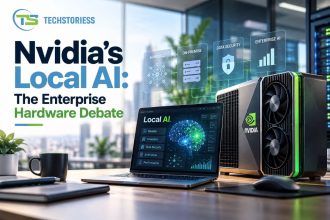
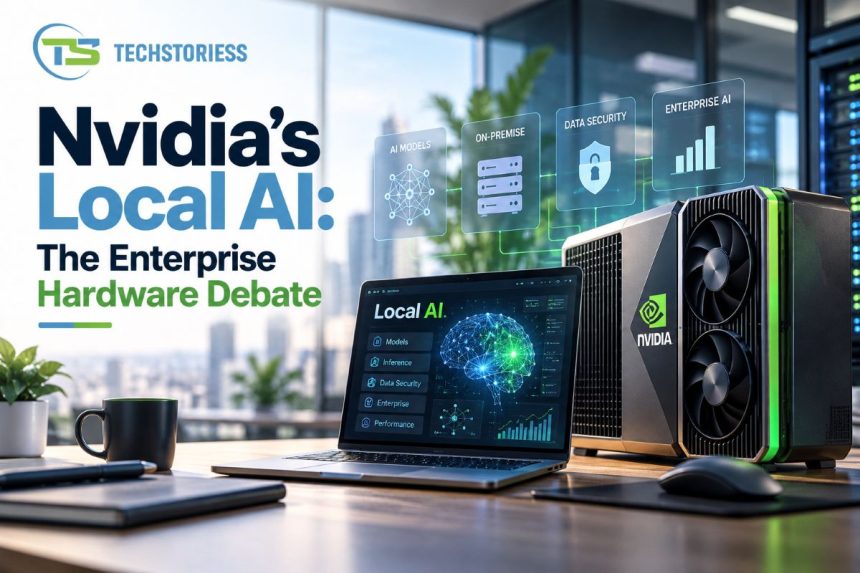
Nvidia’s DGX Spark and DGX Station are not workstations in the traditional sense. They are compact AI systems built to run serious models locally. The question for CXOs is no longer whether a desktop can run AI. It is whether parts of your AI estate belong there.
What Is Actually Arriving Nvidia’s Local AI
Nvidia has positioned two tiers. At CES, it showed DGX Spark running models of up to 100 billion parameters, while DGX Station handles models of up to 1 trillion parameters. In Nvidia’s framing, Spark is for individual developers, and Station is for enterprises and research labs running larger frontier-class workloads.
The entry price is also falling. On October 2, 2026, Nvidia announced a 64GB DGX Spark tier starting at $4,999, aimed at running models and agents privately on a desk without cloud dependency. That is below the price of many high-end laptop fleets, and a rounding error against a multi-year cloud AI commitment.
Distribution matters as much as the hardware. Nvidia AI Enterprise software support is available for Spark-class systems through partners including Dell, HP, Lenovo, ASUS, and Acer, with DGX Station due from vendors such as Dell, HP, and Supermicro. Enterprises can buy through the procurement channels, warranties, and support contracts they already trust. That removes the “science project” stigma that kept earlier on-premise AI experiments out of formal budgets.
Why the Debate Is Starting Now
Three pressures are converging.
Data sovereignty and confidentiality: Many CXOs have blocked or restricted public AI tools because sensitive data should not leave the building. Legal contracts, patient records, source code, M&A documents, and customer financials are the highest-value inputs for AI, and also the ones compliance teams most want to keep close. Local hardware offers a simple answer: the data never travels. Nvidia is leaning into this, demonstrating a local coding assistant that lets developers keep source code on their own machine while still getting AI help.
Cost predictability: Cloud inference is priced by usage, and agentic workloads are usage-hungry. An agent that plans, calls tools, and re-checks its own work can consume many times more tokens than a chatbot. A finance leader who approved a pilot budget can be surprised by the production bill. A fixed-cost device on a depreciation schedule behaves differently. For steady, predictable workloads, owning capacity can beat renting it.
Latency and resilience: Some applications cannot tolerate a round trip to a distant region or an outage at a provider. Factory floors, hospitals, trading desks, field operations, and branch offices in bandwidth-poor locations all fit this pattern. For them, local inference is a reliability decision as much as a privacy one.
The Open-Model Tailwind
None of this would matter without capable models to run. The rapid improvement of open-weight models is what makes local hardware viable. Two years ago, a model that fit on a single box was a toy next to frontier systems. Today, open models in the tens to hundreds of billions of parameters handle summarization, retrieval, coding assistance, and document analysis well enough for many business tasks.
This links directly to another enterprise debate: open versus closed models. Local hardware makes open models a practical choice, because you can run, fine-tune, and inspect them on your own premises. For companies that want a model tuned to their own vocabulary, such as legal clauses, product catalogs, or internal engineering standards, a deskside machine is a low-friction place to experiment.
The Case Against: What the Desk Cannot Do
A balanced view matters here, because the hype around “AI on your desk” can overshoot reality.
Frontier capability still lives in the cloud. The most capable proprietary models are not available to download and run on your own hardware. If your use case needs the best reasoning available, you will keep calling an API.
Scale is a different problem. A desktop system serves a developer or a small team. It does not serve 20,000 employees hitting an internal assistant at 9 a.m. Moving from prototype to production for that kind of load still means data center or cloud infrastructure, with the orchestration, monitoring, and redundancy that implies.
Hidden operational costs. Owning hardware means owning its lifecycle: patching, security hardening, model updates, asset tracking, and eventual replacement. A fleet of unmanaged AI boxes under desks is a shadow-IT risk, not a strategy. If a team buys devices without central visibility, you have recreated the problem of unsanctioned cloud AI tools in physical form.
Hardware moves fast. AI silicon refreshes quickly. A box bought today may look dated within two years, so the depreciation case needs conservative assumptions.
A Practical Framework for CXOs
Rather than asking “cloud or local,” ask which workloads belong where. A useful way to sort them:
- Data sensitivity. The more regulated or confidential the input, the stronger the case for local processing.
- Usage pattern. Steady, high-volume, predictable workloads favor owned capacity. Spiky or experimental ones favor the cloud’s elasticity.
- Capability needs. If a task needs frontier reasoning, use the cloud. If a capable open model is good enough, local becomes viable.
- Latency and uptime. Where connectivity is unreliable or response time is critical, local wins.
- Operational maturity. Do you have the people and processes to manage a distributed hardware fleet? If not, central infrastructure is safer.
Most enterprises will land on a hybrid model. Developers prototype and fine-tune on local systems, sensitive workloads run on-premise, and elastic or frontier tasks go to the cloud. Nvidia itself points to this continuity, noting that developers can use the same toolchain, frameworks, and runtime on a deskside system as in a data center, which makes moving between local and cloud environments easier. If that holds in practice, local hardware becomes the first rung of a ladder, not a separate island.
Conclusion
There is a strategic story behind the product story. Nvidia sells the chips that power cloud AI, and it is now also selling the systems that let some of that work move away from the cloud. That is a company positioning itself at every layer of the stack, from hyperscale clusters to the individual desk. It also suggests Nvidia sees demand for local AI as durable, not a passing curiosity.
For enterprise leaders, the lesson is not to rush out and buy hardware. It is to recognize that the default assumption, “AI means cloud,” is no longer automatic. Privacy rules, cost curves, and capable open models are making the location of AI a real design decision.
The companies that handle this well will treat it as portfolio management: matching each workload to the right environment, keeping governance centralized, and avoiding lock-in to any single path. The ones that ignore it may find their developers have already made the decision for them, one desktop at a time.