


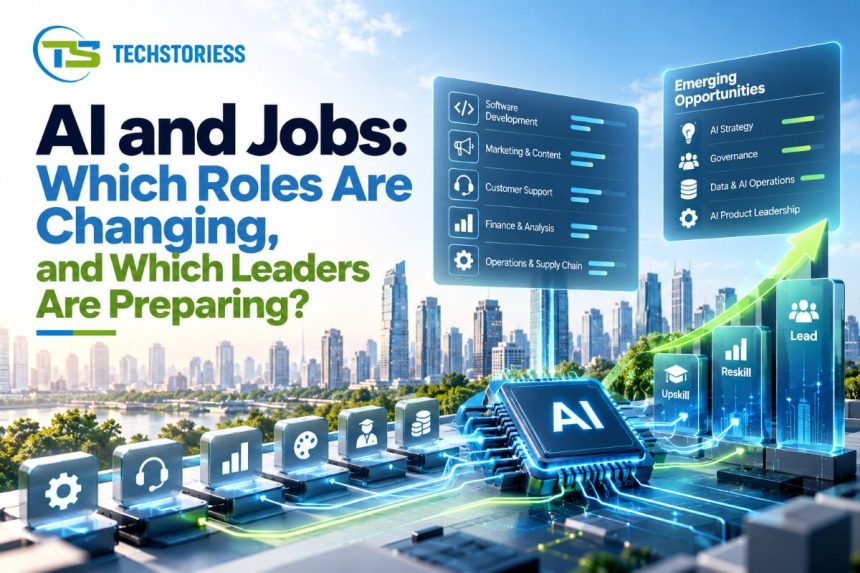
Every boardroom has had the same argument this year. One side says AI will hollow out the workforce. The other says it will create more jobs than it destroys. The evidence points somewhere less dramatic and more demanding: AI is changing the mix of work inside organizations faster than it is changing the total amount of work.
For CXOs, that distinction matters. A company that plans for mass layoffs and one that plans for role redesign will make very different decisions about hiring, training, and organization structure.
What the Data Actually Says
Start with the headline fear. Analysis from Yale’s Budget Lab found no clear effect of AI on overall US employment or unemployment so far, and the shift in occupational mix has been no faster than when personal computers and the internet spread through workplaces.
A fresh international study reinforces this. Researchers from King’s College London and Stanford analyzed 1.25 billion job advertisements across 41 countries and found that firms adopting AI recruited about 3.3% more employees overall. The catch is in who gets hired. Adoption was associated with a smaller share of junior roles and stronger demand for senior staff and for computer and mathematical occupations. As one of the authors put it, generative AI appears to be changing the composition of jobs inside organizations rather than reducing employment overall. (phys) (phys)
So the story is not mass unemployment. It is a reshuffling, and the people at the bottom of the ladder feel it first.
Which Roles Are Changing Most
Entry-level and junior roles. This is where the pressure shows up. Stanford researchers found a 16% employment decline for workers aged 22 to 25 in AI-exposed jobs since November 2022. The mechanism is quiet. Companies are not firing juniors. They are simply not hiring them. One senior engineer with AI can now produce what once took a senior plus three juniors, so those three juniors are never hired.
The picture is not uniform, though. A study of customer support agents found that an AI assistant raised productivity 14 percent on average and 34 percent for the newest, least experienced workers. AI can accelerate a junior’s learning curve even as it reduces the number of junior seats a company thinks it needs.
Administrative and clerical roles. Routine, document-heavy work is the most exposed. McKinsey’s analysis expects office and administrative support to see the highest adoption, covering roughly 80 percent of current work hours by 2035, with technology and analytics at 70 percent and retail and sales at 68 percent. Note that these figures describe hours of work that could be automated, not jobs that vanish. Roles get redesigned around what is left.
Senior and specialist roles. Demand is rising for people who can direct AI, check its output, and carry accountability. PwC’s 2026 barometer found that jobs requiring specific AI skills are growing almost eight times faster than the total jobs market, with the average wage premium for AI skills reaching 62%.
Entry-level jobs are being redefined, not just cut. PwC also found that the most AI-exposed entry-level roles are now seven times more likely to ask for skills once seen as senior, such as leadership, creativity, and face-to-face interaction. Openings for these “seniorised” starter jobs grew 35% since 2019, while other entry-level roles shrank 10%.
A Useful Way to Think About It
BCG’s framework helps CXOs sort roles into four groups: enabled roles, where AI is embedded in daily tasks without changing how work is structured (about 23% of jobs); rebalanced roles, where headcount holds steady but the job is redesigned; divergent roles, where outcomes depend on whether demand can expand (about 12%); and substituted roles, where demand is capped and AI replaces core tasks (about 12%). The same analysis estimates that 50% to 55% of US jobs could be reshaped over two to three years, while 10% to 15% are vulnerable over four to five.
The practical lesson is that “reshaped” is a much larger number than “replaced.” Most of your workforce will not lose their jobs. Most of them will be asked to do their jobs differently.
The Pipeline Paradox Nobody Is Planning For
Here is the risk many leaders are missing. One analysis found that 37% of companies plan to replace entry-level roles with AI, yet none have published plans for developing the mid-level and senior talent those roles used to produce.
Senior judgment is built by doing junior work. If you remove the bottom rungs, you eventually run short of the experienced people you now say you need most. A leader who cuts the graduate intake this year to save cost may face a thin bench of managers in five years, at exactly the point when the market is paying a premium for them.
Leaders also read the situation differently from their teams. Survey research covering nearly 6,000 executives in four countries found that executives expect productivity gains and employment reductions, while employees expect AI to boost employment. That gap is a change-management problem waiting to happen if it is not addressed openly.
What the Better-Prepared Leaders Are Doing
The evidence suggests a pattern. The leaders who look best prepared share several habits.
They map tasks, not jobs. Instead of asking “which jobs will AI take,” they break roles into tasks and ask which ones AI can handle, which need human review, and which stay human. That makes redesign concrete and avoids blunt headcount decisions.
They protect the apprenticeship path. Rather than abolishing junior roles, they redesign them: smaller teams of juniors working alongside AI tools, with deliberate exposure to judgment, client contact, and review work. This addresses the pipeline problem directly.
They invest in AI literacy as a baseline skill. Workers are ready for it. In one recent survey of career changers, 87% said they would likely join AI training if their employer offered it, and 80% believe AI literacy will become as essential as computer literacy. The demand exists. Many companies simply have not supplied the training.
They reward the human skills that grow in value. Judgment, communication, creativity, adaptability, and the ability to build trust are where the evidence points for resilient careers. Leaders who evaluate and promote on these, not just output volume, are aligning incentives with where value is moving.
They communicate early and honestly. Given the gap between executive and employee expectations, silence breeds anxiety. Better-prepared leaders say plainly what is changing, what is not, and what support exists.
They watch the data, not the headlines. Evidence is still mixed. Some studies find clear effects on young workers and others find none, depending on country, method, and how adoption is measured. Leaders who build their own internal metrics, such as hiring mix, internal mobility, and productivity per role, will make better calls than those who react to each new report.
5 Moves to Make This Quarter
Here are the 5 rules you should make this quarter for an immediate start:
- Audit your roles : Sort every major role into enabled, rebalanced, divergent, or substituted. Done when each function head can show their list.
- Protect your talent pipeline : Before cutting junior hiring, define how future senior leaders will be trained. Done when each team has a named apprenticeship path.
- Close the training gap : Check what AI training exists and who has completed it. Done when completion is tracked, not assumed.
- Align your message : Compare what employees hear with what investors hear. Done when both audiences get the same honest story.
- Stress-test your plan : Model your workforce plan for faster and slower AI impact. Done when you have a trigger for each scenario.
Conclusion
AI and jobs is not a story about robots taking over. It is a story about composition: fewer entry points, higher expectations at every level, and a premium on people who can work with AI and still exercise judgment.
The companies that handle this well will treat workforce planning as a design problem, not a cost-cutting exercise. They will redesign roles deliberately, keep a path open for young talent, and be honest with their people.
The ones that chase short-term savings by cutting the bottom of the ladder may find, a few years from now, that they have saved money and lost their future leaders.