



Cloud computing has completely changed how systems are built and scaled. Applications now run across virtual machines, containers, APIs, and managed services that constantly change. Users log in from multiple locations, permissions shift frequently, and services communicate without fixed network boundaries.
- Why Old-School Security Can’t Keep Up With the Cloud
- Catching Known Attacks Using Past Data
- Finding Suspicious Behavior Without Prior Rules
- Smarter Systems That Learn, Adapt, and Connect the Dots
- What Data AI Needs to Identify Cloud Security Threats
- Behind the Scenes: How AI Security Systems Actually Work
- Conclusion
This flexibility is powerful—but it also creates serious security challenges. Traditional security tools depend heavily on static rules and known attack signatures. They work well when threats look familiar, but struggle when attackers use new techniques or hide inside legitimate-looking activity. This is where AI-driven threat detection enters the picture.
Why Old-School Security Can’t Keep Up With the Cloud
Legacy security models assume stable environments. Cloud environments are anything but stable.
Resources spin up and shut down automatically. DevOps teams deploy changes multiple times a day. Employees, vendors, and automated systems access cloud services around the clock. All of this generates massive volumes of logs and events that are nearly impossible to analyze manually.
AI helps by learning what “normal” behavior looks like across users, systems, and workloads—and then spotting activity that quietly breaks those patterns.
Catching Known Attacks Using Past Data
Supervised learning models are trained on historical data that clearly labels activity as either legitimate or malicious. These models are effective at detecting well-documented threats such as brute-force login attempts, credential misuse, and known malware behaviors.
They work best when attack patterns are already understood and don’t change much over time. However, they struggle when attackers deliberately behave in new or unexpected ways.
Finding Suspicious Behavior Without Prior Rules
Unsupervised learning doesn’t rely on predefined attack labels. Instead, it observes behavior across the cloud environment and establishes a baseline of what is normal.
When something deviates—such as unusual login times, unexpected access to sensitive resources, or abnormal data movement—the system raises an alert. This makes unsupervised learning especially useful for identifying insider threats and previously unseen attacks. The downside is that unusual but legitimate behavior can sometimes trigger false alarms.
Smarter Systems That Learn, Adapt, and Connect the Dots
More advanced systems combine reinforcement learning and large language models (LLMs). Reinforcement learning allows systems to improve their responses over time based on outcomes. LLMs help correlate signals across logs, alerts, and system events that would otherwise seem unrelated.
These approaches are powerful for detecting multi-stage attacks that unfold slowly and quietly. However, they require significant data, computing resources, and careful oversight to remain effective.
What Data AI Needs to Identify Cloud Security Threats
AI-based detection is only as good as the data it analyzes. Common data sources include cloud provider logs, network traffic records, container and workload logs, and user activity data such as login history and permission changes.
When these data sources are combined, AI systems can identify subtle patterns that signal potential threats—patterns that would be nearly impossible for human analysts to catch at scale.
Behind the Scenes: How AI Security Systems Actually Work
As discussing the major advantages and benefits of AI in cloud security, let us find out how AI actually helps in securing the cloud ecosystem.
Pulling Signals From Across the Cloud Environment
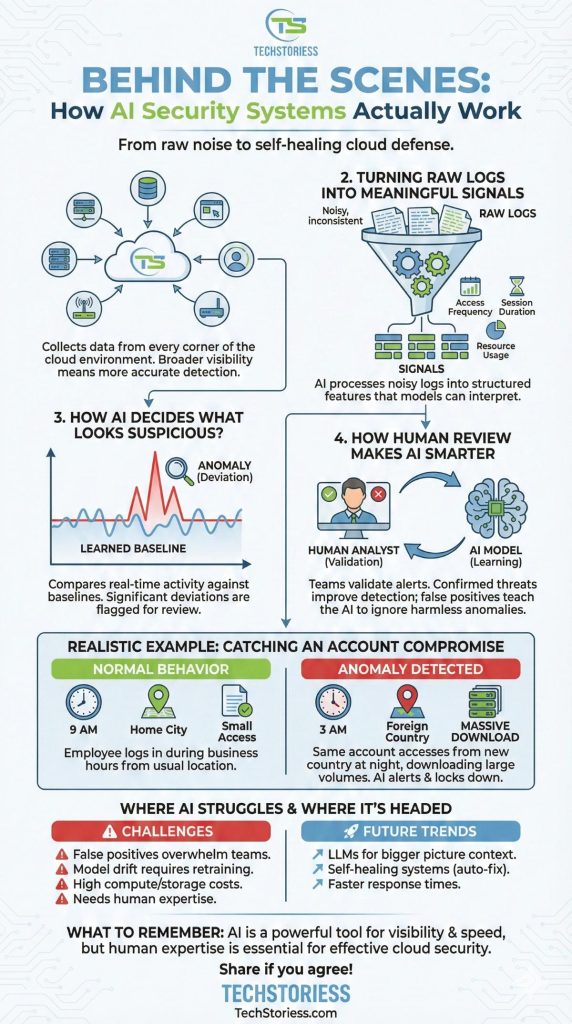
The first step is collecting data from as many relevant cloud components as possible. The broader the visibility, the more accurate the detection.
Turning Raw Logs Into Meaningful Security Signals
Raw logs are noisy and inconsistent. Feature processing converts them into structured signals such as access frequency, session duration, and resource usage anomalies that AI models can interpret.
How AI Decides What Looks Suspicious?
During real-time operation, the AI model compares current behavior against learned baselines. Activity that significantly deviates—such as accessing sensitive data a user never touched before—is flagged for review.
How Human Review Makes AI Smarter Over Time?
Security teams validate alerts and feed results back into the system. Confirmed threats improve future detection, while false positives help reduce unnecessary alerts.
A Realistic Example of AI Catching an Account Compromise
Imagine an employee account that normally logs in during business hours from a single city. One night, the same account accesses cloud resources from another country and begins downloading large volumes of data.
AI detects this deviation, raises an alert, and allows security teams to investigate. The account is found to be compromised and is locked down quickly—preventing a larger breach. The system then learns from this incident to spot similar attacks faster.
Where AI Security Tools Often Struggle?
AI is not a silver bullet. False positives can overwhelm security teams if models aren’t tuned properly. Poor or incomplete data reduces accuracy. Costs can be high due to compute and storage demands. Over time, changing cloud environments can cause model drift, requiring retraining.
Most importantly, effective AI security still depends on skilled humans who understand both cloud infrastructure and cybersecurity.
Where Cloud Threat Detection Is Headed Next?
With the fast changing landscape of technology, AI is acquiring new capabilities which will further help in offering a failsafe security to the Cloud. Here are the various effective ways in which fast evolving AI capabilities can be used to protect the cloud networks:
Understanding Attacks by Seeing the Bigger Picture
LLMs are improving threat detection by connecting events across systems and timelines, helping teams understand not just isolated alerts but entire attack narratives.
When Security Systems Fix Problems on Their Own
Self-healing security systems are emerging that can automatically isolate compromised resources, rotate credentials, and apply fixes without waiting for human intervention—dramatically reducing response time.
What to Remember About AI in Cloud Security?
AI significantly improves visibility and detection in complex cloud environments. Different models serve different purposes, and high-quality data is essential. While AI introduces cost and complexity, it also enables faster, smarter, and more scalable threat detection when used correctly.
Conclusion
AI plays a vital role in strengthening modern cloud security by identifying hidden threats at scale and adapting to a constantly changing digital landscape—something conventional tools struggle to achieve. However, AI is not a standalone solution; its effectiveness depends on high-quality data, continuous tuning, and human oversight. AI therefore acts as an intelligent support layer rather than a replacement for security teams, enabling faster, smarter, and more effective responses to threats in complex cloud ecosystems.