


Artificial intelligence has always been constrained by the economics of data — the collection, labeling, governance, security, and operationalization of data at scale.
- Where AI Training Really Costs Money
- What Synthetic Data Actually Means
- The Economics of Data Creation
- Why 70 Percent Is Not Unrealistic
- From Data Bottleneck to Data Infrastructure
- Hybrid Models: Less Real Data, Same Performance
- The Technical Foundations Behind Synthetic Expansion
- Tabular Synthetic Data and Enterprise Use Cases
- Privacy-Preserving AI as a Strategic Imperative
- Market Momentum and the 2030 Horizon
- The Compute Counterargument
- Where Synthetic Data Will Matter Most
- The Risks and the Responsibility
- Competitive Advantage in the Emerging Synthetic Data Market
- Conclusion
For years, organizations poured millions into building AI training data sets: annotating images frame by frame, transcribing speech manually, cleaning inconsistent records, negotiating access to regulated data, and navigating privacy compliance frameworks. In many industries, the majority of AI project budgets weren’t spent on model architecture or compute. They were spent on data.
Now that equation is shifting.
Synthetic data generation — once a niche research topic — is moving into the center of enterprise AI strategy. Market analysts project multi-billion-dollar growth over the coming years, with some forecasts estimating the synthetic data market approaching $8–9 billion by the end of the decade. At the same time, research firms predict that by 2030, synthetic data could account for the majority of data used to train AI systems.
The implication is not just technological. It’s economic.
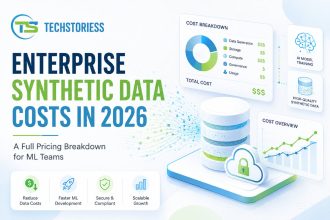
If current trends continue, AI training costs in many domains could fall by as much as 70 percent — not because models are getting cheaper to run, but because the most expensive part of AI development is being fundamentally restructured.
To understand why, we need to examine where the money actually goes.
Where AI Training Really Costs Money
Organizations often focus on GPUs, cloud compute, or foundation model licensing when discussing AI spending. However, in practice, the dominant cost center remains data — especially for domain-specific systems.
To understand this clearly, consider what conventional AI training involves:
- Acquiring large volumes of raw data
- Cleaning and normalizing it
- Removing duplicates and inconsistencies
- Labeling it manually (often at scale through outsourced teams)
- Validating annotation quality
- Handling regulatory compliance (GDPR, HIPAA, financial regulations)
- Implementing data security controls
- Maintaining data storage and processing pipelines
The annotation process alone can account for a substantial share of development costs in fields like autonomous driving, healthcare imaging, cybersecurity, finance, and speech recognition. For highly specialized datasets that require expert labeling — such as radiology scans or legal documents — each labeled instance can cost several dollars. Multiplied across millions of samples, the figures escalate rapidly.
Then comes the regulatory layer. If your AI training data includes personally identifiable information, biometric signals, financial records, or health details, compliance costs increase quickly. The bill is further driven upward by legal reviews, data anonymization procedures, consent management systems, and audit documentation.
Many of these cost drivers can be significantly reduced through synthetic data generation.
What Synthetic Data Actually Means
Synthetic data is not random noise or fabricated records without structure. Properly generated synthetic data statistically reflects the properties, distributions, correlations, and edge cases of real-world datasets without containing real individuals’ information.
Modern approaches rely on generative models such as Generative Adversarial Networks, diffusion models, and advanced probabilistic frameworks. These systems analyze real datasets to learn patterns and then generate fresh artificial samples that preserve underlying statistical characteristics.
The goal is to simulate reality at scale without copying real data, rather than inventing unrealistic or fictitious examples.
When generated correctly, synthetic data can:
- Expand limited datasets
- Fill in rare edge cases
- Generate labeled examples automatically
- Reduce dependence on sensitive real data
- Enable controlled scenario testing
- Support privacy-preserving AI training
This shift directly translates into cost reduction.
The Economics of Data Creation
Real-world data collection depends on external processes that significantly increase costs. It requires physical sensors capturing footage, hospitals logging patient cases, banks accumulating transaction histories, or enterprises storing operational logs. Once collected, human annotators are needed to tag examples, and legal teams must ensure compliance.
Synthetic data bypasses much of this entire pipeline. After training a generative model, new data can be produced programmatically — on demand and at scale.
That changes the financial equation.
Annotation Costs Collapse
The most labor-intensive component of AI training is labeling. In contrast, synthetic data can be generated with built-in labels. For example, when generating synthetic tabular data for fraud detection, the system can create balanced datasets clearly defining fraudulent and legitimate cases.
Developers no longer need to pay teams to annotate rare edge cases; they can instruct a model to simulate them.
With improved tooling, the marginal cost of generating additional labeled data approaches near zero compared to manual processes.
Rare Events Become Affordable
In real datasets, capturing rare events is difficult. Fraud patterns, industrial equipment failures, rare diseases, or cybersecurity breaches occur infrequently. Yet AI training requires large volumes of such examples to build robust models.
Collecting enough examples to train reliable systems may take years.
Synthetic generation enables teams to simulate those rare scenarios efficiently and at scale. This reduces the need to wait for real-world accumulation and shortens development cycles dramatically.
Compliance Becomes Simpler
Regulatory risk decreases significantly when data does not contain personal identifiers. Synthetic datasets minimize exposure to privacy laws because they do not correspond to real individuals.
While governance responsibilities remain, legal complexity, audit burdens, and risk mitigation costs are often reduced.
In regulated industries such as healthcare, finance, and insurance, these savings can materially reshape AI budgets.
Why 70 Percent Is Not Unrealistic
Reports from early adopters suggest that synthetic data can significantly reduce data-related costs — in some cases by up to 70 percent.
This does not mean every AI project will automatically become 70 percent cheaper. Rather, it means that the data preparation portion — which often accounts for the majority of project expenses — can shrink substantially.
A simplified breakdown illustrates this:
- 60–80% of AI project costs often relate to data preparation and management.
If synthetic data reduces that portion by half or more, overall project expenses decline sharply.
These savings are particularly pronounced in high-annotation domains such as natural language processing, speech systems, and computer vision.
Additionally, synthetic data accelerates time-to-market. Faster training cycles reduce engineering salaries, infrastructure expenses, and delayed revenue opportunities. Collectively, these indirect savings amplify the direct cost reductions.
From Data Bottleneck to Data Infrastructure
In conventional AI training models, limited access to high-quality data is a key constraint to progress. This model treats data as a rare resource — something to collect, verify, protect, clean, and label at high cost. Synthetic data generation can fundamentally alter this dynamic. Along with significantly increasing the volume of available data, it also redefines how it is produced.
Organizations no longer need to depend solely on historical records. Instead, they can now build programmable data infrastructure that generates, tests, and refines datasets on demand. After the generative model is trained, it acts as a reusable engine that can produce scenario-specific datasets tailored to different objectives: stress-testing a fraud model, simulating extreme weather events for risk analysis, or balancing underrepresented classes in a medical dataset.
This shift converts data from a passive asset to an actively engineered input. Teams can define constraints, distributions, and edge conditions upfront. The generative system then generates data matching those specifications. It speeds up the feedback loop between experimentation and deployment. This reconfiguration changes the economics of AI development. Instead of being constrained by existing data, AI development is driven by programmable data.
With the fast-maturing synthetic data market, vendors are producing tools to seamlessly integrate it into ML pipelines. It enables synthetic datasets to be version-controlled, audited, and regenerated systematically. In effect, data production is becoming as structured and repeatable as software development.
Hybrid Models: Less Real Data, Same Performance
A common concern is whether synthetic data degrades model quality.
Research increasingly shows that combining smaller portions of real data with larger synthetic datasets enables organizations to maintain performance while reducing reliance on real-world collection.
Models trained on hybrid datasets often achieve classification or detection accuracy comparable to those trained exclusively on large real datasets.
Instead of eliminating real data entirely, organizations reduce its proportion. With 10–20 percent real-world data supplemented by synthetic augmentation, models can maintain statistical fidelity while lowering collection and labeling costs.
The Technical Foundations Behind Synthetic Expansion
Advances in deep generative modeling have significantly contributed to progress in synthetic data generation. One of the most influential techniques includes GANs synthetic data frameworks, where two neural networks — a generator and a discriminator — compete to produce increasingly realistic outputs. Diffusion models and transformer-based architectures have further extended realism, fidelity, and control.
Instead of copying source datasets, these models learn statistical relationships — correlations between features, temporal dependencies, and rare event patterns — and reproduce those dynamics while keeping privacy constraints intact. When carefully calibrated, the output preserves structural fidelity without recreating personally identifiable records.
This capability is particularly beneficial for structured enterprise datasets. For instance, tabular synthetic data must retain column-level dependencies — such as the relationship between income, credit history, and loan default probability — without revealing real customer data. This balance can be achieved through robust statistical validation, distribution testing, and domain oversight.
The technical architecture behind these systems demonstrates that synthetic data is transitioning from experimental to production-grade infrastructure.
Tabular Synthetic Data and Enterprise Use Cases
While image and text generation attract attention, tabular synthetic data is emerging as one of the most commercially significant segments.
Enterprise systems generate vast structured datasets: transaction records, customer profiles, sensor readings, and logistics logs. These datasets are often sensitive and tightly regulated.
Synthetic tabular data enables safer data sharing between departments, third-party collaboration without exposing raw records, model prototyping without accessing production systems, and testing and validation in sandbox environments.
Requesting access to live databases typically triggers compliance reviews and security protocols, slowing progress. Instead, teams can work with statistically equivalent synthetic datasets to avoid regulatory scrutiny.
This accelerates experimentation and speeds AI maturity.
Privacy-Preserving AI as a Strategic Imperative
Global data privacy compliances have tightened significantly over the past decade. Misuse or exposure of personal data — even unintentionally — can result in substantial penalties.
Synthetic data allows companies to preserve data privacy compliance without restricting experimentation. It minimizes the risk of data leakage or re-identification because it does not contain real individuals’ information.
This is especially valuable in sectors where data access barriers slow innovation: healthcare AI, financial services, public sector systems, insurance analytics, and telecommunications.
Using synthetic data reduces compliance overhead, saving both time and money.
Market Momentum and the 2030 Horizon
By 2030, industry analysts project substantial growth in the synthetic data market. Venture capital investment, enterprise pilots, and cloud provider tooling all signal accelerating adoption.
Some forecasts suggest synthetic data could become the dominant source of AI training data.
This projection reflects structural forces: data scarcity in specialized domains, rising privacy regulations, increasing model size and data requirements, escalating labeling costs, and the need for scalable AI governance.
As foundation models proliferate and domain-specific AI becomes mainstream, pressure to reduce data expenses intensifies.
Synthetic data sits at the intersection of necessity and feasibility.
The Compute Counterargument
AI compute costs are rising, especially for large-scale training, and compute and data costs are deeply interconnected.
By minimizing repeated data collection cycles, re-annotation, and compliance remediation, synthetic data shortens development timelines.
Shorter timelines mean fewer compute hours spent retraining models due to data gaps.
Moreover, synthetic data can improve dataset balance and coverage, reducing overfitting and minimizing wasted experiments.
Better data reduces wasted compute.
The savings compound across the development lifecycle.
Where Synthetic Data Will Matter Most
The cost advantages are strongest where data labeling is highly manual, real data is scarce or expensive, privacy compliance is complex, rare events are critical, and edge cases determine performance.
Industries such as autonomous systems, medical diagnostics, cybersecurity detection, fraud modeling, and conversational AI fall squarely into this category.
In these domains, inadequate data has historically slowed innovation. Synthetic generation directly addresses that constraint.
The Risks and the Responsibility
Poorly generated synthetic datasets can introduce bias, amplify errors, or distort distributions. Generative models trained on flawed real data may replicate those flaws.
Overdependence is another risk. Synthetic data does not eliminate the need for rigorous validation.
Organizations must balance cost reduction with model integrity.
To realize substantial savings, enterprises need strong evaluation frameworks, continuous monitoring, and domain expertise alongside synthetic generation.
Competitive Advantage in the Emerging Synthetic Data Market
The synthetic data market is growing into a competitive ecosystem that is reshaping enterprise AI strategy. Cloud providers, AI startups, and enterprise software vendors are adopting synthetic data capabilities and embedding them directly into analytics platforms and ML workflows.
Early adopters gain structural benefits that strengthen their competitive positioning. It speeds up prototyping, enables exploration of more scenarios, and helps organizations stress-test systems under conditions that would be impossible or prohibitively expensive to collect in reality. This leads to more robust models and shorter innovation cycles. With programmable synthetic infrastructure, organizations reduce dependence on unpredictable real-world data flows.
Once synthetic pipelines are operational, creating additional data variations becomes inexpensive. This helps in continuously refining models rather than episodic retraining that depends on slow real-world data accumulation.
In that sense, synthetic data generation evolves from merely a cost-saving tool to foundational infrastructure supporting scalable, privacy-aware, and economically sustainable AI development.
Conclusion
Organizations often focus on model size, multimodality, or compute infrastructure when discussing AI costs. But the deeper transformation is happening in data.
Synthetic data generation is moving from research labs into mainstream enterprise workflows. Market growth projections and early adopter reports suggest the economics are shifting in measurable ways.
If data preparation historically accounted for the majority of AI budgets — and synthetic approaches can cut that burden by half or more — then reducing overall training costs by up to 70 percent in certain domains becomes economically plausible.
This may not be a dramatic overnight disruption, but a gradual structural transition.
And that transition has the potential to redefine the cost of building artificial intelligence at scale.