


In recent years, AI has transitioned from experimental labs to corporate balance sheets. Enterprises are allocating multi-billion-dollar budgets to AI initiatives. Governments are subsidizing semiconductor plants through industrial policy programs. Energy providers are reprioritizing grid expansion to accommodate data center growth. Startups are racing to define entirely new categories of software and automation.
- Energy & Power: The Physical Constraint
- Semiconductor Manufacturing: The Foundry Leverage Point
- Memory: The High-Bandwidth Accelerator
- Processors: NVIDIA’s Ecosystem Advantage
- Data Platforms: Governance as a Service
- Cloud & Inference: The Runtime Economics
- AI Models: Capital-Intensive Competition
- AI Agents: Automation Beyond Chat
- From Horizontal Promise to Vertical Profit
- Why Smaller, Domain-Specific Models Are Winning
- Multi-Modal Models and Physics-Based Industry AI
- Healthcare AI: Clinical Precision and Compliance
- Legal AI: Structured Reasoning Under Regulation
- Financial AI: Risk, Regulation, and Real-Time Decisioning
- Synthetic Data and the Vertical Flywheel
- The Limits of Model-on-Model Bootstrapping
- Why Vertical AI Commands Premium Multiples
- Vertical AI vs. Horizontal AI: The Capital Perspective
- Capital Cycles, Margin Stacking, and the Next Phase of AI Allocation
- Regulation as a Structural Variable
- Labor, Productivity, and Distribution Effects
- Geographic Realignment of the Stack
- Conclusion
Yet most investors still ask a narrow question: Should I invest in AI?
This framing treats AI as one sector. In fact, AI is a complete value chain with multiple layers — including power generation, semiconductor fabrication, chip design, memory production, cloud infrastructure, model development, enterprise software, vertical applications, and edge devices. Every layer has distinct capital intensity, margin profiles, regulatory exposure, and competitive dynamics.
Instead of treating AI as a single stock, it should be understood as a layered stack where capital flows across interdependent infrastructure and software ecosystems.
Institutional research reinforces the scale of the opportunity. According to McKinsey & Company, generative AI could add between $2.6 trillion and $4.4 trillion in annual economic value. Goldman Sachs projects that AI-driven productivity gains could materially contribute to global GDP over the coming decade. Data from Stanford HAI shows exponential growth in training computers. The International Energy Agency estimates that electricity demand from data centers could more than double by 2030.
The signal is straightforward: money is moving through infrastructure.
To understand where value accrues, investors must examine the full AI value chain.
Energy & Power: The Physical Constraint
At its core, AI demands enormous amounts of electricity.
Large AI training clusters can consume power comparable to small municipalities. The IEA estimates that roughly 1–2% of global electricity is already consumed by data centers, and that share is rising rapidly as AI workloads expand.
The constraint is not theoretical. In key U.S. markets such as Northern Virginia, data center developers face multi-year delays in securing grid connections. Transmission capacity, transformer availability, and cooling infrastructure have become tangible bottlenecks.
This shift transfers leverage toward power generation and grid modernization companies. Analysts estimate that energy infrastructure investment linked to AI and electrification could surpass $1 trillion over the next decade.
For investors, the implication is structural: sustained compute growth implies sustained energy demand. Unlike software cycles, electricity consumption does not pivot overnight. Power infrastructure represents long-duration exposure to AI expansion.
However, this layer intersects directly with policy risk. Regulators must reconcile decarbonization targets with rising energy intensity. AI workloads require baseload stability, renewing interest in nuclear power, geothermal systems, and grid-scale battery storage.
The first layer of AI is not digital. It is electrical.
Semiconductor Manufacturing: The Foundry Leverage Point
Chips are the backbone of AI.
As demand for AI accelerators grows, so does reliance on advanced manufacturing capacity. The dominant force in leading-edge fabrication is TSMC, which produces the majority of the world’s most advanced logic chips. Its scale, yield optimization, and process leadership make replication extraordinarily difficult.
Building a cutting-edge fabrication plant can cost more than $20 billion and take years to complete. Even with U.S. and European subsidies aimed at reshoring semiconductor production, technological catch-up is not guaranteed.
Regardless of which chip designer leads the AI race — whether NVIDIA, AMD, or emerging competitors — all depend on advanced foundry capacity.
Geopolitics intensifies this layer’s importance. Taiwan’s central role in semiconductor production introduces strategic tension and has elevated semiconductor independence into a national security priority for multiple governments.
Foundries sit at a chokepoint. Chokepoints command pricing power.
Memory: The High-Bandwidth Accelerator
AI accelerators require not only processing cores but also extraordinary data throughput.
High-bandwidth memory (HBM) has emerged as one of the fastest-growing segments within semiconductors. Analysts project annual growth rates exceeding 40% into the early 2030s.
The market is concentrated among players such as SK hynix, Samsung Electronics, and Micron Technology. This concentration improves pricing discipline relative to historically fragmented memory cycles.
Historically, memory markets have been cyclical and volatile. However, AI training and inference workloads increasingly depend on stable HBM supply. That structural demand may dampen traditional volatility.
Memory plays a less visible but indispensable role in AI performance. From an investment perspective, quiet scarcity can outperform visible hype.
Processors: NVIDIA’s Ecosystem Advantage
When it comes to AI infrastructure, NVIDIA remains central.
Its GPUs power the majority of large-scale AI training clusters. Beyond hardware, its proprietary CUDA software ecosystem provides a durable competitive advantage. Developers worldwide have built AI workflows on CUDA; rewriting those stacks requires time, expertise, and capital.
In NVIDIA’s data center segment, margins have reached levels rarely seen in hardware. Ecosystem lock-in slows competitive advances from AMD and custom silicon programs developed by hyperscalers.
The processor layer captures the most direct monetization of AI enthusiasm. It also carries long-term risk if alternative architectures mature or if vertical integration by cloud providers compresses margins.
For now, the processor layer remains the commercial engine of AI infrastructure.
Data Platforms: Governance as a Service
AI systems require clean, accessible, and governed data to function effectively.
Enterprises must address compliance, security, and data lineage before deploying generative systems. Platforms such as Databricks and Snowflake are emerging as foundational AI operating layers within enterprises.
According to Gartner, most organizations lack comprehensive AI governance frameworks. That gap creates opportunities for platforms that unify data pipelines with model deployment.
Rather than competing at the frontier model layer, these companies embed AI capabilities directly into enterprise infrastructure. This approach creates switching costs and predictable recurring revenue.
Governance is often overlooked, yet it underpins enterprise-scale AI adoption.
Cloud & Inference: The Runtime Economics
While training attracts headlines, inference generates recurring revenue.
Hyperscalers such as Amazon Web Services, Microsoft Azure, and Google Cloud are investing aggressively in AI infrastructure. Goldman Sachs projects AI-related data center investment exceeding $1 trillion in coming years.
Long-term profitability, however, hinges on inference efficiency — the cost of serving AI queries at scale. If inference costs decline meaningfully, applications proliferate. If costs remain elevated, adoption narrows to high-value use cases.
Cloud providers occupy a dual role: they are both infrastructure suppliers and AI product competitors. That vertical integration creates both leverage and competitive tension.
AI Models: Capital-Intensive Competition
Model builders dominate the public narrative.
Organizations such as OpenAI, Anthropic, and Google invest billions in training frontier systems. Stanford HAI data highlights exponential growth in training compute requirements.
Training costs can exceed hundreds of millions of dollars per model. Leadership depends on access to capital, proprietary datasets, and elite engineering talent.
Yet commoditization pressure is real. Open-source alternatives narrow performance gaps. International competitors reduce cost structures. As baseline intelligence becomes widely accessible, differentiation shifts toward distribution, integration, and ecosystem control.
Accuracy matters, but partnerships and platform control increasingly define durable advantage.
AI Agents: Automation Beyond Chat
The initial phase of generative AI focused on prompts and content generation. The next phase centers on tasks and execution.
Agentic systems can plan multi-step actions, call external tools, and operate autonomously across applications. Consulting research projects rapid integration of agent capabilities into enterprise software over the coming years.
This layer challenges traditional SaaS boundaries. By coordinating workflows across systems, agents may reduce dependence on individual software silos.
Capital is flowing toward frameworks that orchestrate agents. While still early, this layer represents a shift from conversational interfaces to operational automation.
From Horizontal Promise to Vertical Profit
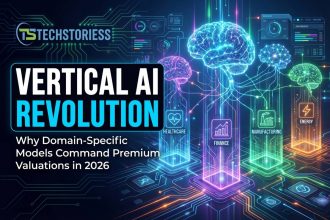
Horizontal AI tools – chat interfaces, productivity copilots, and generic assistants – demonstrated capability and captured attention. But enterprise-scale monetization requires something different: alignment with industry workflows, compliance structures, and domain constraints.
This forms the core of the vertical AI vs. horizontal AI comparison.
Horizontal AI typically offers:
- Broad use cases
- Generalized intelligence
- Lower switching costs
- High competition
Vertical AI typically offers:
- Domain-embedded workflows
- Regulatory alignment
- Proprietary data advantages
- Higher defensibility
General models can answer prompts and draft emails. But automatically adjudicating insurance claims under jurisdiction-specific regulations demands deep domain tuning. They can summarize legal documents. But safely advising on case law without structured validation requires curated legal corpora and compliance safeguards.
The premium emerges where models move from assistance to decision infrastructure.
Why Smaller, Domain-Specific Models Are Winning
A structural shift is underway. In several enterprise benchmarks, smaller reasoning models optimized for specific domains outperform larger general-purpose models on industry tasks.
Why?
Because performance is not merely about parameter count. It is about:
- Data alignment
- Domain constraints
- Structured reasoning requirements
- Regulatory precision
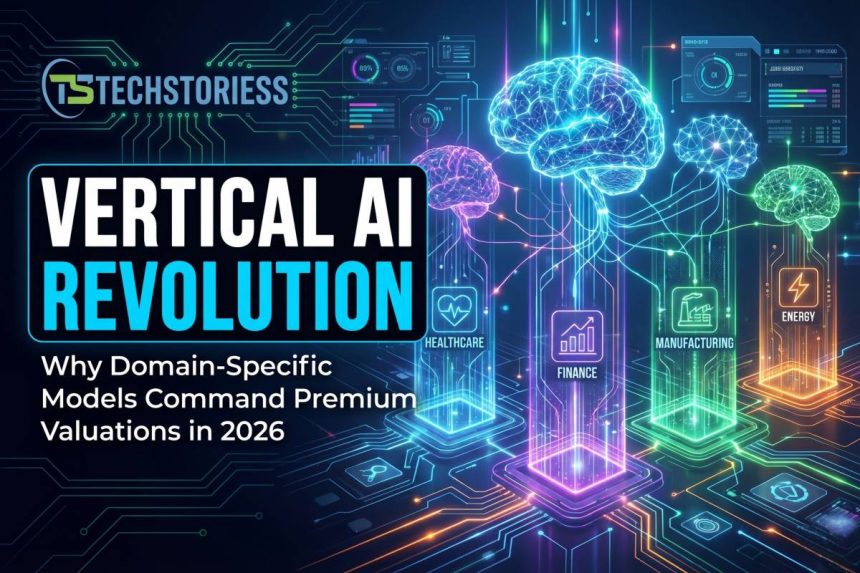
For instance, in healthcare AI, diagnostic support systems must operate within medical ontologies and coding standards. A general chatbot may provide medically plausible answers. A domain-specific AI trained on curated clinical datasets can integrate with electronic health records, reference peer-reviewed research, and adhere to compliance mandates.
The same principle applies in legal AI. The expanding legal AI market reflects strong demand for contract review, litigation analysis, and regulatory compliance automation. Law firms and corporate legal departments require systems that understand jurisdiction-specific precedent and structured legal taxonomies.
Precision is monetizable.
Multi-Modal Models and Physics-Based Industry AI
Another frontier of industry AI models is multi-modal intelligence aligned with real-world physics.
NVIDIA has introduced multi-modal foundation models such as Cosmos, designed for physics-based simulation environments. These systems integrate vision, language, and physical modeling — critical for robotics, manufacturing, and industrial automation.
In sectors like aerospace, energy, and advanced manufacturing, AI must understand spatial constraints, material dynamics, and safety margins. This is not prompt engineering. It is an embedded simulation within operational environments.
Domain-specific AI in industrial settings benefits from:
- Digital twins
- Sensor fusion
- Simulation-based training
- Physics-constrained modeling
When AI minimizes prototyping cycles or reduces predictive maintenance failures, it generates immediate and measurable return on investment. That direct cost replacement underpins valuation premiums.
Healthcare AI: Clinical Precision and Compliance
One of the most promising vertical domains is healthcare AI.
Hospitals operate under stringent regulatory frameworks, reimbursement systems, and malpractice risk. By integrating with electronic health records and diagnostic imaging pipelines, AI systems can reduce administrative burden and improve clinical accuracy.
However, general models lack domain constraints. Healthcare AI requires:
- Curated clinical datasets
- Medical ontology alignment
- HIPAA-compliant deployment
- Structured reasoning under uncertainty
More focused, domain-optimized models often outperform general systems in tasks such as radiology triage or coding automation because they are tuned for clinical signal rather than broad linguistic coverage.
Capital continues to flow into vertical AI startups targeting healthcare workflows rather than generic conversational tools.
Legal AI: Structured Reasoning Under Regulation
Legal services are document-intensive and rule-bound.
The growing legal AI market signals strong demand for automated contract review, due diligence support, and compliance monitoring. Domain-specific AI models trained on structured case law and contract libraries can reduce review times dramatically.
Yet this vertical carries constraints:
- Jurisdictional variation
- Regulatory liability
- Auditability requirements
Purpose-engineered reasoning models for legal logic frequently outperform general systems in clause extraction, risk flagging, and precedent analysis. The value lies not in creativity, but in structured reliability.
Premium valuations follow recurring enterprise contracts and integration into governance pipelines.
Financial AI: Risk, Regulation, and Real-Time Decisioning
Financial institutions require AI that interprets structured data streams in real time while adhering to regulatory frameworks.
In financial AI, vertical specialization is essential for:
- Credit underwriting
- Fraud detection
- Portfolio risk modeling
- Compliance surveillance
General models lack embedded risk logic. Industry AI models trained on proprietary transaction datasets and stress-tested under regulatory simulations create measurable economic impact.
Valuation premiums reflect direct margin expansion. AI that reduces default rates or fraud exposure translates into quantifiable financial gain.
Synthetic Data and the Vertical Flywheel
Synthetic data is emerging as a cornerstone of domain-specific AI.
In regulated industries such as healthcare and finance, real-world data access is constrained by privacy laws and scarcity. Synthetic data environments enable safe model iteration without exposing sensitive records.
This creates a defensible flywheel:
- Vertical deployment
- Proprietary data capture
- Synthetic augmentation
- Improved model specialization
Each cycle strengthens competitive moats.
The Limits of Model-on-Model Bootstrapping
Rapid scaling has produced techniques such as model-on-model bootstrapping. The open-source ecosystem demonstrates that smaller models can be improved by training on outputs from larger systems.
However, experiments such as those popularized by DeepSeek illustrate the limits of this technique. While synthetic augmentation improves baseline reasoning, it cannot fully substitute for domain-grounded data or real-world validation.
Hallucinations are unacceptable in vertical markets. A healthcare AI cannot depend solely on synthetic training loops. A legal AI cannot cite fabricated precedent.
Bootstrapping accelerates experimentation. It does not eliminate domain constraints.
Why Vertical AI Commands Premium Multiples
There are structural reasons investors assign higher multiples to vertical AI companies:
Embedded Workflows
Domain-specific AI integrates directly into enterprise systems — EHR platforms, compliance software, trading engines — increasing switching costs.
Regulatory Alignment
Industry AI models are built around compliance frameworks from inception, reducing enterprise friction.
Proprietary Data Moats
Vertical players often access curated datasets unavailable to general AI firms.
Clear ROI Metrics
Unlike broad productivity tools, vertical AI can demonstrate cost savings, revenue uplift, or risk reduction within defined business units.
In 2026, capital markets reward measurable economics over abstract capability.
Vertical AI vs. Horizontal AI: The Capital Perspective
When analyzed through capital allocation, the vertical AI vs. horizontal AI dynamic becomes clearer.
Horizontal AI often faces:
- High research costs
- Rapid commoditization
- Intense price competition
Vertical AI more often exhibits:
- Focused domain R&D
- Premium enterprise pricing
- Durable contracts
As general models commoditize, value migrates upward into distribution layers and downward into specialized execution layers. The middle — generalized capability without domain embedding — faces compression.
Capital Cycles, Margin Stacking, and the Next Phase of AI Allocation
With AI value chain maturing, capital allocation is becoming more disciplined. The early phase of the cycle rewarded exposure — companies associated with AI, regardless of positioning, benefited from narrative momentum. The next phase rewards structural positioning within the stack.
Three dynamics are beginning to define returns.
Enterprise Procurement Is Becoming Rational
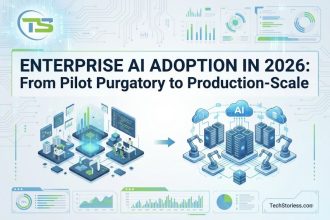
Enterprise buyers have already started shifting from experimentation to procurement discipline. In 2023 and 2024, many organizations funded pilot programs across multiple AI vendors. By 2026, CFO scrutiny is tighter. AI budgets must tie directly to measurable cost savings, revenue expansion, or risk reduction.
This transition favors:
- Vendors with clear integration pathways
- Platforms that reduce operational complexity
- Solutions embedded in existing compliance frameworks
- Providers able to offer multi-year contractual certainty
It disfavors standalone tools that require workflow redesign without demonstrable efficiency gains.
The procurement shift also accelerates consolidation pressure. Enterprises prefer fewer vendors with broader capabilities rather than fragmented tool stacks. This dynamic advantages hyperscalers, major enterprise software platforms, and vertical AI firms that deeply integrate into industry systems.
Regulation as a Structural Variable
Regulation is not a peripheral concern. It is a structural factor within the AI value chain.
In Europe, risk-based regulatory frameworks impose stringent obligations on high-impact AI systems. In the United States, sector-specific oversight continues to evolve across healthcare, finance, and consumer protection. In Asia, sovereign AI initiatives are accelerating domestic infrastructure investment.
Regulation affects:
- Data governance requirements
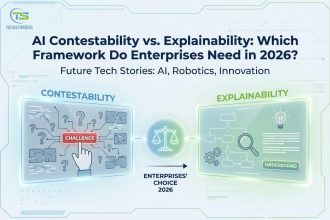
- Model transparency and auditability
- Cross-border data flows
- Liability allocation
By designing compliance into their architecture from inception, companies can reduce friction in enterprise sales cycles. Vertical AI firms, particularly in healthcare and finance, often treat regulation as a feature rather than a constraint.
Over time, regulatory clarity may entrench incumbents who can absorb compliance costs, while smaller competitors struggle with certification and audit burdens.
Labor, Productivity, and Distribution Effects
AI’s long-term impact extends beyond corporate margins to labor economics.
In knowledge industries, AI is increasingly automating first-pass analysis, drafting, and triage. Human professionals shift toward oversight, judgment, and exception handling. This reallocation alters cost structures within law firms, consultancies, financial institutions, and healthcare providers.
The distribution of gains will vary:
- Infrastructure providers capture capital-intensive returns.
- Platform companies capture recurring subscription revenue.
- Enterprises capture productivity improvements.
- Labor markets adjust through task reallocation rather than wholesale replacement.
Investors need to assess which segments convert productivity gains into retained margins versus passing savings to customers.
Geographic Realignment of the Stack
The AI value chain is also reshaping global industrial geography.
Semiconductor fabrication remains concentrated in East Asia. Data center expansion is accelerating in North America and parts of Europe. Sovereign cloud initiatives are expanding in the Middle East and Asia-Pacific. Energy availability increasingly influences data center siting decisions.
Geopolitical tensions reinforce supply chain diversification. Governments view AI infrastructure as strategic capacity rather than purely commercial investment. Subsidies, export controls, and industrial policy increasingly shape competitive positioning.
Companies aligned with national infrastructure priorities may benefit from policy tailwinds. Those exposed to cross-border restrictions may face volatility.
Conclusion
AI is fast evolving from a single investment theme to a layered industrial system where capital flows unevenly across energy, semiconductors, cloud infrastructure, models, and vertical applications.
With the maturing cycle, returns will concentrate in structurally advantaged layers — those controlling bottlenecks, embedding deeply into enterprise workflows, or converting intelligence into measurable economic gains.
So we can see that AI is fast expanding. The question is where within the value chain durable pricing power, recurring revenue, and capital efficiency converge. That is where long-term value compounds .