


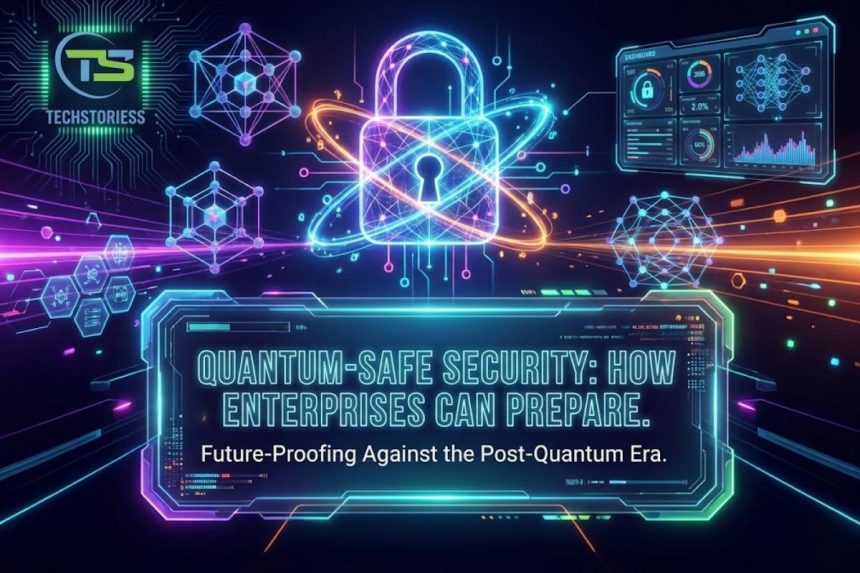
Digital trust depends on encryption. Every online transaction, cloud workload, financial exchange, and secure government communication relies on cryptographic systems designed decades ago. These systems—especially RSA and elliptic curve cryptography—were built on mathematical assumptions that classical computers cannot efficiently break within feasible timeframes.
- Quantum-Safe Cryptography: A Clear Enterprise Definition
- NIST Post-Quantum Standards: The 2024 Breakthrough
- Enterprise Adoption Trends: Market Signals Are Clear
- Regulatory & National Security Mandates Accelerating Change
- Enterprise Risk Assessment: Where Are You Most Vulnerable?
- Migration Strategy: Implementing Quantum-Resistant Algorithms Enterprise-Wide
- Technical Considerations: Performance, Scalability & Integration
- Business Impact: Cost of Delay vs Strategic Advantage
- The Road to Post Quantum Encryption 2026 and Beyond
- What Is Quantum Safe Cryptography?
- NIST Post-Quantum Standards: The 2024 Milestone
- The “Harvest Now, Decrypt Later” Threat
- Enterprise Risk Assessment: Where Are You Exposed?
- Gartner Forecast: Why 2025 Became a Strategic Inflection Point
- NSA Mandate: The 2030 Hard Stop
- Migration Strategy: What Enterprises Must Do Now
- Update Vendor Contracts
- Develop a Phased Roadmap (2025–2030)
- Performance & Practical Challenges
- Real-World Comparison: RSA-2048 vs CRYSTALS-Kyber
- Conclusion
However, quantum computing fundamentally challenges that assumption. As quantum research accelerates, quantum safe cybersecurity is no longer an academic concern—it has become a strategic imperative for enterprise risk management.
The year 2026 signals a visible inflection point. As standards are finalized and regulatory timelines approach, enterprise boards, CISOs, and risk committees must now understand quantum safe cryptography and why it requires architectural planning today.
Quantum-Safe Cryptography: A Clear Enterprise Definition
Quantum-safe cryptography refers to cryptographic algorithms specifically designed to remain secure against both classical and quantum attacks. Unlike RSA or ECC, post-quantum cryptography (PQC) relies on mathematical problems believed to resist quantum algorithms such as Shor’s algorithm. These include lattice-based, hash-based, and code-based cryptographic constructions.
For enterprises, quantum resistant algorithms enterprise deployment is far more complex than replacing a cipher suite. It requires rethinking key exchange mechanisms, digital signatures, firmware security, secure boot processes, and cloud authentication models.
The shift to post quantum encryption 2026 represents a structural modernization of cryptographic infrastructure.
Core principles
- PQC protects against both classical and quantum adversaries.
- Algorithm agility is a critical architectural requirement for long-term adaptability.
- Enterprise cryptography is deeply embedded across applications, devices, and protocols.
- Migration requires phased, hybrid implementation to minimize operational disruption.
To ensure a smooth transition, standardization plays a foundational role.
NIST Post-Quantum Standards: The 2024 Breakthrough
The first set of NIST post-quantum standards was released in 2024, marking a historic milestone in modern cryptography. These included CRYSTALS-Kyber for key establishment and CRYSTALS-Dilithium for digital signatures. This formalized the shift from research experimentation to enterprise-grade implementation.
Standardization provides clear guidance on which quantum-resistant algorithms to deploy. It enables vendors, governments, and enterprises to align roadmaps and accelerate ecosystem-wide adoption. The NIST process matured over several years through global peer review, open cryptanalysis, and rigorous performance benchmarking—making these standards foundational to quantum-safe cybersecurity strategies worldwide.
Why this matters:
- CRYSTALS-Kyber replaces vulnerable RSA/ECC key exchange mechanisms.
- CRYSTALS-Dilithium secures digital signatures against quantum attacks.
- Standardization enables vendor interoperability and ecosystem alignment.
- With validated standards available, enterprises can now confidently initiate migration planning.
With clear standards established, adoption trends have accelerated.
Enterprise Adoption Trends: Market Signals Are Clear
Gartner research indicates that nearly half of global enterprises initiated PQC preparedness programs by 2025. Cryptographic upgrades demand long-term planning and dedicated capital allocation. Meanwhile, major technology vendors are embedding hybrid PQC capabilities into TLS libraries, hardware security modules (HSMs), and cloud platforms.
IBM’s projections and Gartner’s forecasts demonstrate that quantum-safe cybersecurity is no longer speculative foresight. It has transitioned into operational risk planning with defined budget lines and governance oversight. Enterprises that delay action risk being forced into accelerated migrations under compressed regulatory and vendor-imposed timelines.
Adoption drivers
- Board-level cybersecurity risk governance discussions are increasing.
- Vendor roadmaps align with NIST post-quantum standards.
- Industry pilots integrate hybrid classical + PQC encryption models.
- Proactive security posture provides competitive differentiation.
Regulatory mandates are further accelerating this shift.
Regulatory & National Security Mandates Accelerating Change
Government directives are actively shaping enterprise timelines. The U.S. National Security Agency (NSA) has mandated quantum-resistant cryptography transition milestones for national security systems by 2030. Such mandates cascade through defense contractors, federal suppliers, and global technology ecosystems.
Compliance obligations and national security directives are transforming post quantum encryption 2026 into a supply chain requirement. Organizations supporting federal systems must align with PQC standards or risk exclusion from procurement eligibility.
Policy impact
- 2030 milestones create hard compliance deadlines.
- Defense and aerospace sectors face accelerated transition timelines.
- Supply chain security requirements extend beyond federal agencies.
- Regulatory signals influence global cybersecurity norms.
Mandates are shifting quantum-safe migration from theoretical preparation to structured enterprise risk assessment.
Enterprise Risk Assessment: Where Are You Most Vulnerable?
One of the major challenges is visibility. Most enterprises lack a comprehensive inventory of cryptographic assets. RSA keys are embedded in VPN gateways, IoT firmware, cloud APIs, identity providers, code signing certificates, and database encryption modules. Without full cryptographic visibility, migration cannot be prioritized effectively.
Organizations must identify systems that store long-lived sensitive data, especially in sectors such as healthcare, finance, intellectual property, and government services. IBM’s 10-year quantum projection and NSA’s 2030 mandate make proactive vulnerability mapping essential.
Risk priorities
- Identify RSA/ECC dependencies across infrastructure.
- Assess data retention horizons exceeding 5–10 years.
- Evaluate third-party and vendor cryptographic dependencies.
- Prioritize high-value systems for early PQC deployment.
A thorough assessment directly informs an execution strategy aligned with risk tolerance and regulatory timelines.
Migration Strategy: Implementing Quantum-Resistant Algorithms Enterprise-Wide
Crypto agility is the foundational requirement for effective migration. In practical terms, crypto agility refers to the architectural capability to replace or upgrade cryptographic algorithms without system-wide redesign.
Hybrid deployment models—combining classical cryptography with CRYSTALS-Kyber during transition phases—allow backward compatibility while strengthening the security posture against future quantum threats.
To ensure operational continuity, enterprises should phase migration according to data sensitivity and system criticality, aligning implementation with 2026 strategic checkpoints and 2030 regulatory milestones. This structured rollout ensures business continuity while advancing quantum resistant algorithms enterprise adoption.
Execution roadmap
- Conduct cryptographic inventory and dependency mapping.
- Implement hybrid TLS supporting PQC algorithms.
- Establish governance for algorithm lifecycle management.
- Align upgrades with vendor ecosystem and compliance timelines.
More than technical execution, performance and scalability considerations must also be evaluated as part of enterprise-wide PQC transformation.
Technical Considerations: Performance, Scalability & Integration
PQC algorithms often involve larger key sizes and signature payloads that increase computational and bandwidth overhead compared to classical cryptography. CRYSTALS-Kyber and CRYSTALS-Dilithium are engineered for practical efficiency, but enterprises must rigorously test scalability across distributed cloud and hybrid environments to ensure latency, throughput, and user experience remain within acceptable thresholds.
Enterprises may encounter several integration challenges, including certificate lifecycle management adjustments, hardware acceleration compatibility, firmware constraints, and interoperability between classical and PQC systems. To accurately validate performance impact, testing environments must simulate production-scale workloads rather than isolated lab conditions.
Technical checkpoints
- Evaluate key size, handshake overhead, and bandwidth implications.
- Test performance under peak enterprise traffic loads.
- Ensure compatibility with hardware security modules (HSMs) and secure enclaves.
- Conduct phased pilot deployments before full-scale rollout.
These technical decisions directly influence operational stability and long-term business outcomes.
Business Impact: Cost of Delay vs Strategic Advantage
Encryption failure could result in catastrophic financial and reputational consequences. A sudden compromise of RSA-based trust infrastructure could disrupt core digital services such as online banking, payment gateways, e-commerce transactions, secure communications, and digital identity verification at scale. Early adoption of quantum-safe cybersecurity mitigates systemic risk while reinforcing stakeholder confidence.
Investors, regulators, and insurers increasingly evaluate long-term cyber resilience as part of enterprise risk assessment. Organizations demonstrating proactive PQC adoption may benefit from reduced compliance friction, stronger insurance positioning, and enhanced market trust.
Strategic benefits
- Reduced risk of emergency cryptographic overhauls.
- Improved investor and customer confidence.
- Alignment with evolving cyber insurance and regulatory expectations.
- Competitive differentiation through proactive infrastructure modernization.
The transition ultimately defines long-term resilience in the quantum era.
The Road to Post Quantum Encryption 2026 and Beyond
The path forward requires clearly defined and structured milestones. By the end of 2026, enterprises should complete comprehensive cryptographic inventories, initiate hybrid deployments, and align vendor ecosystems with NIST standards. Full alignment with national security mandates should be achievable before the end of this decade.
Quantum computing capabilities will continue advancing beyond these checkpoints. Therefore, quantum-safe cybersecurity must not be treated as a one-time migration project. It must evolve into a permanent architectural discipline embedded within enterprise security governance and technology strategy.
Milestone outlook
- 2026: Hybrid PQC deployment across critical systems.
- 2027–2028: Enterprise-wide crypto-agility maturity and vendor alignment.
- 2030: Compliance with NSA PQC adoption mandates.
- Beyond 2030: Continuous adaptation to evolving quantum capabilities.
What Is Quantum Safe Cryptography?
In simple terms, post-quantum cryptography (PQC) refers to cryptographic algorithms engineered to resist attacks from both classical and quantum computers.
Current encryption systems rely on mathematical problems that are extremely difficult for classical computers:
- RSA relies on integer factorization.
- ECC relies on the discrete logarithm problem.
However, these problems can be solved dramatically faster using Shor’s Algorithm on a sufficiently powerful quantum computer. If such systems become viable at scale, much of today’s public-key infrastructure would become vulnerable.
This is why enterprise environments must adopt quantum resistant algorithms enterprise-wide that are based on mathematical foundations believed to withstand quantum attacks, including:
- Lattice-based cryptography
- Hash-based signatures
- Code-based cryptography
- Multivariate polynomial cryptography
NIST Post-Quantum Standards: The 2024 Milestone
In 2024, the National Institute of Standards and Technology (NIST) formally introduced its first set of post-quantum cryptography standards—widely regarded as a historic turning point in cybersecurity.
NIST finalized two primary algorithms:
- CRYSTALS-Kyber – for encryption and key establishment
- CRYSTALS-Dilithium – for digital signatures
These standards are designed to replace RSA and ECC in most enterprise applications.
Why does this matter?
- Enterprises now have standardized and extensively reviewed quantum-resistant algorithms.
- Vendors can begin large-scale integration with confidence.
- Compliance frameworks will increasingly reference PQC standards.
- Procurement decisions will begin requiring PQC readiness.
By removing uncertainty from the standardization phase, the industry can now shift decisively toward execution and deployment.
The “Harvest Now, Decrypt Later” Threat
Contrary to common belief, quantum threats are not distant concerns—they are already influencing adversarial strategies.
Attackers may be collecting encrypted data today with the intention of decrypting it later once quantum capabilities mature. This is particularly dangerous for industries requiring long-term confidentiality:
- Government intelligence communications
- Financial contracts and transaction archives
- Intellectual property repositories
- Legal records and classified documentation
If quantum systems capable of breaking RSA-2048 emerge within a decade, encrypted data intercepted today could be exposed retroactively.
This is precisely why post quantum encryption 2026 strategies must begin now—not after a public cryptographic failure.
Enterprise Risk Assessment: Where Are You Exposed?
Before migration, enterprises must understand their cryptographic dependencies. Most organizations lack full visibility into how deeply encryption is embedded across their digital ecosystem:
- TLS certificates
- VPN gateways
- Secure email systems
- Identity and access management platforms
- API authentication layers
- Cloud workload encryption
- IoT firmware signatures
- Software update mechanisms
- Blockchain systems
The first step is developing a comprehensive cryptographic inventory. Without visibility, migration prioritization is impossible.
Gartner Forecast: Why 2025 Became a Strategic Inflection Point
Industry forecasts indicate that approximately 50% of enterprises began preparing for PQC transitions by 2025.
This signals two realities:
- Early adopters gain strategic resilience and competitive trust positioning.
- Late movers face elevated regulatory, operational, and reputational risk.
By 2026, post quantum encryption readiness is increasingly embedded into procurement requirements across sectors such as banking, defense, telecommunications, and cloud services.
The migration window is narrowing faster than many CISOs initially expected.
NSA Mandate: The 2030 Hard Stop
According to the U.S. National Security Agency (NSA), quantum-resistant cryptography transition milestones must be met by 2030 for national security systems.
This mandate sets a global precedent.
Historically, U.S. federal cryptographic transitions have influenced:
- Global compliance standards
- Defense contractor security requirements
- International cybersecurity regulations
- Enterprise vendor product roadmaps
For organizations interacting with federal systems, defense supply chains, or critical infrastructure, 2030 is not simply a target year for experimentation with PQC.
It represents a hard compliance milestone.
Migration Strategy: What Enterprises Must Do Now
Quantum safe cybersecurity is far more than a “lift-and-shift” upgrade. It demands structured, multi-year transformation.
Conduct a Cryptographic Inventory
Identify:
- All public-key cryptography implementations
- Certificate authorities currently in use
- Hardware dependencies (HSMs, TPMs, secure enclaves)
- Third-party vendor cryptographic dependencies
Without a comprehensive inventory, prioritization is impossible.
Adopt Crypto-Agility
Crypto-agility means architecting systems so cryptographic algorithms can be replaced without redesigning entire infrastructures.
Without crypto-agility, every future cryptographic change becomes a disruptive IT overhaul rather than a controlled update.
Pilot NIST-Approved Algorithms
Begin controlled testing of:
- CRYSTALS-Kyber
- CRYSTALS-Dilithium
Evaluate:
- Performance impact
- Key and signature size implications
- Latency overhead
- Compatibility with legacy systems
Hybrid deployments (classical + PQC) can help maintain backward compatibility during transition.
Update Vendor Contracts
Ensure vendors commit to:
- Alignment with NIST post-quantum standards
- Clear timelines aligned with post quantum encryption 2026 planning
- Transparent PQC integration roadmaps
Vendor readiness will directly affect enterprise migration speed.
Develop a Phased Roadmap (2025–2030)
A typical enterprise roadmap may include:
- 2025: Assessment and pilot testing
- 2026–2027: Hybrid cryptographic deployments in critical systems
- 2028–2029: Gradual deprecation of RSA/ECC in high-risk environments
- 2030: Broad PQC implementation aligned with compliance milestones
Structured planning prevents emergency migrations under crisis conditions.
Performance & Practical Challenges
Quantum resistant algorithms enterprise teams must understand that PQC adoption introduces practical friction. Common challenges include:
- Larger public keys and signature sizes
- Increased bandwidth consumption during handshake processes
- Potential performance trade-offs in high-throughput environments
- Hardware acceleration compatibility issues
- Certificate lifecycle management complexity
While these challenges can complicate crypto-agile transformation, the cost of inaction is significantly greater.
IBM research scenarios suggest that waiting until quantum systems reach cryptographically relevant scale could force migration under breach-response conditions rather than strategic control.
Real-World Comparison: RSA-2048 vs CRYSTALS-Kyber
IBM researchers have published projections outlining scenarios in which sufficiently advanced quantum systems could break RSA-2048 within the next decade. Meanwhile, industry analyses suggest that nearly half of large enterprises initiated PQC readiness efforts by 2025. The urgency is reinforced by the U.S. National Security Agency (NSA), which has mandated PQC adoption milestones by 2030.
Security Basis: RSA-2048 depends on the mathematical difficulty of integer factorization. CRYSTALS-Kyber on the other hand is based on lattice-based cryptography.
Quantum Vulnerability: RSA-2048 is vulnerable to quantum attacks through Shor’s Algorithm once sufficiently powerful quantum computers emerge. CRYSTALS-Kyber can efficiently defend against sophisticated quantum attacks under current research assumptions.
Standardization Status: RSA has long been standardized and widely deployed while CRYSTALS-Kyber was formally standardized by NIST in 2024 as part of the first post-quantum cryptography standards.
Enterprise Adoption: RSA-2048 is deeply embedded across global enterprise infrastructure today. CRYSTALS-Kyber adoption is emerging as organizations begin phased PQC migration.
Future Viability: in a quantum enabled digital world RSA-2048 has limited long-term viability. CRYSTALS-Kyber is considered highly viable for future-proof encryption under current cryptanalytic understanding.
This doesn’t just represent an incremental optimization. It is an architectural replacement of core trust infrastructure.
Board-Level Implications
Quantum-safe migration extends far beyond purely technical execution.
It directly impacts:
- Regulatory compliance posture
- Cyber insurance underwriting assessments
- M&A cybersecurity due diligence
- Long-term digital trust architecture
- National security alignment for critical sectors
Boards are increasingly asking a strategic governance question: “If quantum computing compromises encryption within the next decade, what actions are we taking today?”
Enterprises without a documented PQC roadmap risk heightened governance scrutiny and stakeholder concern.
Conclusion
Quantum computing is steadily advancing. Standards are finalized. Government mandates are defined. Enterprise planning has accelerated.
This represents an inevitable structural shift toward quantum resistant algorithms enterprise environments must deploy. Post quantum encryption 2026 is no longer optional—it is a resilience checkpoint.
Early adopters will gain strategic stability and trust advantage over delayed responders. The question is no longer whether quantum will disrupt cryptography.
The question is whether your enterprise will be prepared when it does.