


Your teams devoted hours and days to deploy fast. They used the best of their technical skills to automate pipelines. They erased the line between dev and ops. And then—somewhere between your complex stack and your layered dashboards—something quietly broke. No. It wasn’t the tooling, it was the cognitive contract between developers and their infrastructure.
- What actually changed between 2022 and 2026
- Platform engineering vs DevOps: not a replacement, a refinement
- The IDP implementation framework: a phased enterprise roadmap
- Beyond just a tooling upgrade platform engineering is a strategic business transformation
- Where DevOps goes from here: evolution, not extinction
- Measuring IDP success: the metrics that matter in 2026
- The bottom line for 2026 enterprise engineering leaders
Instead of “owning” the stack, developers were spending around half of their week struggling with platform concerns: configuring cloud resources, debugging CI pipelines, managing secrets, chasing approvals. It quietly turned the promise of DevOps — faster software, happier engineers — into recurring platform issues and developer’s struggle.
This pressure is fast driving the 2026 enterprise shift toward platform engineering internal developer platforms (IDPs). This approach recognizes that DevOps is not a destination, but a starting point towards productizing the developer experience — that you must treat your developer experience as a product to take the next leap.
Here are some of the relevant stats indicating how this shift is impacting the industry:
- 78%the DevOps primitives of Fortune 500 firmsthe DevOps primitives have a dedicated platform engineering team by 2026 (Gartner)
- 4.5× faster feature delivery reported after IDP implementation (DORA 2025 Report)
- 40% drop in cognitive load on dev teams post-IDP rollout (Humanitec State of IDP 2025)
What actually changed between 2022 and 2026
The 2022 to 2026 phase of evolution in DevOps wasn’t a single inflection point. It was a holistic organizational scaling and operational complexity pressure. To understand why internal developer platforms are now board-level conversations you need to identify the four forces that made platform engineering inevitable.
Cognitive load became a performance metric
For the first time cognitive load was introduced as a formal engineering performance indicator in Google’s DORA 2025 Report. It revealed a critical insight: teams operating under high cognitive load—regardless of tooling efficiency—delivered software at nearly half the frequency of those with lower cognitive load. DevOps, ironically, had been adding to that load.
The ‘you build it, you run it’ model hit a ceiling
At 20 engineers full-stack ownership worked excellently. At 200, it introduced chaos — every product team was independently solving the same infrastructure problems without any shared abstractions, paved paths, and exponential effort duplication. According to The Humanitec State of IDP 2025 survey the enterprises with over 150 engineers spent an average of 31 hours per developer per month on undifferentiated platform work. This leads to slower release velocity, architectural fragmentation, and increased operational overhead.
Platform engineering internal developer platforms matured into products
Early IDPs were just a bit more efficient than internal wikis and Helm chart repos — loosely integrated tooling without a cohesive developer experience or ownership model. By 2025, tools like Backstage, Port, and Cortex had evolved the concept of developer experience platforms into genuine products with complete self-service ecosystems including service catalogs, golden path templates, automated workflows, and real-time infrastructure visibility. The industry’s response has been highly encouraging too — for instance, tools like Backstage got adopted by over 3,000 organizations as per the CNCF Annual Survey 2024.
Regulatory and compliance complexity demanded abstraction
As compliance frameworks and standards like SOC 2, ISO 27001, and FedRAMP controls are now expected as default infrastructure behavior rather than audit-time additions, enterprises needed a robust layer that could enforce policy, manage secrets, and automate compliance evidence — automatically, at deploy time. That layer is the IDP.
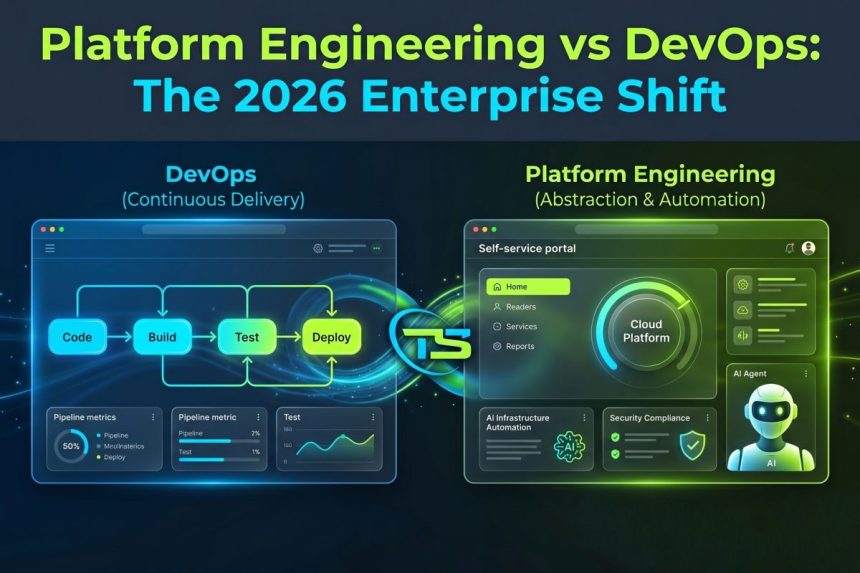
Platform engineering vs DevOps: not a replacement, a refinement
When this debate is framed as “DevOps vs platform engineering” it creates a false choice that actually distracts enterprise teams from the real decision. For the reasonable enterprise engineering leader, it should be framed as: where does DevOps responsibility live, and at what layer of abstraction should developers operate?
In 2026, the DevOps evolution
In 2026, the DevOps evolution isn’t about abandoning what originally worked — it’s about acknowledging that DevOps principles like collaboration, automation, and shared ownership are best produced through a reliable platform product that teams consume and extend, not a methodology that every team independently reimplements.
The IDP implementation framework: a phased enterprise roadmap
A number of enterprise platform engineering initiatives fail as they treat IDP implementation as an infrastructure project. In fact, an IDP is a product with your developers as the key users. It has a proper roadmap, well-defined adoption metrics. More than just engineering execution it requires a reliable product management discipline.
Let us explore the detailed framework reflecting patterns from Spotify’s original Backstage build, Netflix’s Paved Roads initiative, and Airbnb’s developer platform work. It is properly distilled into a well-phased roadmap applicable to enterprises with 100 to 10,000 engineers.
Phase 1: Foundation
Timeline : Months 1–3
Key Actions & Outcomes: Audit developer toil (measure hours lost to undifferentiated platform work). Identify the top 5 pain points. Appoint a Platform Product Manager. Select your IDP framework (Backstage recommended for >500 devs; Port or Cortex for faster start). Establish platform team charter.
Phase 2: Paved Paths
Timeline: Months 4–6
Key Actions & Outcomes: Build 3–5 golden path templates covering your most common workloads (e.g., microservice in Kubernetes, serverless function, data pipeline). Integrate with existing CI/CD. Launch self-service environment provisioning. Target: 30% reduction in time-to-first-deploy for new services.
Phase 3: Service Catalog
Timeline: Months 7–9
Key Actions & Outcomes: Deploy a software catalog covering all production services. Implement ownership metadata, SLO tracking, and dependency mapping. Integrate runbooks and on-call context. Target: 100% service ownership visibility across the org.
Phase 4: Policy & Compliance
Timeline: Months 10–12
Key Actions & Outcomes: Implement policy-as-code for security controls, secrets management, and compliance evidence generation. Automate SOC 2 / ISO 27001 control mappings. Integrate cost attribution per service. Target: compliance evidence generation time cut by 60%.
Phase 5: Scale & Measure
Timeline: Month 13+
Key Actions & Outcomes: Launch developer NPS and platform adoption dashboards. Implement SPACE framework metrics (Satisfaction, Performance, Activity, Communication, Efficiency). Expand golden paths to cover 80%+ of new service types. Begin platform reliability SLAs.
Implementation warning:
Most organizations focus on building without measuring which is the most common IDP implementation failure. So, it is crucial to establish your baseline before writing a line of platform code: define the key metrics like hours per developer per week lost to platform toil, time-to-first-deploy for new services, and developer satisfaction score. These numbers define success — and justify the investment to leadership.
Beyond just a tooling upgrade platform engineering is a strategic business transformation
In 2026, enterprises must perceive platform engineering internal developer platforms are not an engineering cost center. It is a developer experience platform investment with a measurable return on strategic capability.
An engineering blog published on Shopify website documented a 60% reduction in time spent on infrastructure concerns after deploying their internal developer platform, with a corresponding 35% increase in feature throughput over 18 months. According to Zalando, whose Sunrise IDP now serves 2,000+ engineers, the platform investment pays back in roughly 9 months through reduced toil alone — before accounting for faster time-to-market.
These aren’t outliers. The DORA 2025 Report notices that elite-performing engineering organizations — those in the top quartile for deployment frequency and stability — are 2.3× more likely to have a centralized platform team than low-performing organizations. It indicates a statistically robust correlation between IDP maturity and engineering performance.
The CFO conversation
According to Gartner’s 2025 report, Enterprise platform engineering budgets average $2.1M annually for a 500-engineer organization. Against an estimated 31 hours/developer/month of recovered toil — valued at fully-loaded developer cost — the ROI calculation for a 500-person engineering org typically reaches breakeven within 14 months.
The board conversation
Developer experience platforms have evolved as a talent retention lever. In a 2025 State of Software Engineers survey by Hired, 67% of senior engineers cited “quality of internal tooling and developer experience” as a top-three factor in employment decisions — ranking above salary in the 35–44 age cohort. Building platform engineering internal developer platforms doesn’t just buy efficiency. These platforms help in buying the ability to recruit and keep the engineers who build the products that generate revenue.
Where DevOps goes from here: evolution, not extinction
In 2026 DevOps evolution narrative is not a eulogy. DevOps principles — CI/CD automation, infrastructure as code, blameless postmortems, shared observability — serve as the bedrock that platform engineering is built on. The discipline isn’t disappearing; it’s being absorbed into the platform layer and productized.
What changes is the locus of responsibility. In the emerging model, the DevOps primitives are owned by your platform team — the pipelines, the Kubernetes platform, the observability stack, the secrets management, the deployment patterns. Product engineering teams consume those primitives through the IDP. They gain the benefits of mature DevOps practice without bearing the cognitive cost of maintaining it.
This is the robust organizational model that companies like Netflix, LinkedIn, and Mercado Libre have operated at scale for years. In 2026, this model has been democratized- accessible to any enterprise willing to treat developer experience as a product discipline rather than an IT cost.
Key distinction:
Rather than removing the DevOps ownership from developers the Platform engineering removes DevOps toil. Developers still act as the owners of their services end-to-end — they simply build on a platform that handles the undifferentiated complexity, so ownership becomes an asset rather than a burden.
Measuring IDP success: the metrics that matter in 2026
Adoption is the key decisive factor when it comes to Developer experience platforms — which is driven entirely by whether developers find them genuinely useful. The metrics framework below combines DORA, SPACE, and platform-specific KPIs into a measurement system that communicates value to both engineering and business stakeholders.
- Developer NPS (dNPS): Monthly pulse survey on platform satisfaction. Target: >40. Baseline before launch, track monthly post-rollout.
- Time-to-first-deploy: How long does it take a new service to reach production for the first time? Elite benchmark: under 4 hours.
- Platform adoption rate: % of new services created via IDP golden paths vs. manual bootstrapping. Target: >70% within 12 months of launch.
- Toil reduction index: Hours/developer/week spent on undifferentiated platform work. Baseline this before launch; track quarterly.
- Self-service success rate: Total percentage of platform requests completed without a support ticket or platform team intervention. Target: >85%.
- Deployment frequency (DORA): Track at org level pre- and post-IDP. Expect meaningful uplift within 6–9 months of Phase 2 completion.
The bottom line for 2026 enterprise engineering leaders
The conversation surrounding platform engineering internal developer platforms is not really about platforms. It’s about what your organization believes software delivery is worth.
Platform engineering reframes the entire problem. Every hour that an engineer loses to infrastructure over product is a choice. Every team that rediscovers configs, controls, and pipelines multiplies this choice. Platform engineering is the decision to stop making it.
The DevOps evolution 2026 precisely fits this scenario — leading engineering organizations are proactively centralizing the complexity, productizing the paved paths, and measuring developer experience with the same rigor they apply to customer experience. Practices like IDP implementation frameworks, developer experience platforms, and concrete phased roadmaps are no longer just theoretical constructs, but they separate the organizations that can ship at the speed of the market from those that are perpetually catching up.
Instead of passively waiting for the perfect architecture, your competitors are actively shipping on good-enough platforms that get incrementally better every quarter. So, to stay ahead in the market you simply can’t afford to delay platform engineering adoption and IDP investments into 2027.