


Quantum computing discussions have silently shifted from speculative research to operational urgency. Once considered a long-term cryptographic concern, quantum computing is now being reframed as a present-day risk management problem—especially for enterprises handling long-lived sensitive data. Beyond triggering technological progress, it is also actively influencing regulatory alignment and standardization frameworks. The National Institute of Standards and Technology formalized post-quantum cryptographic standards in 2024. Policy frameworks like NSM-10 are accelerating federal and enterprise readiness. As a result, organizations are transitioning from passive observation to proactive preparedness.
- What Actually Changed in 2024: From Theory to Standards
- The Risk Reality: RSA Is Living on Borrowed Time
- Cost vs Risk: The Decision Is Not Binary
- The 90-Day Post-Quantum Cryptography Migration Checklist
- Real-World Use Cases: Where PQC Becomes Non-Negotiable
- Implementation Challenges: The Reality CISOs Must Navigate
- Global Compliance Momentum Is Accelerating
- The 2026–2030 Outlook: From Optional to Mandatory
- Conclusion
However, this urgency is not fully reflected in current enterprise discussions. The focus still leans heavily toward algorithms rather than real-world execution. This creates an open strategic gap for CISOs: what exactly should be done now, within realistic enterprise constraints? This article bridges that gap with a practical, vendor-neutral, 90-day post quantum cryptography migration checklist enterprise leaders can act on immediately.
What Actually Changed in 2024: From Theory to Standards
The most significant development came with the National Institute of Standards and Technology finalizing three foundational standards in August 2024:
- FIPS 203 — designed for secure key exchange (based on Kyber)
- FIPS 204 — focused on digital signatures (Dilithium)
- FIPS 205 — hash-based signatures for high assurance
More than just an academic milestone, this signaled cryptographic directionality. For the first time, organizations have a standardized path forward for implementing quantum-safe encryption enterprise strategies. The formalization of these standards has triggered a measurable shift in industry response. Vendors, cloud providers, and infrastructure platforms are aligning around these standards, even if full ecosystem maturity is still evolving.
However, enterprises still fail to recognize a critical nuance: standardization does not mean immediate large-scale deployability. Real barriers such as performance trade-offs, interoperability gaps, and legacy dependencies still need to be addressed. This creates a clear need for phased migration planning.
The Risk Reality: RSA Is Living on Borrowed Time
A deeper examination of the RSA encryption quantum threat timeline reveals the urgency behind early preparation. Current public-key systems like RSA and ECC rely on mathematical problems that are computationally infeasible for classical computers but can be efficiently solved by sufficiently advanced quantum systems using algorithms like Shor’s algorithm. Rapid advancements in quantum computing are steadily narrowing this gap.
While cryptographically relevant quantum computers (CRQCs) are not yet operational, most credible estimates suggest a 5–10 year horizon. This may not demand panic, but it does highlight a subtle yet powerful emerging threat: “harvest now, decrypt later.”
Attackers are already collecting encrypted data today with the expectation that future quantum capabilities will decrypt it into readable form. This delayed breach scenario is particularly dangerous for:
- Financial records with long retention cycles
- Healthcare and genomic data
- Government and defense communications
- Intellectual property and trade secrets
The real concern is not when quantum arrives—but what data today must remain secure over the next decade.
Cost vs Risk: The Decision Is Not Binary
For most CISOs, the challenge lies in justifying the timing rather than understanding the risk. Migration introduces cost, complexity, and operational friction—but delay leads to compounding exposure.
Cost vs Risk Trade-off Table
| Dimension | Delay Migration | Start PQC Migration Now |
| Security risk | High (future decryption risk) | Reduced (forward-secure posture) |
| Compliance exposure | Increasing (NSM-10, EU mandates) | Aligned with emerging standards |
| Cost (short-term) | Lower upfront | Moderate initial investment |
| Cost (long-term) | Higher (forced rapid migration later) | Controlled, phased spending |
| Operational complexity | Deferred but amplified later | Managed incrementally |
| Data longevity risk | Severe | Mitigated |
The takeaway is not that every enterprise must fully migrate today. Rather, the cost of inaction is no longer neutral—it is accumulating risk debt.
The 90-Day Post-Quantum Cryptography Migration Checklist
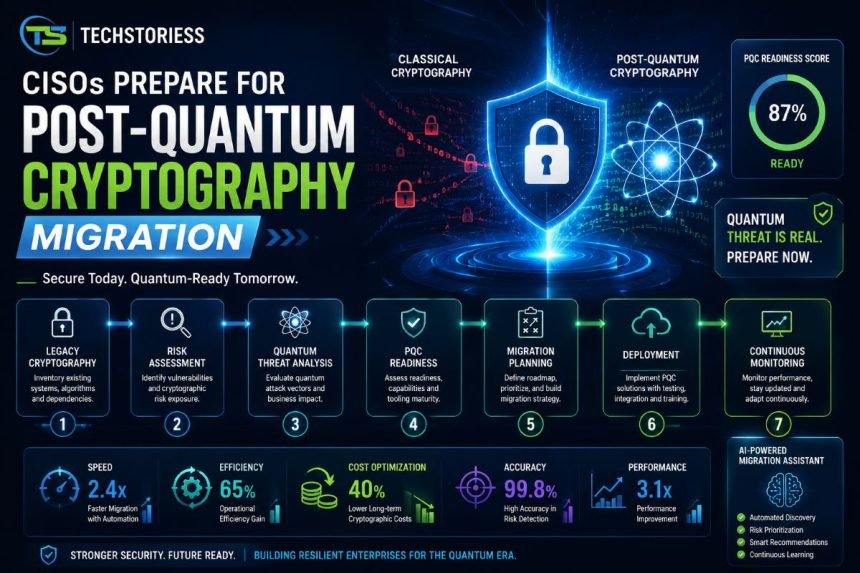
This is where the narrative gap becomes clear. Awareness without execution leads to stagnation. This 90-day roadmap, aligned with NSM-10 and global regulatory direction, provides a realistic starting point.
Phase 1 (0–30 Days): Discovery & Risk Mapping
Enterprises must understand their current cryptographic posture before introducing new systems. Most organizations lack even a basic centralized inventory of cryptographic usage.
Start by building cryptographic visibility:
- Identify all systems using RSA, ECC, or TLS-based encryption
- Map data flows across applications, APIs, and third-party integrations
- Classify data based on longevity (short-term vs long-term sensitivity)
This phase often reveals a critical issue: cryptography is deeply embedded but poorly documented. Legacy systems, hardcoded certificates, and unmanaged keys create hidden dependencies.
Identifying high-risk data zones is equally important. This includes systems where data must remain confidential for more than 5–10 years—often referred to as long-term confidentiality assets.
Phase 2 (30–60 Days): Strategy & Architecture Design
Once visibility is established, the focus shifts to controlled transition planning.
Hybrid cryptography is a practical transitional approach, where classical and post-quantum algorithms operate together to maintain security continuity. This ensures backward compatibility while preparing for future resilience.
Key actions:
- Evaluate vendor readiness (cloud providers, SaaS platforms, security tools)
- Redesign identity and key management systems for crypto agility
- Align internal architecture with FIPS 203 and FIPS 204 implementation paths
- Define enterprise-wide policies for cryptographic upgrades
At this stage, leadership decisions are critical. This is not just a technical transition—it impacts procurement, compliance, and long-term architecture strategy.
Phase 3 (60–90 Days): Pilot & Controlled Deployment
At this stage, the goal is validated experimentation to assess feasibility and performance in real environments.
- Deploy PQC algorithms in controlled environments
- Test hybrid TLS implementations
- Measure performance impact (latency, compute overhead)
- Validate interoperability across systems
Simultaneously, begin reducing reliance on legacy VPN-style encryption models and transition toward quantum-safe encryption enterprise frameworks.
At the end of 90 days, the organization should ideally have:
- A validated migration roadmap
- Identified high-risk systems
- Initial PQC deployment experience
- Executive alignment on next-phase investments
Real-World Use Cases: Where PQC Becomes Non-Negotiable
PQC is especially a non-negotiable security requirement for sectors with strict regulatory mandates or those handling highly sensitive, long-lifecycle data vulnerable to future quantum threats.
Banking & Financial Services
Transaction records and cryptographic signatures hold long-term value and must remain secure for decades. A breach—even years later—can still create significant legal and financial consequences.
Healthcare & Life Sciences
Patient records, clinical trials, and genomic datasets often carry lifetime sensitivity. Delayed decryption risk is particularly severe in this sector.
SaaS & Cloud Providers
Risk is amplified in multi-tenant environments. A single cryptographic weakness can expose multiple customers simultaneously, making early PQC adoption both a security necessity and a competitive differentiator.
Implementation Challenges: The Reality CISOs Must Navigate
Despite the urgency, migration comes with real challenges:
- Performance overhead: Larger key sizes and higher computational requirements
- Legacy integration: Older systems may lack compatibility
- Vendor ecosystem maturity: Not all providers are fully aligned
- Operational complexity: Hybrid cryptography increases coordination overhead
Major technology organizations like IBM and Google are already experimenting with PQC in production-like environments, but enterprise-wide adoption is still in early stages.
Global Compliance Momentum Is Accelerating
Rather than fragmented movement, regulatory alignment is converging globally alongside NSM-10:
- The European Union is advancing coordinated quantum transition strategies
- The NSA has introduced CNSA 2.0 guidance
- ENISA is actively publishing migration frameworks
This convergence signals a clear shift: post-quantum readiness is moving from competitive advantage to compliance baseline.
The 2026–2030 Outlook: From Optional to Mandatory
Looking ahead, based on current technological and regulatory momentum, the trajectory is becoming clearer:
- Hybrid cryptography becomes the default transitional model
- PQC support becomes standard in enterprise infrastructure
- Regulatory mandates tighten across critical sectors
- VPN-style perimeter security continues to decline
By 2027, the question will no longer be whether to migrate—but how delayed an organization’s response has been.
Conclusion
From a quantum risk perspective, the biggest mistake enterprises can make is waiting for perfect readiness. Contrary to traditional upgrade cycles, post-quantum migration is not a one-time project. It is a multi-year transition where early action reduces long-term risk exposure and operational disruption.
A well-planned post quantum cryptography migration checklist enterprise strategy begins not with full deployment—but with visibility, prioritization, and controlled experimentation.
The real risk is not immediate disruption. In the quantum era, it is delayed realization of existing exposure that could eventually compromise sensitive data at scale.