


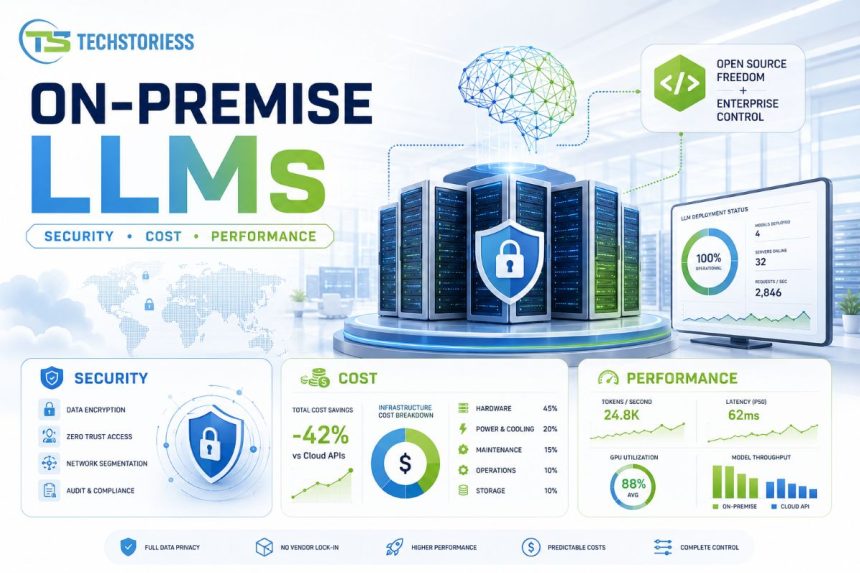
Over the last two years, the decision around enterprise AI deployment has fundamentally shifted. What was once a straightforward choice about consuming intelligence via APIs has evolved into a strategic infrastructure decision. Instead of simply integrating third-party AI services, it is now shaped by factors like regulation, cost predictability, and operational control. An increasing number of IT decision makers such as CIOs and CISOs are no longer asking if or how AI should be integrated-they are asking, where those models should live.
- Why On-Premise LLMs Are Rising in 2026
- Open Source vs Proprietary LLM Cost: The Real Trade-Off
- The 3-Column Decision Matrix (2026 reality)
- Security: Control vs Responsibility
- Cost: The Myth of “Free” Open Source
- Performance: The Gap Is Narrowing
- Real-World Use Cases Driving Adoption
- Self-Hosted LLM Comparison 2026 (Enterprise Lens)
- Decision Framework: When to Choose What
- Conclusion
In 2026, that decision increasingly points inward.
Mature enterprises are seriously reassessing their reliance on external AI APIs to comply with tightening data residency mandates, especially across Europe, along with a broader global push toward sovereign AI data privacy. This has resulted in a measurable transition toward open source LLMs on premise enterprise deployment, not merely as experimentation, but as a well-planned architectural shift.
Despite this, most existing comparisons remain focused on developer-centric metrics like model benchmarks, token throughput, and inference speed. This misses a critical element-the decision framework for IT buyers that meaningfully balances security, cost, and performance in operational terms.
This gap encouraged us to produce this in-depth article to clarify the landscape and help decision-makers evaluate trade-offs more effectively.
Why On-Premise LLMs Are Rising in 2026
Along with performance breakthroughs, the rise of self-hosted LLMs is being shaped by structural pressures beyond engineering teams.
Regulatory compliance frameworks such as GDPR and emerging AI governance laws compel organizations to rethink how sensitive data is processed. Model inference involving financial records, healthcare data, or proprietary IP introduces compliance ambiguity when that data is sent to third-party APIs. This ambiguity is eliminated through self-hosting models by ensuring zero data egress-a crucial requirement in regulated environments.
At the same time, enterprises are becoming increasingly aware of vendor dependency risks. While API-based models offer benefits like rapid deployment and minimal infrastructure overhead, they also lock organizations into pricing structures and operational dependencies that can escalate over time. This has created a need to approach AI strategy in the same way as cloud infrastructure decisions-shifting from short-term convenience to long-term sustainability.
A notable driver in this shift is the rapidly changing economics. With recent advancements, open-source LLMs now deliver comparable performance to proprietary models at significantly lower cost-often 60–90% less in operational scenarios. This cost differential is substantial enough to trigger board-level scrutiny.
Open Source vs Proprietary LLM Cost: The Real Trade-Off
At a surface level, the comparison appears simple:
- Proprietary APIs require minimal setup and are fast to deploy
- Open-source on-premise deployments demand infrastructure and expertise
However, this framing is incomplete. The real decision is not just about simplicity-it is about long-term control versus convenience. In many scenarios, the initial advantages of speed and ease diminish over time as costs and dependencies accumulate.
Cloud-based LLM APIs offer significant value during early stages by enabling rapid experimentation without infrastructure complexity. However, these benefits often mask underlying constraints such as:
- Recurring usage costs tied to token volume
- Limited control over model behavior
- Data exposure pathways outside enterprise boundaries
In contrast, on-premise deployments invert this model. They require upfront investment-in GPUs, orchestration, and skilled talent-but deliver:
- Full control over data and inference
- Predictable long-term cost curves
- Independence from vendor pricing changes
Industry research indicates that on-premise LLM deployments reach cost break-even only at scale, typically in environments processing hundreds of millions of tokens monthly or more. For smaller workloads, APIs remain more cost-efficient.
The choice, therefore, is not universal-it is a threshold-based decision.
The 3-Column Decision Matrix (2026 reality)
| Factor | Open Source LLMs (On-Prem) | Proprietary LLM APIs |
| Security | Full data control, zero external exposure, supports sovereign AI mandates | Data flows through external systems; relies on vendor guarantees |
| Cost | High upfront (GPU + talent), low marginal cost at scale | Low entry cost, but unpredictable and usage-dependent |
| Performance | Lower baseline but tunable, optimized for specific workloads | Higher out-of-box performance, continuously updated |
| Compliance | Easier to meet strict residency and audit requirements | Compliance depends on vendor contracts and geography |
| Scalability | Infrastructure-bound, requires planning | Instantly scalable via cloud |
| Control | Full control over model, data, and updates | Limited control, black-box behavior |
This matrix is where most enterprise decisions are ultimately anchored.
Security: Control vs Responsibility
The strongest argument for on-premise LLM deployment is security-but this advantage is often misunderstood.
Self-hosted models provide absolute control over data locality, ensuring that sensitive information never leaves the organization’s environment. This eliminates risks associated with third-party processing. In sectors like BFSI and government, where even metadata exposure is critical, this level of control is essential.
However, control does not automatically translate to security-it shifts responsibility.
Deploying open-source LLMs moves the entire security stack inward:
- Model integrity validation
- Dependency and supply chain management
- Protection against prompt injection and adversarial attacks
- Continuous patching and monitoring
This creates a paradox: open-source reduces external exposure but expands the internal operational risk surface.
Enterprises must secure the entire AI pipeline-from model weights to training data pipelines and inference endpoints. Rather than eliminating security concerns, open models redistribute them.
In practice:
- Strong ecosystem support makes Llama-based enterprise deployment a preferred choice for internal copilots
- In EU environments, Mistral models are often favored due to licensing clarity and regional alignment
Ultimately, the deciding factor is not just model capability but how effectively the enterprise can secure its deployment stack.
Cost: The Myth of “Free” Open Source
One of the most persistent misconceptions in enterprise AI is that open-source equals low cost.
In reality, it restructures cost rather than eliminating it.
Key cost components in on-prem deployment:
- GPU infrastructure (A100/H100-class or equivalent)
- Storage and networking
- ML engineering and DevOps talent
- Continuous optimization and monitoring
Proprietary APIs bundle these into usage-based pricing, simplifying cost visibility.
However, at scale, the economics shift:
- Below ~100M tokens/month – APIs are more cost-efficient
- 100M–1B tokens/month – cost parity zone
- Above 1B tokens/month -on-premise becomes significantly cheaper
Many organizations underestimate hidden API costs such as rate limits, latency overhead, and vendor lock-in during early adoption stages.
The key takeaway: open source is not inherently cheaper-it becomes cost-efficient under specific scale, usage, and compliance conditions.
Performance: The Gap Is Narrowing
Performance used to be the defining advantage of proprietary models, but that gap is narrowing rapidly due to advancements in open-weight architectures and fine-tuning techniques.
Modern open-source models:
- Achieve ~90% or more of proprietary model performance in many enterprise tasks
- Can be optimized for domain-specific accuracy
- Offer lower latency in local deployments due to proximity
However, trade-offs remain:
- Larger models require significant compute to match top-tier APIs, increasing infrastructure cost
- Proprietary models continue to improve rapidly, shifting performance benchmarks
- Reliable large-scale inference remains operationally complex
This shifts the performance discussion from binary to contextual:
- Proprietary models lead in general-purpose intelligence tasks
- Open-source models excel in domain-specific workflows after tuning
Real-World Use Cases Driving Adoption
The shift toward self-hosted LLMs is already visible across industries.
BFSI: Internal Document Intelligence
Banks are deploying on-premise LLMs to process loan documents, compliance reports, and audits securely-without exposing sensitive data externally.
Government: Sovereign AI Initiatives
National AI strategies increasingly mandate local model deployment to maintain control over citizen data and critical infrastructure.
Enterprise Knowledge Systems
Organizations are replacing internal search tools with self-hosted copilots to securely access proprietary knowledge bases.
In all these cases, decisions are driven less by raw performance and more by data control and compliance certainty.
Self-Hosted LLM Comparison 2026 (Enterprise Lens)
When evaluating the best open source LLMs on premise enterprise deployment, three model families dominate:
- Llama series → Strong ecosystem, flexible deployment, high enterprise adoption
- Mistral models → Lightweight, efficient, aligned with EU regulatory needs
- Qwen / DeepSeek → High performance, cost-efficient, rapidly evolving
Beyond benchmarks, key differentiators include:
- Licensing clarity
- Deployment complexity
- Hardware requirements
- Security auditability
Notably, open-weight models are increasingly evaluated for EU deployment readiness, reflecting how compliance now directly influences model selection.
Decision Framework: When to Choose What
Deciding whether you should use open source,proprietary APIs or go for a hybrid model is often more challenging than it seems. This framework can help you take informed decision:
Choose Open Source On-Prem If:
- You operate under strict data residency or compliance mandates
- Your workloads exceed high token volumes (cost advantage)
- You need deep customization and control
- You have internal capability to manage infrastructure and security
Choose Proprietary APIs If:
- Speed of deployment is critical
- Workloads are variable or low-volume
- You lack ML infrastructure expertise
- You need best-in-class performance out-of-the-box
Hybrid Model:
- APIs for general workloads
- On-prem models for sensitive or high-volume tasks
This hybrid approach is rapidly becoming the default enterprise architecture.
Conclusion
The shift toward on-premise LLMs represents more than a technical evolution-it reflects a broader transition from AI consumption to AI ownership.
Instead of acting purely as consumers of intelligence, enterprises are becoming operators of it.
Open-source models have reached a level of maturity where they can meaningfully support this shift. They offer:
- Cost advantages at scale
- Control over data and model behavior
- Alignment with regulatory requirements
However, they also demand:
- Infrastructure investment
- Strong security practices
- Ongoing operational commitment
Ultimately, the decision is not about choosing the “better” model – it is about choosing the level of control your organization is prepared to own.
In 2026, that question is shaping enterprise AI strategy more than any benchmark.