


Artificial intelligence has changed various fields of digital marketing, including audience targeting, bidding control, campaigns measurement, and creative testing. The next step in this transformation is about a new development in the form of AI agents that are capable of performing complex tasks with virtually no human help. While a lot of discussions are held about whether AI will replace media buyers, a much more important question is how AI will change the concept of media buying.
Digital marketers have always been involved in making daily decisions about the operations of advertising. Be it budget adjustments, bid alterations, audience exclusion, pacing, or channel distribution, each action previously required constant supervision. Though some automation features are now available on the platform for ad management, campaigns usually look fragmented, and marketers have to analyze every piece of information before applying it.
AI agents are starting to fill that gap.
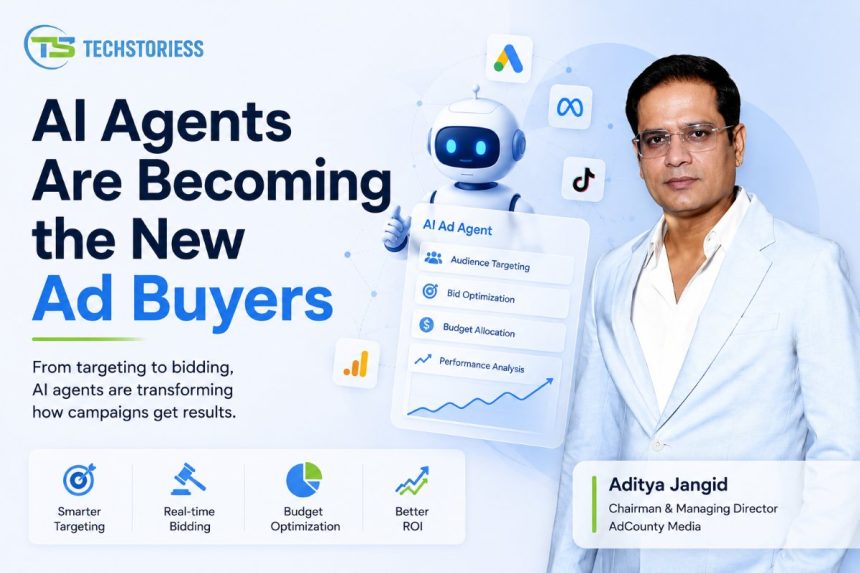
In contrast to traditional automation, which applies fixed rules, AI agents have the ability to recognize objectives, gather signals of performance, and carry out a series of connected tasks. Rather than just simply increasing the bid at a threshold point, an AI agent would be able to detect deteriorating performance of a campaign, assess the reasons from many factors, suggest some redistribution of budget, implement the change and track the results. Thus, the focus has moved from isolated automation to ongoing decision-making help.
This shift is particularly important with today’s advertising ecosystem that is becoming more and more sophisticated. Nowadays, marketers work with search, social media, connected television, retail, digital audio, and mobile systems, which create huge amounts of performance information. It has become time-consuming and labor-wasting to extract important patterns from everything. AI agents can process this information continuously and make decisions faster with lower workload.
However, describing AI agents as “the new ad buyers” can be misleading if interpreted literally.
Media purchases cannot merely be defined as execution of a campaign. The basic concept of media buying involves taking into consideration commercial objectives, making sense of market opportunities, determining the right balance between efficiency in the short term and brand-building in the long run, negotiating with partners, studying consumer behavior, and making investment decisions. All these functions are done with the help of business judgment, business priorities, and market conditions, where human skills come into play.
It is much more fitting to refer to AI agents as intelligent operators because they carry out time-consuming optimization tasks, spot all missing opportunities, and free marketers to deal with more strategic issues. The implication is not that media buyers cease to exist – they make a transition from managing campaign techniques to strategizing marketing activities and evaluating the results.
The transformation also results in alterations in the skills that marketing businesses are going to put a lot of significance on. It is known that technical execution in itself might not necessarily be enough in a situation when a lot of the operational complexity is handled by AI. More importance will be paid to first-party data strategies, measurement frameworks, experimentation, customer insights, as well as the capability to convert the business goals into successful AI-driven processes.
When it comes to advertisers, this is more than just efficiency improvement. Faster optimization can deliver quicker responsiveness of the campaigns and some other positive effects, but the real merit of it lies in the ability of businesses to make smarter decisions on a larger scale. With advertising becoming more dynamic and consumers’ behavior evolving, the capacity to adapt can be as important as creativity and investment into the media.
AI agents are unlikely to replace marketers’ strategic functions, but they will change how advertising is done. The future of media buying will not be defined by a contest between humans and the machines but by the extent to which both are complementary in their efforts. Organizations that successfully combine human instincts and smart automation will be best positioned to operate within an increasingly complicated advertising environment.