


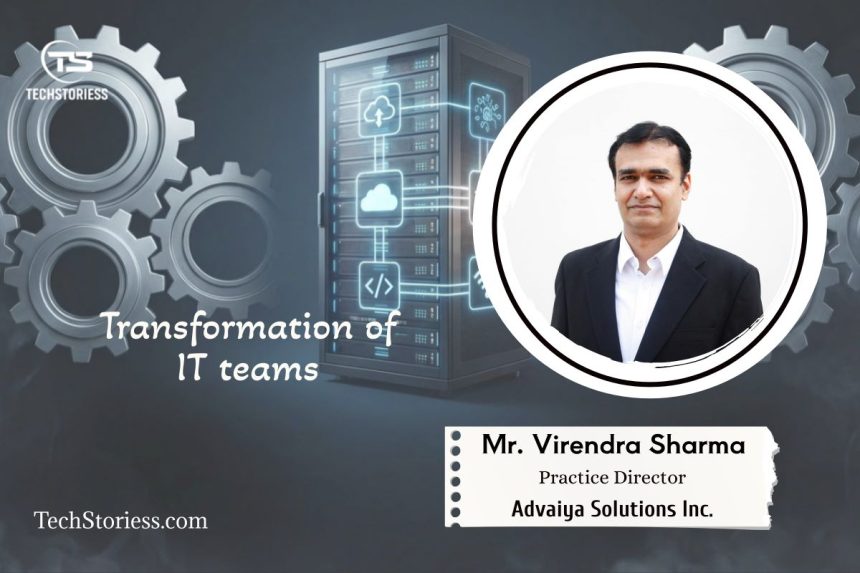
For years, IT teams were viewed primarily as the groups that ‘kept the lights on’—maintaining servers, resolving tickets, and deploying tools selected by business units. Today, that perception is rapidly evolving. With modern advancements in AI, data platforms, and automation, IT is transforming into a strategic partner that helps shape how work is designed and delivered across the entire organization, not just the systems underneath it.
According to a recent survey of more than 700 CIOs makes this explicit: by 2030, CIOs expect that 0% of IT work will be done without AI, with about 75% of IT work done by humans augmented with AI and 25% by AI alone. In other words, IT work is not going away; it is being reshaped so that people and intelligent systems work together on almost every task.
Data, Automation & Intelligence (DAI)
A useful way to understand this shift is through three simple building blocks: Data, Automation and Intelligence (DAI).
• Data – IT teams are shifting from scattered logs and spreadsheets to unified data platforms and observability tools. With clean, timely insights into systems, user behavior, and business processes, IT can make informed decisions instead of relying on guesswork.
• Automation – Once data is in place, repetitive work can be automated: provisioning environments, applying patches, routing incidents, updating records, granting access and more. Research shows that by 2026, 30% of enterprises will automate more than half of their network activities. That same pattern is spreading across infrastructure, applications and support – freeing IT teams from routine tasks so they can focus on improvement and innovation.
• Intelligence – On top of data and automation, AI adds prediction and assistance. In practical terms, this looks like AI copilots that help developers write code, tools that summarize incidents and suggest fixes, or assistants that guide employees through complex processes.
Peripheral Automation: An architecture approach that makes technology & AI works
Peripheral Automation is an Advaiya’s architectural approach that keeps core systems stable (ERP, CRM, core banking, HR, line-of-business applications) while building flexible layers around them – the “periphery”, to handle processes, automation and user experiences.
Instead of trying to replace everything and start from scratch, IT teams:
- Treat the core systems as systems of record
- Build automation and AI services at the edges – for approvals, reconciliations, notifications, checks, data movement and interactions
- Create experience layers (portals, apps, dashboards, chatbots) that talk to those cores through APIs
This approach matters because most friction for business users lives at the periphery: hand-offs between teams, manual updates, duplicate data entry, waiting for answers, chasing status. Peripheral Automation approach can support IT teams to use data, automation and intelligence to remove those pain points without disrupting critical back-end systems.
What this means for IT leaders and business stakeholders
Putting DAI and Peripheral Automation together gives a practical roadmap that IT teams & leaders can understand:
- Start from journeys, not technologies. Pick a business journey for example customer onboarding, project delivery, financial closing, employee onboarding and map where delays, manual work and errors occur.
- Use data to make the journey visible. Ensure that IT and business can see the key steps and metrics in one place.
- Apply automation to the repetitive edges. Automate status updates, hand-offs, reconciliations, and policy checks around existing systems, instead of immediately replacing them.
- Add intelligence where it helps people decide. Use AI to recommend next steps, flag risks early, summarize information and answer questions – always with humans in control.
- Iterate using a Peripheral Automation architecture. Keep cores stable, evolve the periphery quickly, and let IT and business experiment with new capabilities without taking big operational risks.
IT teams that embrace DAI and Peripheral Automation will find their jobs becoming less about constant firefighting and more about designing smart, resilient, business-friendly systems. For leaders across any domain, this is the real transformation: IT no longer just supports the business; it becomes a co-creator of how the business works in a digital, AI-enabled world