


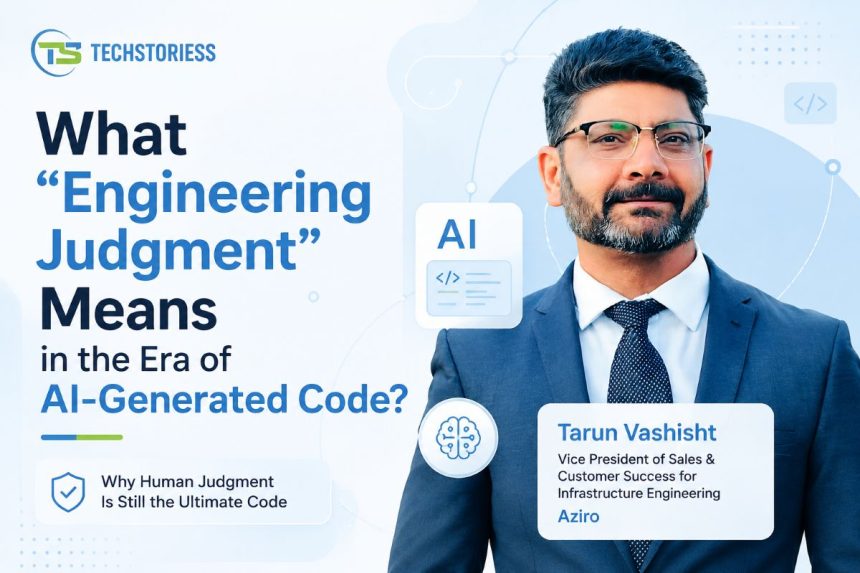
With AI-generated code becoming the norm, it is essential for engineers to be adept at making technical calls and properly evaluating their work.
The pace at which artificial intelligence (AI) is transforming software development has been nothing short of extraordinary. One can have AI put together a function, an API or an integration in a matter of minutes now. It is no surprise that more than 75% of developers make use of AI assistants; those who do are finishing their work 30 to 55 per cent quicker.
The numbers bear this out, GitHub sees the same kind of results with Copilot, and McKinsey puts the annual contribution of generative AI to the world economy at between $2.6 and $4.4 trillion. Yet for all that is to be gained, it changes the nature of the work. The issue is not so much how quickly one can code as how soundly one decides. Productivity is not what sets an engineer apart anymore. That comes down to judgment.
AI Can Write Code but Cannot Make Engineering Decisions
There is no disputing that AI has a talent for pattern recognition and churning out code. It will put together a syntactically sound answer in short order and make light of any repetitive work. Yet one should not mistake software engineering for simply writing code; it is about the context. The right decision is one informed by business imperatives, security and compliance, the demands of legacy systems and architecture, and scalability. A solution can be technically flawless and still be the wrong call.
AI does not have the capacity to appreciate such trade-offs. It is without the institutional memory or an understanding of what has gone wrong before, let alone the kind of subtle reasoning an experienced engineer brings to bear instinctively. Consequently, the role of the engineer is evolving from author to assessor. Some are devoting as much as 40 per cent of their day to vetting what the AI has produced. That brings with it the danger of approval fatigue. When the output is polished enough, there is a temptation for teams to give it a quick sign-off, confusing fluency with being right.
Judgment Is Becoming the New Definition of Senior Engineering
For the most part, engineering excellence has been measured by what is put out, the features, the speed, and how few defects there are. AI is putting an end to that old way of thinking. As code generation gets cheaper, good judgment is in shorter supply. Take the World Economic Forum, for instance; they point to analytical and complex problem-solving as the skills that matter in an AI-driven world. Gartner expects half of all engineering teams to be using AI-assisted coding by 2027, which in turn demands more human oversight.
In a sense, what separates one engineer from another these days is what they have the foresight not to build. A senior engineer will have context that an algorithm simply cannot match, from an awareness of regulatory risk and hidden constraints to the lessons of past incidents. They know a shortcut taken today is just technical debt in waiting. Given that AI tools are in use by more than 70% of the industry, one can hardly be surprised to find nearly 60% of developers are not entirely convinced of their dependability. After all, while the technology will expedite things, it is a person’s judgment that ensures the work is done properly.
The Next Challenge, Teaching Judgment in an AI-First World
There is a more pressing concern than the mere adoption of AI, it is a matter of how engineers are taught. In the old days, one built expertise by way of repetition, putting in the hours to write code and debug problems, learning as much from mistakes as from success. AI has a way of shortening that process, which can let a junior developer bypass some of the more important formative steps. To be sure, an AI tool can put twice the speed in a developer’s hands, but if it is used in a passive fashion, it will erode any deep conceptual grasp of the work.
The answer is not to put limits on AI so much as to rethink the learning process. A code review ought to be about the reasoning, not the syntax, so the logic of a decision is clear. When pair programming, the emphasis should be on making decisions rather than simple execution to foster critical thinking. In architecture talks, one should be looking at trade-offs and weighing different options; after an incident, the review should get to the bottom of why something was done, not only what failed. Those who put resources into mentorship find they have fewer defects and better code for it. After all, experience is something to be learned, not produced by a machine.
Conclusion
One could say AI is in the process of redefining the engineer rather than putting one out of a job. According to Gartner, accountability will remain a matter for the human element, even in a future where AI is responsible for more than 70% of production code by 2028. The firm is clear that without adequate oversight, one is bound to see defects arise. In the end, what distinguishes the teams is culture, an engineer is encouraged to question what the AI has produced, to verify the assumptions and ensure the decision holds water from a business standpoint. With the commoditisation of code generation, it is engineering judgment that now provides a real edge. AI is capable of churning out solutions, yet it lacks the capacity to determine which are of consequence or will stand the test of time. In the end, the way forward for software engineering has less to do with the speed at which one puts code down and more with the wisdom in selecting it.