


Around two years ago, the pitch for agentic AI was straightforward: hand an agent a goal, let it act autonomously, and take the human out of the loop entirely. In 2026, that pitch has changed. The enterprises actually running agents in production aren’t chasing full autonomy – they’re deliberately deciding where it stops.
The numbers make the case. According to Gartner, 40% of enterprise applications will include task-specific agents by the end of 2026 – an eightfold jump from under 5% in 2025, proof that adoption is real, not hype. But in a separate survey of more than 3,400 organizations, Gartner also forecasts more than 40% of agentic AI projects will be cancelled by the end of 2027, citing escalating costs, unclear business value, and inadequate risk controls. The gap between adoption headlines and what’s actually happening inside enterprises isn’t a contradiction – adoption and abandonment are rising together.
The governance gap nobody priced in
Shiva Varma, Senior Director Analyst at Gartner, put the failure pattern plainly: enterprises treat AI agent governance as binary – either locked down or fully trusted – and that binary thinking is the root cause of failure. Gartner’s research sharpens the picture further, predicting that by 2027, 40% of enterprises will demote or decommission autonomous agents specifically because governance gaps only surface after something has already gone wrong in production.
That is the retreat in one sentence: instead of rejecting agents outright, enterprises are correcting course after discovering that “autonomous” had quietly become interchangeable with “unsupervised” inside their own deployments.
Where the industry is actually landing
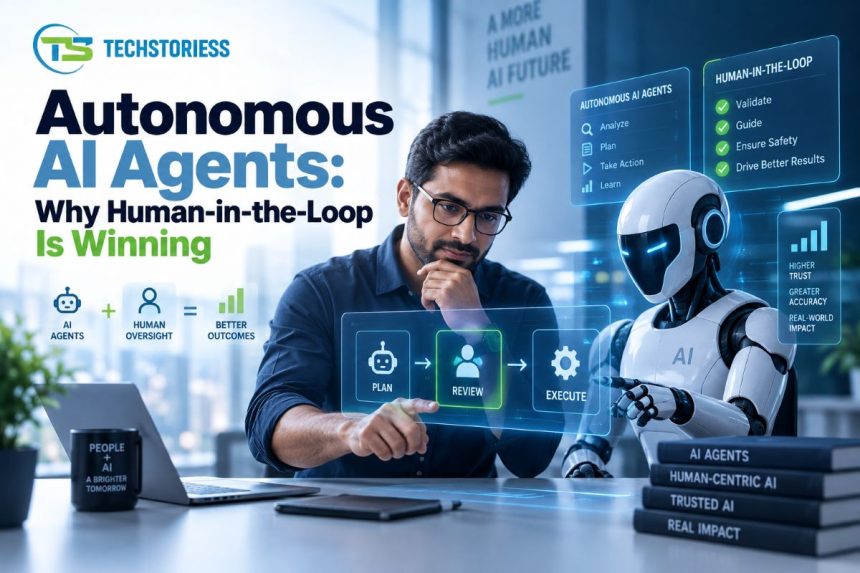
The emerging consensus isn’t zero autonomy. It’s calibrated autonomy – treated as a dial, not a switch. Analysts describe three tiers of human involvement rather than one blunt on/off toggle:
- Human-in-the-loop (HITL): instead of executing immediately, the agent proposes an action and waits for a human to approve it – reserved for high-stakes moves like financial disbursements, legal commitments, or access to sensitive data.
- Human-on-the-loop (HOTL): the agent acts on its own, while a human monitors outcomes and can step in after the fact – workable when mistakes are reversible and speed matters more than a checkpoint.
- Full autonomy: no human checkpoint at all – increasingly reserved for narrow, low-risk, high-volume tasks where errors are cheap to catch and fix.
Enterprises that are actually seeing ROI, according to industry analysis from Kore.ai, are not the ones running blanket high-autonomy deployments across every function. They’re the ones confining agents to constrained, well-governed domains – IT operations, employee service, finance operations reconciliation, onboarding – where boundaries are clear and human-in-the-loop is tolerated without killing the speed advantage.
The airline example that keeps coming up
One illustration analysts keep returning to: an airline agent rebooking passengers after a cancelled flight. For the ordinary passenger, the agent finds the next seat, rebooks, and confirms – no human involved. But when the agent hits a first-class passenger on an international itinerary with a loyalty-tier override and a fare class requiring manual reissuance, it recognises the policy boundary, pauses, and routes the decision to a human agent for approval.
That pattern – automate the routine majority, checkpoint the risky and irreversible minority – is what’s replacing the “remove the human entirely” pitch of 2024.
Why this matters more than a workflow preference
Regulation is starting to make this a compliance question, not just an engineering one. The EU AI Act’s Article 14 formally incorporates human oversight requirements into law, and frameworks like NIST’s AI Risk Management Framework treat human-AI teaming as a control surface, not an optional nicety. For regulated industries, a documented human sign-off on a decision is becoming the difference between a defensible incident report and a liability.
There’s also a more basic, less regulatory reason enterprises are pulling back: error compounding. A small error rate at each step adds up quickly across a multi-step autonomous workflow, and by the time a fully autonomous chain of decisions reaches its output, small mistakes have often stacked into large ones nobody caught in time. That single dynamic – not any single dramatic failure – is enough to make most CIOs cautious about granting autonomy beyond a narrow, well-tested scope.
The bottom line for enterprise leaders
The lesson from 2026 so far isn’t that autonomous ai agents don’t work. The enterprises succeeding with them stopped asking “how much can we automate” and started asking “where does a mistake actually cost us something we can’t undo.” Identity, least-privilege access, audit logs, and human checkpoints are being designed into agent deployments upfront now, not bolted on after an incident forces the question.
The quiet retreat isn’t cold feet. It’s the industry learning, the hard way, that removing humans was never really the goal of agentic AI – designing the right checkpoints was.