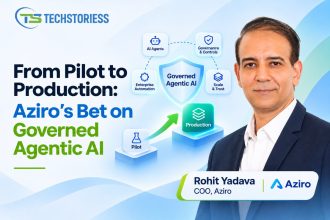



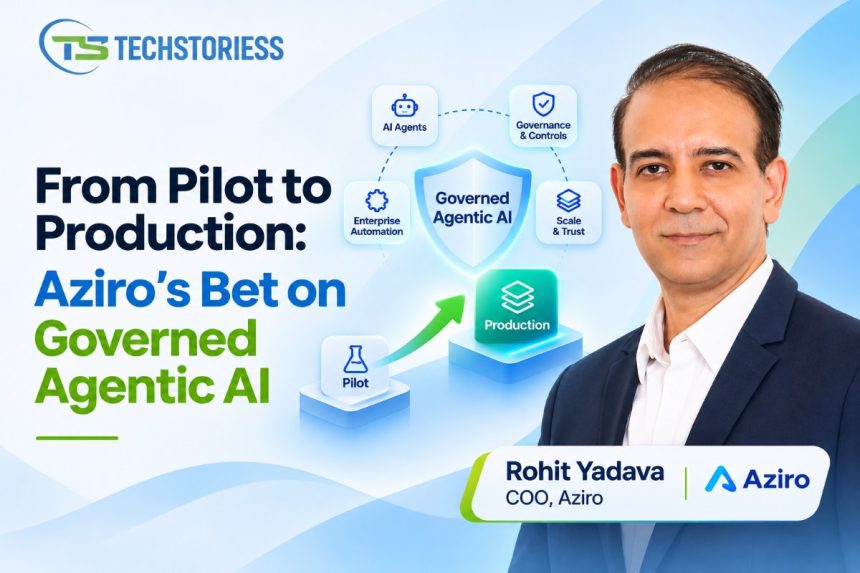
While the enterprise tech landscape is crowded with flashy AI copilots and endless pilot programmes, most organisations still struggle to move autonomous agents into production. The missing ingredients? Trust, seamless integration, and strict governance. In this exclusive Q&A, Aziro shares how it bridges the gap between experimental demos and accountable business execution. From building proprietary platforms like CAWi, Aziron, and APEX to championing Indian engineering depth on the global stage, the company breaks down why sustainable AI adoption requires putting transparency before speed, and keeping humans firmly in control of critical decisions.
What drew you to enterprise technology, and which experiences shaped Aziro’s vision for agentic AI?
For the majority of my professional experience, I have worked at the intersection of technology and operations – among the delivery teams, production systems and the customers who rely upon them. After a while, I noticed a pattern. Enterprises rarely have a shortage of insight. What they struggle with is acting on it consistently. So when AI began to move beyond answering questions and started planning and carrying out work, we didn’t want to sit back and wait for someone else’s product. We built our own. That’s the thinking behind Aziro’s AI platforms today: AI that does real enterprise work, inside clear governance limits, with people still making the final decisions.
Which pivotal decisions have most influenced Aziro’s direction, and what lessons emerged from those choices?
Two decisions stand out. The first was to build our own AI platforms instead of only implementing what others had made. The AI Centre of Excellence gave that effort a home, and it’s where lessons from client work become products like CAWi, Aziron and APEX. The second was to make governance part of the platform from the start. Our regulated clients were forthright about it: no amount of capability would get us into production without it. To summarise what I learned from both decisions, it boils down to trust when selling enterprise AI. While speed is certainly appreciated, it should come only after sufficient transparency has been achieved in the process.
How does Aziro differentiate itself in an agentic AI market crowded with copilots, consultancies and platform vendors?
Honestly, the crowding is mostly at the experimentation end. Copilots will answer your question and then stop. A lot of agent tooling makes it easy to put together a demo, and much harder to run that agent in production. We spend our effort on the stretch between a working agent and a governed production system. CAWi lets teams ask questions of their own systems and get answers with the sources shown. Aziron goes further and takes a question through to a governed outcome, with modules for engineering automation, incident reasoning and model cost control. APEX takes a requirement written in plain English and turns it into a governed multi-agent flow. APEX can be hosted by the user with their own model, thereby guaranteeing that the user maintains control over their data, their models, and expenses incurred.
What challenges are enterprises struggling to solve as they move AI from pilots into production?
It mostly comes down to distance. A pilot looks promising, but getting from there to something the business can truly rely on is a long road. Plenty of enterprises are running dozens of AI experiments, and very few of those carry a critical workflow. The usual blockers show up again and again. There is fragmentation in systems, and legacy systems stand in the way. No one is quite sure about who will be held responsible for any activity performed by the AI system. Costs associated with models are unpredictable, and it is equally difficult to prove a return on investment. However, there is always an underlying issue of lack of trust due to the fact that the leaders hesitate to give any AI room to function without understanding its decision-making process.
How can agentic AI translate enterprise data and signals into measurable improvements in business decision-making?
Most of the value comes from linking signals that normally sit separately, and each of our products is built around that. CAWi brings email, documents, CRM and engineering tools into one conversation, and every answer points back to where it came from. Aziron’s Signal module does something similar for operations. It looks across incidents and works out the likely cause. What you can measure in terms of improvement is time to decision. Leaders no longer have to wait for a manual investigation to finish. They can act on a cause they’re able to check for themselves, since the evidence is in front of them.
What practical barriers prevent organisations from adopting agentic AI at scale, and how can technology partners overcome them?
We see the same three barriers over and over. In regulated organisations, access is tightly restricted, so it’s hard for a vendor to show value early on. Integration is another, because an agent that can’t connect to the tools a team already runs isn’t much use. The third is trust. Leaders have to be aware of what has been done, how much it has cost, and who authorized it. Our AI Center of Excellence takes care of all these requirements by providing value through simulated reality, integration through industry standards such as MCP, and audits through human intervention.
How does Aziro approach data privacy, security and responsible AI as agents take on more autonomous work?
In our case, governance and security reside in the architecture itself, not just in some policy document. Every occurrence of the use of our AI is well documented, including the individual who utilised it, the specific model employed, and the total amount expended. Each separate use consists of a different trail, and any reversions are saved in a traced manner. Anything an agent does can be traced, and any outcome can be audited. Sensitive data is protected before a model ever sees it, and we have defences against prompt injection so that inputs can’t be used to steer an agent off course. Autonomy always has a boundary. Routine tasks will get done automatically without stopping, while anything critical will pause and wait for someone specified to give their approval. Organisations may also host the model themselves and make use of their keys, ensuring that all data remains in their possession.
What milestones best demonstrate market validation for Aziro’s agentic AI approach, and how do you measure sustainable customer adoption?
The first sign of validation is adoption. Several agents have already been built on APEX Core, and we work with partners including AWS, Databricks, HPE and Oracle in demanding sectors such as financial services. When we assess adoption, we look past the number of licenses sold. We want to know how many workflows have gone from pilot to production, how often teams reuse agents and tools, and what the results look like in practice, for example, faster resolution times and less engineering effort. To me, adoption is sustainable when customers keep expanding their use because they can see it working, and they’re not locked in.
How do you balance product innovation, integration complexity and customer requirements when prioritising Aziro’s AI roadmap?
We start from the customer’s workflow, and our feature list comes second. Each roadmap decision gets put through three questions. Does it remove a real barrier to production? Does it fit the systems customers already have? Can it be governed? That’s the reason Aziron is modular, so teams only take on what they need, and it’s why CAWi connects existing systems and doesn’t replace them. In my experience, integration often matters more than novelty. An agent that plugs neatly into existing tools will deliver more than a clever one that doesn’t.
What strategies help an India-rooted engineering company compete effectively for enterprise AI work in global markets?
Cost alone won’t win this work. Engineering depth and owning your intellectual property will. Global enterprises are looking for results they can trust, which means an India-rooted company has to solve hard problems to the same standard as any competitor. For us, that has meant building our own AI products, continuing to invest in our engineers’ skills and forming close partnerships with global platforms. Credibility in regulated industries counts for a lot as well, since trust is judged most strictly there. Our people are a genuine strength, but it’s people combined with products that earn a place at the table.
How do you evaluate investment priorities and capital allocation across services, platforms and partnerships while building a sustainable AI business?
We put money where engineering expertise can build up into something repeatable. Services link us to the problems that exist for our customers, and our AI experts turn the information they gather into something we can create. By collaborating, we increase our reach, and we don’t make something that the bigger picture has already taken care of. Every decision has to pass two criteria. Does it reduce the distance to tangible value for the customer? Does it build a more robust company for the future rather than this quarter? Sustained growth requires that focus. Jumping on every emerging AI fad doesn’t take you there.
What long-term changes do you expect agentic AI to bring to enterprise operations, and where do you see Aziro contributing most?
Today, people do the work using tools. I think that will shift toward people overseeing work that agents carry out. Routine jobs like incident triage, compliance checks and release qualification will become largely agent-driven, which leaves people free to concentrate on judgment, exceptions and strategy. Governance will be what separates the organisations that adopt this well from those that don’t. I see Aziro contributing most where execution meets accountability. We’ll keep building AI that takes work from a question through to an outcome and helps enterprises run agents safely in production, with full traceability and security built in.