


For more than three decades, ERP systems have been foundation of business digitisation. They have allowed organisation to manage finance, procurement, inventory, manufacturing, projects, human resources and other critical business functions through one centralised platform. With industries becoming more specialised, it becomes clearer that generic ERP could not effectively support the unique workflows, compliance requirements, terminology, and operational practices of every sector. Hence leading to emergence of industry specific ERP solutions built to address the distinct needs of individual industries.
For example a consulting firm where operations revolve around client engagements, resource allocation, deliverables and billing cycles. A construction company manages drawings, contractors, site execution, quality inspections, procurement, approvals, and hundreds of interconnected project activities. Very similar differences exist across industries such as healthcare, manufacturing, retail, logistics and hospitality.
Industry specific ERP solutions were developed to address these unique requirements, making implementation customisation, improving user adoption and ultimately driving better operational efficiency.
The introduction of industry specific marks an important milestone in digital transformation journey.
Business operations have evolved way faster than ERP softwares.
Today, organisations no longer rely on single application to run the businesses. Instead it uses range of specialised solutions, each designed to perform a very specific solution. CRM platforms manage customer relationships, HRM systems handle workforce management, chat applications support internal communication, email remains primary channel for formal correspondence, task management tools drive execution, document repositories store business information, business intelligence platforms provide analytical insights and AI powered applications assist with analysis and decision making.
Individually, each of the applications performs its role effectively.
The challenge is that they operate in isolation.
This fragmentation has quietly become one of the most significant operational challenges facing modern organisations.
Consider a typical day in project driven organisation. As an engineer may be following up with a consultant through chat application about a pending drawing, unaware that the revised version has already been uploaded to ERP system. At same time, engineer continues sending requested by email, not realising that the consultant has already responded. In another instance, an employee receives an important request through chat or email but forgets to create a task, causing activity to slip through cracks until it begin affecting overall project schedule.
In many organisations, it is common for project manager for repeatedly calling a colleague or an external stakeholder for urgent information, only to discover that the person is on approved leave. Such situations lead to unnecessary follow-ups, communication gaps, frustration and at times misunderstanding. Similarly, employees who are absent may still retain access to the ERP system because attendance records and system access operate independently, which creates both operational inefficiencies and potential security risks.
The issue is not these applications fail to perform their intended roles. Individually each works efficiently. This problem arises as they do not provide a unified business context. Information exists across organisation, but it remains scattered across independent systems, making it difficult for employees to access the complete picture and make timely, well informed decisions.
Hence, employees spend a significant part of their days switching between applications, searching for information, confirming document versions, following up with colleagues and manually piecing together information that already is there.
This is not a technology issue. It is a connectivity problem.
The impact is way more seen in project based industries such as contribution, engineering, infrastructure, manufacturing, consulting, and EPC, where multiple organisations collaborate throughout the lifecycle of a project. Clients, consultants, contractors, subcontractors, suppliers, project management teams, architects and quality inspectors continuously exchange drawings, approvals, decisions, RFIs, inspection records, test reports, meeting minutes, invoices, site updates and other project documents.
In environments like this, project success depends less on whether information is available and more on whether it reaches right stakeholder at right time.
Unfortunately this flow of information relies heavily on fragmented communication channels.
The modern workplace adds another layer of complexity. Professionals are constantly interrupted by instant messages, promotional emails, social media notifications, news alerts and countless other distractions. With conversations stacked up, important project discussions often get buried beneath unrelated messages. Employees frequently spend hours searching through emails, chat histories, shared folders and attachments just to locate a single approval or the test drawing revision.
As multiple projects run together and similar discussions take place across different teams and stakeholders, tracing correct communication history becomes increasingly challenging. Critical decisions often remain in email threads, while execution teams continue working with incomplete, outdated missing information.
The result of this disconnect is greater than most organisations realise.
It reveals itself through missed follow-ups, delayed approvals, duplicated effort, rework, communication breakdowns, accountability gaps, lower productivity, project delays, increased management pressure and ultimately dissatisfied customers.
Disconnected systems do more than fragment information as they fragment attention.
Employees spend more time searching for context, decisions take longer to make, and execution slows down across organisation.
To address such challenges, organisations usually invest in more advanced procurement systems or upgrade their ERP platforms. While procurement is undoubtedly a critical function, successful project execution depends on much more than timely purchase of materials.
In construction projects, materials can broadly be divided into categories: fast moving consumables and planned materials. Consumables require regular replenishment but delays can usually be managed via temporary purchases and local suppliers, with minimal impact on overall project cost. Planned materials, by contrast are typically procured well in advance through carefully coordinated schedule making them relatively less likely to become primary reason for project delays.
In real world, much bigger disruptions are caused by pending drawings, unresolved design decisions, delayed approvals, unavoidable test reports, or revised documents that fail to reach execution teams on time. These issues often lead to rework, idle manpower, disrupted workflows, contractual disputes, schedule overruns and ripple effect across multiple project activities.
Experienced contractors can quickly identify organisations where drawings, approvals, and key decisions get delayed. To avoid carrying prolonged idle costs, they often reduce manpower deployment until work can resume. While this helps manage their own costs, it directly impacts project timelines, productivity and overall quality of execution.
Traditional ERP systems are highly effective at managing procurement, inventory, purchase orders, invoices and financial controls.
However they were never designed to continuously manage the flow of information across people, documents, approvals, communications, workflows, and execution dependencies throughout entire lifecycle of project.
This is where next phase of digital transformation needs to move.
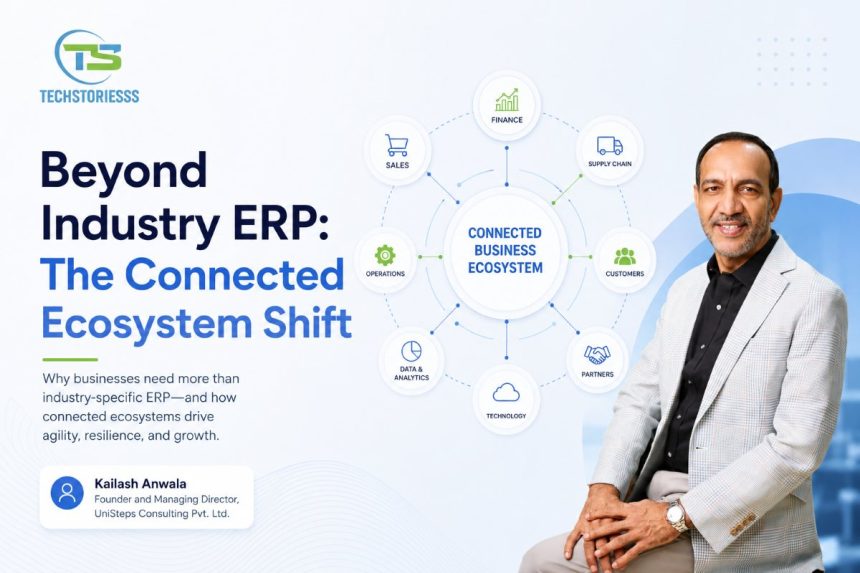
What organisations need today is a connected business ecosystem as a digital environment where ERP, HRM, task management, communication platforms, document management, workflow automation, AI analytics, and cloud technologies work together as a single operational framework rather than as isolated applications.
This goes far beyond simply integrating software through APIs. The real value lies in ensuring that business information remains connected throughout its entire lifecycle, allowing workflows to move seamlessly across functions and departments.
For example, a customer inquiry can automatically create an opportunity in the CRM system. Once the opportunity is confirmed, it can trigger workflows within ERP, assign tasks to relevant teams, notify stakeholders through communication platforms, link supporting documents, initiate approval workflows, update dashboards and maintain traceability throughout the process.
Employees no longer need to manually transfer information between multiple applications because of the workflow progresses as one connected process.
The same principle applies to construction projects. Drawings, RFIs, approvals, quality inspections, test reports, contractor communications, manpower deployment, procurement activities and project execution can all remain connected throughout the project lifecycle, ensuring every stakeholder has access to right information at right stage.
The objective is not simply to share data between systems. It is create continuity across business workflows.
A connected business ecosystem also provides greater clarity during execution. Teams gain visibility into what needs to be done, who is responsible for every activity, when it should be completed, what it depends on and how it impacts subsequent tasks. As a result, ERP evolves from being a passive system for recording information into active platform that supports execution and decision making.
Artificial intelligence further strengthens the vision.
AI delivers meaningful recommendations only when it has access to complete business context. If approvals remain buried in email, discussions stay confined to chat applications, documents sit in isolated repositories, workflows exist separately in task management tools and operational records remain locked inside the ERP, AI receives only fragmented information. Hence the insights generated are fragmented as-well.
With a Connected Business Ecosystem, AI can understand complete workflows rather than isolated datasets. This allows it to identify bottlenecks, predict delays, recommend corrective actions, monitor project health, answer context aware business queries automate repetitive administrative tasks and help managers make faster and better decisions.
This is also a strong environmental case for adopting this approach.
A typical construction project covering one lakh square feet can generate nearly two lakh printed pages during lifecycle, consuming paper equivalent to approximately 24 mature trees. Around 35% of these pages consist of construction drawings, many of which still need to be printed for practical site execution and therefore cannot be eliminated entirely.
However large portion of remaining documentation including RFIs, approvals, inspection reports, meeting minutes, purchase orders, invoices, contracts, HR records, quality documents, compliance records and internal correspondence can be digitised when ERP, communication platforms, document management, and task workflows operate as one connected ecosystem.
By elimination of duplicate documentation, repetitive printing, manual data transfers, courier movement, document scanning, physical storage and multiple versions of same information, organisations can realistically reduce overall paper consumption by 40-50%.
When this reduction is multiplied across thousands of projects executed every year, the impact extends well beyond operational savings. It leads to lower paper consumption, reduced printing costs, fewer carbon emissions, less office waste, and meaningful contribution toward broader sustainability goals.
As governments, investors and customers place increasing emphasis on sustainability and ESG commitments, digital connectivity is no longer operational advantage. It is becoming an important part of an organisation’s environmental responsibility.
For organisations planning their next phase of digital transformation, this calls for a shift in perspective. The questions they ask before making technology investments also need to evolve.
The focus should no longer be limited to asking, “Does this ERP manage my operations?”.
Instead, organisations should be asking, “Can this ERP function as part of connected business ecosystem? Can it seamlessly connect people, workflows, communication, documents, approvals, AI, automation and future technologies to create truly integrated operating environment?”
Industry specific ERP solutions will play a critical role because they are designed around unique processes and requirements of individual industries. They will remain operational backbone of modern enterprises.
However, the future of digital transformation will not be shaped by ERP alone. It will be determined by how effectively organisations connect every business function into unified digital ecosystem where information, communication, workflows, documents, decisions and people remain continuously connected.
Over past two decades, the enterprise software market has made remarkable progress in developing solutions for different business functions. Yet despite advancement, organisations truly lack a digital ecosystem.
Bringing this gap is next major opportunity. The next era belongs to Connected Business Ecosystem.