


Every week, an accelerator somewhere announces a new cohort and an impressive applicant count. Most of these announcements are forgettable. Google’s latest one deserves a closer look, because it shows where one of the world’s largest AI platform companies wants to spend its attention: directly alongside the founders building on its models.
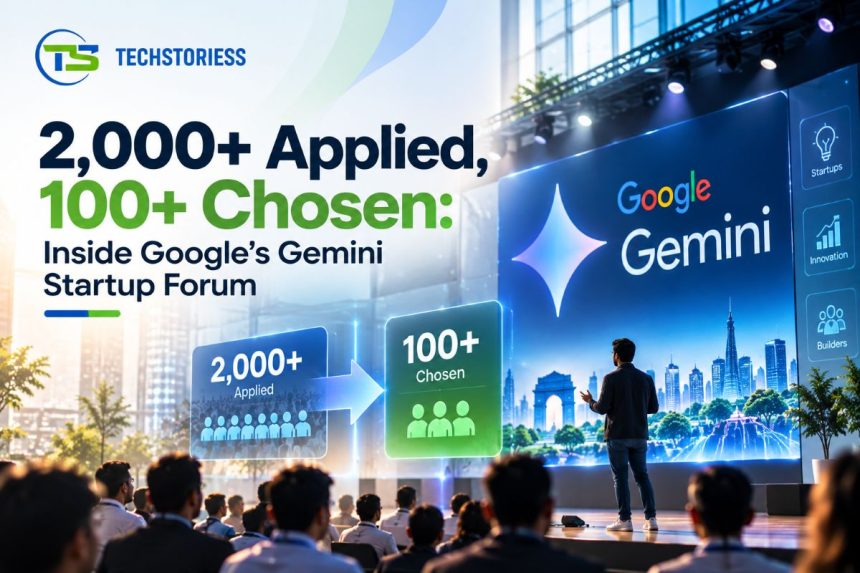
On 9 October 2026, Google said it had selected more than 100 startups from over 2,000 applications for the fourth cohort of its Gemini Startup Forum. Founders from 17 countries will travel to Google’s Mountain View headquarters in November for two days of hands-on work with specialists from Google DeepMind and Google Cloud.
What Google Actually Announced
The forum is aimed at Seed to Series A companies building with artificial intelligence. It is not designed as a conventional conference with keynotes and booth conversations. The format centers on direct work between founders and Google’s AI teams. Participants receive technical support from engineers, see AI demonstrations, and join sessions with Google experts and fellow founders.
The stated goal is practical: help startups sharpen their AI roadmaps and work through product and technical challenges with the teams that build the underlying models and infrastructure.
Google launched the first Gemini Startup Forum in November 2025 as a collaboration between DeepMind and Google Cloud. Reaching a fourth cohort in under a year suggests Google sees the format as repeatable and worth scaling.
Reading the Numbers
The headline figures are simple. More than 2,000 startups applied, and a little over 100 were chosen. That works out to roughly one in twenty, which is selective but not extreme.
For context, Techstars NYC reported in 2013 that it chose eleven startups from nearly 1,700 applicants, an acceptance rate of about 0.6%. By that yardstick, Google’s forum is far more open. That is not a criticism. A two-day, high-touch event can host a larger group than a months-long residency, and the selection bar is reasonably set for the format.
It is also worth remembering that application counts are a soft metric. Programs with strong brands attract many casual submissions, so the real competitive pool is usually smaller than the headline suggests. The more informative detail is the breadth of the cohort: 17 countries, and sectors that include genetic disorder diagnosis, cancer screening, and control systems for next-generation robotics.
That sector mix matters. A few years ago, startup cohorts built around generative AI were dominated by chat assistants, copilots, and content tools. This cohort points toward healthcare, life sciences, and physical-world automation, where the stakes are higher and the engineering is harder.
Why This Matters Beyond the Startups
For enterprise leaders, the question is not who Google picked. It is what this kind of program does to the technology landscape they will be buying from over the next few years.
- It shapes the vendor pipeline. Today’s Seed and Series A startups are tomorrow’s specialist vendors, integration partners, and acquisition targets. Access to DeepMind and Cloud engineers can shorten the path from prototype to production-grade product. CXOs evaluating AI suppliers should expect more of them to be built on Gemini and tuned with direct input from Google’s teams.
- It signals where AI value is moving. The inclusion of diagnostics, screening, and robotics control shows AI work migrating from general-purpose interfaces into regulated and physical domains. These are areas where reliability, validation, and data governance matter as much as model quality. Enterprise buyers in these sectors should be asking vendors how they handle those issues, not just which model sits underneath.
- It reflects platform competition. Every major AI provider wants developers and founders building on its stack. Hands-on engineering access is a powerful incentive, and it is more personal than a credit voucher. In our assessment, programs like this are as much about ecosystem gravity as about charity toward startups. That is not cynical; it is how platform businesses grow.
Part of a Larger Package
The forum sits within Google for Startups’ wider Gemini Kit, which bundles support for companies building with Google’s AI technology. Eligible AI startups can access up to $350,000 in Google Cloud credits across Cloud services. The broader program also includes API sprints, training resources, learning materials, and access to Google AI Studio.
Seen together, the pieces form a ladder. A founder can start experimenting in AI Studio, move into structured API sprints, scale on Cloud credits, and then, if selected, spend two days with DeepMind and Cloud specialists. Each rung deepens the relationship. For startups, that is genuinely valuable support. For observers, it is also a reminder that technical dependence tends to follow free access: once a product is architected around one provider’s models and tooling, switching later carries real cost.
The fourth cohort also joins the network built through the previous three groups, which gives alumni a peer community in addition to Google’s own experts.
What the Announcement Does Not Tell Us
A responsible read of any accelerator announcement should note what is missing.
- No outcome data. The announcement describes inputs, not results. We do not yet know how earlier cohorts performed in terms of funding raised, products shipped, or customers won.
- Approximate figures. Both headline numbers are phrased as “more than” and “over,” so the exact acceptance rate is not available.
- Short duration. Two days of focused work can unblock specific technical problems, but it is not a substitute for sustained mentoring or capital.
- Selection is not success. Being chosen is a credibility signal, but it does not guarantee a startup will survive, scale, or win enterprise contracts.
- We also note that this reporting draws on a secondary source, and readers should check Google’s own announcement for the definitive details.
What to Watch Next
Three things will indicate whether the forum is more than a well-packaged marketing exercise.
First, whether Google or the participants publish concrete outcomes: products launched, partnerships formed, or funding raised after attending. Second, whether the healthcare and robotics startups in the cohort reach regulated or production environments, since that is where the real test of AI maturity lies. Third, whether enterprise buyers begin to cite forum alumni as a trust signal when selecting vendors.
If those signals appear, “selected for the Gemini Startup Forum” could become a recognizable credential in the enterprise AI market, in the way certain accelerator badges already are.
The Bottom Line
The numbers in this story, over 2,000 applicants and a little over 100 selected, are not the most remarkable part. What stands out is the model: a platform giant putting its own AI researchers and cloud engineers in a room with outside founders, repeatedly, and at growing scale.
For founders, it is a chance to get unstuck on hard technical problems. For enterprise leaders, it is a preview of which startups will be building with Google’s AI stack, and in which industries. And for the wider market, it is another sign that the contest in AI is no longer only about who trains the best model. It is about who builds the largest, most loyal community of people building on top of it.