


On July 22, Tesla reported second-quarter 2026 revenue of $28.24 billion, a 26% YoY surge and comfortably ahead of Wall Street’s $25.71 billion expectations. Deliveries hit a record 480,126 vehicles. By almost any traditional measure, it was a strong quarter.
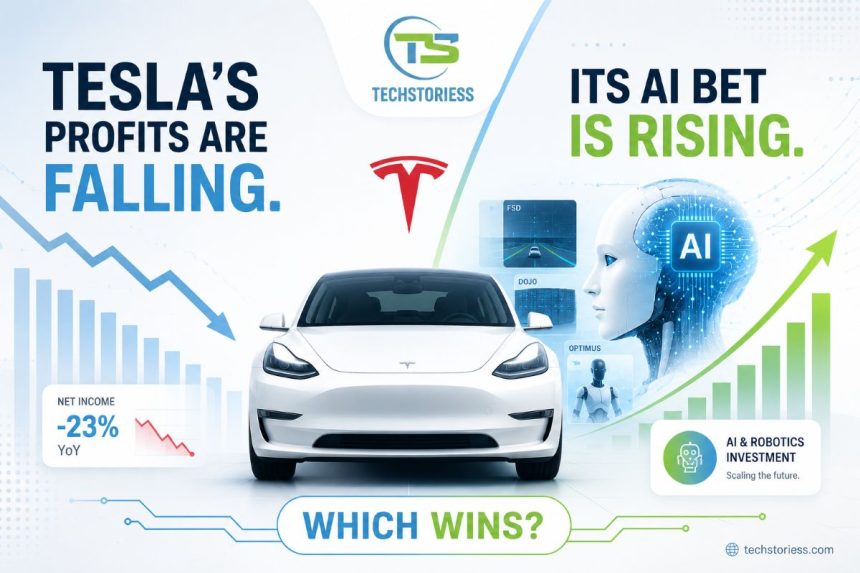
Then investors looked at the profit line and didn’t like what they saw. Adjusted earnings per share came in at just $0.33, against a consensus estimate near $0.51 – a miss of roughly a third. GAAP net income fell 5% year-over-year to $1.11 billion. Operating income also dropped 57% to about $400 million, and operating margin fell from 4.1% to 1.4% – a decline of roughly 66% from the previous year. Free cash flow turned negative, at a deficit of $1.09 billion, reversing a $1.44 billion surplus in the prior quarter. The stock lost more than 12% over the following sessions, erasing over $140 billion in market value – one of the sharper single-week drawdowns in Tesla’s history as a public company.
Where the money actually went
Instead of the demand problem, it was a spending problem, by design. Tesla’s operating expenses rose 47% to $4.35 billion, and capital expenditure jumped 142% year-over-year to $5.79 billion, driven by robotaxi expansion, Optimus humanoid robot production lines, in-house AI compute, and new semiconductor fabrication investment. CFO Vaibhav Taneja told analysts the company expects full-year 2026 capex to exceed $25 billion, with further increases likely over the next two to three years, and said Tesla is arranging debt facilities for up to $30 billion in additional borrowing capacity to fund the buildout.
Automotive gross margin also slipped, to 16.9% (16.3% excluding regulatory credits), as Tesla leaned on lower-cost Model 3 and Model Y variants following the retirement of Model S and Model X. Even the profit cushion narrowed. Regulatory credit revenue registered $146 million, down from $439 million a year earlier, removing a buffer that had flattered margins in past quarters.
Not every segment struggled, though. The company found pockets of strength elsewhere. Energy generation and storage revenue rose 13% to $3.14 billion, and the services segment grew 50% to $4.58 billion, both hitting record gross margins. Full self-driving subscriptions also climbed 56% to 1.48 million. These are the businesses Tesla’s bulls point to as evidence that the software-and-services narrative still holds, even as the core car business absorbs margin pressure.
Musk’s answer: spend faster, not slower
On the earnings call, CEO Elon Musk made no attempt to play down the scale of the shift. Tesla, he said, is entering “the largest investment period” in its history, aimed at scaling robotaxi, Optimus manufacturing, AI compute, and semiconductor capacity simultaneously. His stated philosophy was blunt: it’s acceptable to be less capital-efficient if it means moving faster. Optimus in particular carries outsized ambition – Musk has previously called it a business that could eventually be worth trillions, a claim that remains untested given the robot is still in pre-production, with Tesla acknowledging it has no existing supply chain to draw on and that initial units will be used for internal data collection rather than customer deployment.
Meanwhile, robotaxi has expanded to seven U.S. markets, with Cybercab test drives underway. Musk struck a more cautious tone than in prior quarters on the pace of that rollout, emphasizing safety over speed of geographic expansion.
The CFO’s dilemma, in one chart
Tesla’s quarter captures a trade-off familiar to any CXO weighing AI investment: near-term earnings versus long-horizon capability. Tesla is choosing to run at a 1.4% operating margin, funded partly by debt, in exchange for a claim on markets – autonomous ride-hailing, humanoid labor, in-house AI silicon – that don’t yet generate meaningful revenue and may not for years.
That, by itself, is not an unusual position for a company mid-transition. What makes Tesla’s case unusually visible is the bet size relative to the base business. A $25 billion-plus capex year against roughly $1.1 billion in quarterly net income is a multiple most industrial companies would comfortably avoid. Analysts on the call pressed on execution risk – juggling robotaxi, Optimus, and chip fabrication at once – and on supply chain constraints in batteries and electronics that management confirmed remain unresolved.
What CXOs should actually take from this
Three things are worth separating, as they carry different implications:
Demand is not the problem. Record deliveries and record revenue say the core product is still doing good in sales. Any reading of this quarter as a demand story is wrong.
Margin compression is structural, not cyclical. Lower average selling prices, the loss of regulatory credit income, and heavier R&D allocation are unlikely to reverse quickly, regardless of the performance of new AI initiatives.
The revenue does not validate the AI bet. Robotaxi and Optimus remain pre-commercial at a meaningful scale. The market’s sharp reaction reflects investors’ waning willingness to fund that gap indefinitely on narrative alone – they want to see the timeline compress.
The scoreboard doesn’t exist yet
Neither, decisively – yet. Tesla’s core auto business is proving it can still grow volume, but not while protecting margin. Its AI and robotics bet is real, well-funded, and backed by serious capital commitments from suppliers including TSMC, Samsung, Panasonic, and Micron, according to Musk’s own comments on the call. But it remains a future claim, not a line on the income statement.
The honest answer is that Tesla has decided near-term profit was never the point this quarter – it’s a multi-year bet where 2026’s profit and free cash flow are the price of admission. Whether that trade wins depends entirely on execution timelines Tesla itself has repeatedly slipped in the past. Investors just signaled, within a single week, that patience for that pattern is wearing thin.