


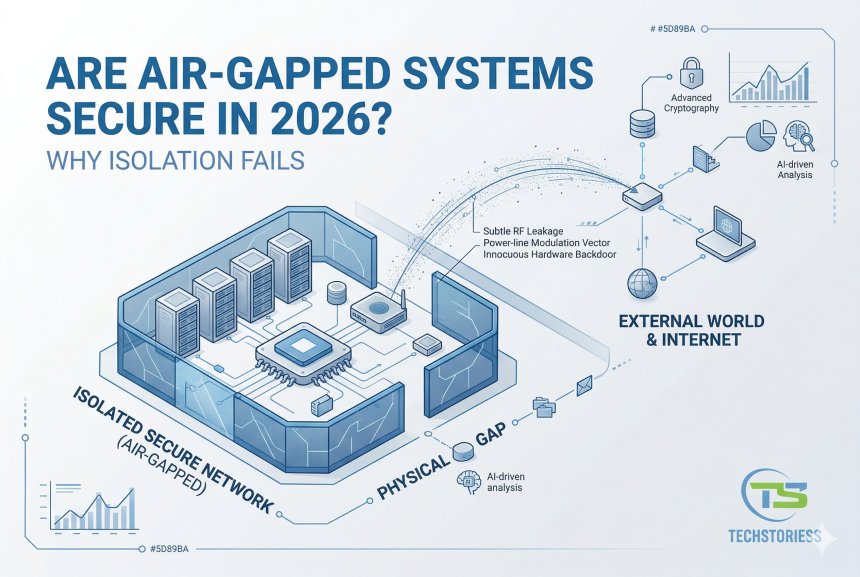
Air gaps have long been considered one of the best ways to ensure cybersecurity, especially in environments where a security compromise could lead to catastrophic operational, economic, or even national security consequences.
- Understanding Air-Gapped Systems
- Limitations of Air-gapped systems
- Why do air-gapped systems fail?
- Physical Media Compromise
- Insider Threats
- Social Engineering Attacks
- Supply Chain Attacks
- Covert Channels and Side-Channel Attacks
- Zero-Trust Architecture
- Strong Network Segmentation
- Secure Unidirectional Data Transfer
- Comprehensive Endpoint Protection
- Strict Access and Media Controls
- Controlled Patch Management
- Employee Training and Awareness
- Continuous Monitoring and Auditing
- The Real-World Impact of Air-Gap Breaches
- Moving Beyond Air Gaps: Blueprint for Measurable Industrial Security
- Strategic Risk Assessment & Operational Context Modeling
- Real-Time Asset Visibility & Passive Discovery
- Advanced Network Segmentation & Secure Architecture
- Identity Governance & Privileged Access Management
- Secure Remote Access & Vendor Risk Controls
- OT-Aware Patch & Vulnerability Management
- Continuous Monitoring & Behavioral Detection
- Resilience Engineering & Incident Response
- Supply Chain & Firmware Integrity
- Zero Trust Adapted for OT
- Physical & Environmental Security Integration
- Workforce Training & Cultural Alignment
- Conclusion
Air-gapped systems have historically protected military networks, nuclear facilities, and industrial control environments that support critical infrastructure security. The approach is based on a straightforward logic — malware and cyberattacks are transmitted through connected networks, so no connection means no intrusion.
However, modern threat actors, increasingly sophisticated adversary techniques, and rising operational complexity have revealed the practical limitations of isolation-only strategies.
Understanding Air-Gapped Systems
Air-gapped systems protect critical environments by physically or logically separating them from unsecured networks, particularly the public internet. Organizations deploy them to secure high-value assets that directly control physical processes, such as industrial control systems (ICS), backup repositories, and classified computing environments.
This isolation aims to prevent digital breaches from affecting real-world operations by eliminating direct communication channels between production networks and protected zones. Air gaps are highly effective against common network-based threats such as remote scanning, ransomware campaigns, botnet activity, and automated malware distribution.
Limitations of Air-gapped systems
While air gapped systems efficiently protect organizations from cyberthreats they are not inherently immune to all forms of attack. They are exposed to attacks involving insider access, removable media, supply chain compromise, or covert data exfiltration techniques.
• Physical or logical separation prevents direct remote intrusion.
• Commonly used in operational technology (OT) and industrial control systems.
• Designed to shield cyber-physical environments from internet-facing threats.
Why do air-gapped systems fail?
Air gaps protect against remote network threats but they do not address insider activity, physical access risks, or advanced covert techniques. Modern cyber-physical security requires layered defenses built on the assumption that compromise is possible. Threat actors increasingly exploit indirect pathways — supply chains, removable media, identity abuse, and side-channel techniques — to bypass isolation controls.
Here are some major reasons that air-gapped systems remain vulnerable:
Physical Media Compromise
Even in strictly isolated environments, operational data must occasionally cross security boundaries through removable media. USB drives, portable hard disks, external SSDs, and third-party maintenance laptops effectively create physical bridges between secure and external systems. The Stuxnet incident remains the most well-documented case of malware infiltrating an air-gapped industrial environment through infected removable devices.
The attack did not rely on internet connectivity; it leveraged trusted operational workflow. Malicious code traveled alongside legitimate files, exploiting human procedures rather than network weaknesses. Once introduced, it spread internally and executed its payload against targeted industrial control components.
Physical transport does not guarantee security. Without strict device control policies, malware scanning, and transfer validation protocols, removable media becomes one of the most effective methods for bypassing isolation controls.
• Removable media introduces hidden malware risks.
• Manual transfers create unmonitored attack paths.
• Inadequate device scanning enables silent infiltration.
Insider Threats
Air-gapped systems assume that authorized personnel will adhere strictly to established security procedures. However, insider threats — whether malicious, coerced, or negligent — remain one of the most significant vulnerabilities in isolated environments. Once physical access is granted, traditional perimeter defenses provide limited resistance.
The disclosures by Edward Snowden illustrated how privileged access can override multiple layers of technical control when governance and oversight are insufficient. While not specific to air-gapped systems, the case underscores the systemic risk posed by trusted insiders with elevated permissions.
Within critical infrastructure security environments, insider misuse can disrupt industrial processes, compromise sensitive operational data, or enable external adversaries. If privilege management and monitoring are weak, isolation controls quickly lose effectiveness.
• Authorized users can bypass isolation controls.
• Insider data theft remains difficult to detect in closed environments.
• Privileged access significantly increases systemic risk.
Social Engineering Attacks
Rather than attacking technical controls directly, adversaries frequently exploit predictable human behavior. In so-called “USB drop” attacks, malicious actors intentionally leave infected drives in accessible areas, relying on curiosity to trigger compromise. Behavioral research has shown that a notable percentage of found USB devices are plugged into corporate systems, highlighting human susceptibility to manipulation.
Phishing emails, impersonation tactics, and fraudulent vendor communications can persuade employees to introduce diagnostic tools, unauthorized updates, or manually transferred files into secure environments. Even when network isolation is strong, procedural manipulation can create pathways around technical safeguards.
Without structured security awareness programs and enforcement mechanisms, human trust, urgency, and routine operational shortcuts become effective attack vectors.
• Deceptive tactics bypass technical defenses.
• Human curiosity and trust become entry points.
• Awareness gaps undermine air-gapped protections.
Supply Chain Attacks
Air-gapped systems depend heavily on hardware, firmware, and software sourced from external vendors. However, compromise can occur before equipment is ever deployed into a secure facility. The SolarWinds supply chain attack demonstrated how malicious code embedded within trusted software updates could infiltrate thousands of organizations through legitimate distribution channels.
In supply chain attacks, malware may be inserted during manufacturing, firmware development, software compilation, or distribution processes. Because the compromise occurs upstream, traditional network isolation controls provide no defense once the component is installed internally.
Without rigorous vendor validation, cryptographic integrity verification, and supply chain auditing, trusted providers can become high-impact infiltration vectors.
• Vendor compromise introduces pre-installed malware.
• Firmware-level threats evade traditional monitoring controls.
• Trusted supply chains become sophisticated infiltration pathways.
Covert Channels and Side-Channel Attacks
Advanced adversaries increasingly exploit physical characteristics of hardware rather than network connectivity. Side-channel attacks analyze unintended emissions such as electromagnetic radiation, acoustic signals, power consumption patterns, optical signals, or thermal variations to infer sensitive information.
Academic research has demonstrated that cryptographic keys and other sensitive data can sometimes be extracted through electromagnetic monitoring or power analysis techniques. These methods do not require internet connectivity — only proximity and signal interpretation.
Such findings reinforce a critical reality: network isolation does not equate to physical isolation. Hardware physics introduces measurable signals that can serve as covert communication channels in high-value environments.
• Unintended hardware emissions create covert communication paths.
• Electromagnetic and power analysis can reveal sensitive data.
• Physical-layer vulnerabilities challenge traditional isolation assumptions.
Misconfiguration Risks
Even isolated environments depend on correct and secure configuration practices. Minor errors — such as incorrect firewall rules, poorly segmented VLANs, or enabled wireless adapters — can silently bridge isolation boundaries while creating a false sense of protection. Maintenance oversights, including temporary rule changes or disabled controls, may also introduce unintended exposure.
Hybrid IT–OT environments, layered access policies, and complex scripting increase operational fragility, allowing small administrative mistakes to escalate into systemic weaknesses. As a result, an entire isolation strategy can be undermined by minor configuration lapses.
• Misconfigured systems create hidden connectivity paths.
• Maintenance lapses weaken isolation controls.
• Complex environments increase human error probability.
Outdated Systems and Patch Delays
Updating air-gapped systems is often slow and resource-intensive. Patch delays allow known vulnerabilities to persist for extended periods. Once attackers gain access through physical, insider, or supply chain vectors, they can exploit these weaknesses to escalate privileges or move laterally.
Isolation can foster complacency, leading teams to deprioritize updates because systems are not internet-facing. Over time, legacy operating systems, outdated firmware, and unsupported software become prime exploitation targets through publicly documented vulnerabilities.
• Manual patching slows remediation cycles.
• Known exploits remain viable longer.
• Operational friction discourages consistent updates.
Shadow Connections
Temporary or undocumented connections frequently undermine isolated architectures. Maintenance laptops, rogue wireless access points, cellular modems, or emergency remote-access configurations can unintentionally bridge air gaps through transient network pathways.
These shadow connections invalidate core isolation assumptions. Limited infrastructure visibility and incomplete asset inventories may leave such exposures undetected, making hidden connectivity a structural vulnerability.
• Undocumented links bypass oversight.
• Temporary connections can become persistent risks.
• Visibility gaps weaken cyber-physical security.
Limited Monitoring and Incident Response
Air-gapped systems often restrict real-time monitoring and centralized analytics due to limited connectivity. Deploying advanced telemetry, automated detection, or cloud-based SIEM solutions becomes challenging.
Reduced visibility delays detection and extends response timelines. Suspicious activity may go unnoticed when log reviews are manual and infrequent, increasing breach impact before containment.
• Limited telemetry delays detection.
• Manual analysis slows investigations.
• Response timelines expand during active threats.
Operational Inefficiency and Workarounds
Strict isolation can reduce operational efficiency. In high-pressure environments, employees may bypass procedures to meet deadlines. Personal devices, unauthorized tools, or informal file transfers introduce new vulnerabilities into protected zones.
Over time, operational frustration erodes security discipline. Air gaps can create a perceived trade-off between productivity and protection, where convenience gradually overrides compliance.
• Manual controls reduce productivity.
• Users create insecure alternatives.
• Convenience often overrides policy.
So, we see that critical infrastructure security cannot rely solely on disconnection; it requires resilience against human error, hardware manipulation, and systemic vulnerabilities. Organizations must shift from perimeter-centric thinking to adaptive, defense-in-depth strategies.
• Isolation blocks remote threats but not insider or physical risks.
• Advanced attack methods bypass traditional barriers.
• Resilience demands layered security controls.
Best Alternatives and Practices: A Layered Security Approach
As threat actors systematically target global supply chains, exploit human behavioral vulnerabilities, and leverage sophisticated covert exfiltration techniques, organizations must shift away from perimeter-centric security models toward resilience-driven security architecture. The most effective strategy today is not dependence on a single defensive mechanism, but the adoption of a layered security framework that assumes compromise, constrains lateral movement, enforces least-privilege access controls, and continuously validates trust across identities, endpoints, applications, and operational workflows.
Zero-Trust Architecture
In distributed industrial environments, Zero Trust eliminates implicit network trust. Every user, device, and workload must continuously verify identity and authorization.
Rather than replacing air gaps, Zero Trust strengthens them by adding continuous validation and granular access control. Security becomes dynamic instead of perimeter-bound.
• Enforces continuous authentication and authorization.
• Limits lateral movement.
• Reduces reliance on perimeter-only defense.
Strong Network Segmentation
Structured segmentation divides networks into tightly controlled zones with defined communication paths. Micro-segmentation restricts east-west movement even after initial compromise.
Segmentation complements physical isolation by adding logical containment.
• Limits blast radius.
• Protects critical components.
• Controls lateral traffic.
Secure Unidirectional Data Transfer
Data diodes enforce one-way communication, blocking exfiltration while allowing controlled inbound updates. This reduces dependence on removable media and ad-hoc transfers.
Controlled data flow strengthens isolation without disrupting operations.
• Prevents outbound data leakage.
• Enables secure updates.
• Reduces removable media risk.
Comprehensive Endpoint Protection
Behavior-based endpoint tools detect anomalies without relying solely on signatures. AI-driven monitoring identifies suspicious activity even inside isolated networks.
Local detection improves resilience against insider and covert threats.
• Detects behavioral anomalies.
• Protects OT and ICS systems.
• Reduces privilege misuse risk.
Strict Access and Media Controls
Physical access governance and mandatory media scanning are essential. Logging and audit trails enhance accountability and reduce unauthorized interaction.
Operational discipline keeps isolation effective.
• Controls physical access.
• Scans removable media.
• Audits privileged activities.
Controlled Patch Management
Structured patch validation and scheduled maintenance reduce vulnerability exposure without disrupting uptime.
Timely updates prevent legacy systems from becoming exploitation anchors.
• Maintains system integrity.
• Reduces exposure to known exploits.
• Ensures repeatable update processes.
Employee Training and Awareness
Humans remain a primary vulnerability in air-gapped systems. Regular training, simulations, and awareness programs reduce social engineering success and reinforce secure behavior.
Security culture strengthens compliance and resilience.
• Reduces phishing risk.
• Promotes secure device handling.
• Builds accountability.
Continuous Monitoring and Auditing
Local monitoring, behavioral baselining, and periodic audits restore visibility inside isolated environments. Continuous assessment identifies shadow connections and configuration drift early.
Isolation combined with visibility enhances overall security posture.
• Improves anomaly detection.
• Identifies misconfigurations.
• Strengthens compliance assurance.
The Real-World Impact of Air-Gap Breaches
Here are several real‑world examples showing how air‑gapped systems — once thought impervious — have been compromised or proven vulnerable:
Agent.BTZ Shows How USBs Bypass Air-Gapped Security”
One prominent case involves U.S. military networks, where malware called Agent.BTZ spread via infected USB drives, showing how removable media can bypass physical isolation and compromise supposedly secure environments.
Ramsay Espionage Toolkit: Malware That Breaches Air-Gapped Windows Systems
In 2020, researchers discovered the Ramsay malware, specifically designed to target air-gapped Windows machines. Introduced via compromised storage devices, it silently exfiltrated sensitive documents from isolated systems, proving that physical separation alone cannot guarantee security.
Side-Channel Attacks: Leaking Data Through Electromagnetic and Acoustic Signals
Experiments like AirHopper have shown that attackers can exploit electromagnetic emissions, acoustic signals, or even thermal fluctuations to extract data from air-gapped systems. These side-channel methods bypass traditional network protections, demonstrating that isolation cannot fully prevent information leakage. This creates the risk of electromagnetic attacks.
Supply Chain Attacks: Compromised Firmware and Software Undermining Isolation
Malicious firmware or software inserted during production or deployment can compromise air-gapped environments from day one. Industrial and enterprise systems are increasingly targeted through this vector, showing that isolation is ineffective without supply chain verification.
Insider Risks: How Human Errors and Unauthorized Devices Defeat Air Gaps
Even with strict policies, human mistakes or deliberate actions — such as connecting unverified USB drives or executing unauthorized updates — can introduce malware into air-gapped systems, bypassing all network-based safeguards.
Collectively, these incidents demonstrate that while air gaps reduce exposure, they cannot guarantee security without layered, continuously monitored defenses.
Moving Beyond Air Gaps: Blueprint for Measurable Industrial Security
Airgaps alone can no longer deliver failsafe protection for industrial environments. Guidance from NIST SP 800-82 Rev. 3, CISA, and ISA/IEC 62443 consistently reinforces that defense-in-depth must replace perimeter-only thinking.
Regulatory pressure is also intensifying. Governments worldwide are strengthening cybersecurity mandates for critical infrastructure, requiring demonstrable resilience rather than assumed protection. Compliance now demands continuous risk assessment, documented controls, and verifiable monitoring — reinforcing that isolation must be supported by measurable, auditable security practices.
Below is a blueprint grounded in research, regulatory expectations, and real-world industrial breach patterns.
Strategic Risk Assessment & Operational Context Modeling
Traditional IT risk models underestimate OT risk by overlooking safety, uptime dependencies, and cascading consequences. Effective modeling must combine cyber likelihood with operational impact — including downtime costs, regulatory penalties, environmental damage, and safety risks. NIST stresses that ICS assessments evaluate both cybersecurity and process safety impacts, especially in sectors like energy and utilities.
Key Actions:
• Map critical processes to PLCs, HMIs, SCADA, and field devices.
• Quantify financial and safety impact of downtime.
• Conduct recurring threat modeling for ransomware, vendor compromise, and insider misuse.
Real-Time Asset Visibility & Passive Discovery
Incomplete asset inventories remain a core OT weakness. Because many OT devices cannot tolerate active scanning, passive monitoring and protocol-aware discovery are essential for maintaining visibility and detecting unauthorized changes.
Key Actions
• Deploy passive monitoring for Modbus, DNP3, OPC, and Profinet.
• Maintain updated inventories of firmware and device models.
• Detect unexpected configuration changes.
Advanced Network Segmentation & Secure Architecture
Segmentation is architectural discipline, not compliance formality. ISA/IEC 62443 recommends dividing systems into zones connected by controlled conduits. Flat OT networks still allow lateral movement across production systems.
Key Actions
• Separate IT, DMZ, and OT zones with industrial firewalls.
• Deploy unidirectional gateways where feasible.
• Restrict east-west traffic through micro-segmentation.
Identity Governance & Privileged Access Management
Stolen or misused credentials remain dominant breach vectors. Shared and hardcoded OT credentials significantly increase exposure.
Key Actions
• Eliminate shared administrative accounts.
• Implement PAM for PLC and SCADA access.
• Enforce MFA and audit vendor sessions.
Identity now functions as the operational perimeter.
Secure Remote Access & Vendor Risk Controls
Vendor pathways and remote connectivity remain high-risk exposure points. Time-bound, monitored sessions reduce attack surfaces.
Key Actions
• Replace always-on VPNs with just-in-time access.
• Require MFA and device validation.
• Monitor and log all remote activity.
OT-Aware Patch & Vulnerability Management
While uptime complicates patching, unpatched systems attract exploitation. Mature vulnerability programs reduce breach impact and lifecycle duration.
Key Actions
• Use passive ICS-focused vulnerability detection.
• Prioritize remediation by exploitability and criticality.
• Test updates before production deployment.
Continuous Monitoring & Behavioral Detection
Industrial environments require protocol-aware detection capable of identifying abnormal command sequences or PLC logic changes.
Key Actions
• Deploy OT-specific IDS/IPS.
• Monitor command-level activity.
• Correlate OT telemetry with SIEM platforms.
Detection speed directly influences operational impact.
Resilience Engineering & Incident Response
Recovery planning is as critical as prevention. OT response must prioritize safety alongside containment and include engineering leadership.
Key Actions
• Develop OT-specific response playbooks.
• Conduct tabletop exercises.
• Maintain offline PLC backups and test restoration.
Supply Chain & Firmware Integrity
Firmware tampering or malicious updates can compromise systems before deployment.
Key Actions:
• Require SBOMs from vendors.
• Verify firmware signatures.
• Audit third-party workflows and scan removable media.
Industrial security depends on supplier integrity.
Zero Trust Adapted for OT
Zero Trust in OT emphasizes continuous verification without disrupting operations.
Key Actions
• Authenticate devices and users.
• Continuously assess trust posture.
• Log activity at defined trust boundaries.
Zero Trust replaces assumption with measurable assurance.
Physical & Environmental Security Integration
Physical access to OT cabinets or USB ports can bypass digital safeguards. Cybersecurity must align with facility controls.
Key Actions
• Restrict access to control rooms and cabinets.
• Monitor USB usage.
• Integrate badge logs with security systems.
Workforce Training & Cultural Alignment
Human factors remain central to industrial breaches. Security awareness must extend to engineers, operators, and maintenance teams.
Key Actions
• Conduct phishing simulations for OT staff.
• Train engineers in secure configuration practices.
• Align executive KPIs with cybersecurity maturity.
Conclusion
Air-gapped systems remain valuable but insufficient as standalone controls. Modern adversaries exploit human behavior, identity weaknesses, and covert channels beyond simple network connectivity.
Critical infrastructure protection now depends on layered cyber-physical security integrating isolation with Zero Trust, segmentation, monitoring, and disciplined governance. The future lies in resilient architecture designed to detect, contain, and recover from inevitable compromise.