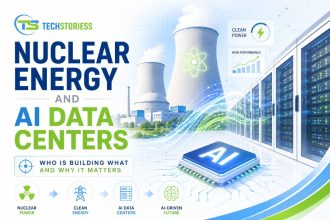



Artificial intelligence is generally perceived as a software revolution. But it relies on real physical infrastructure to drive the power – servers, cooling infrastructure, and unprecedented volumes of electricity. AI data center electricity consumption has moved from a background metric to a central indicator in global energy policy, infrastructure investment, and corporate strategy.
- Inside an AI Data Center: Where Does All the Power Go?
- GPU Power Requirements: The Core Driver
- Northern Virginia: The World’s Most Power-Hungry Region
- Why AI Workloads Are Fundamentally Different From Traditional Computing
- Inference: The Hidden Multiplier
- Grid Infrastructure Impact: When Data Centers Outgrow the Power System
- The Speed Mismatch Problem
- Transmission Bottlenecks and Renewable Energy Complications
- Hyperscale Energy Costs: The Economics of Powering AI at Scale
- Power Procurement Strategy
- Co-location with generation facilities to reduce transmission costs
- The Hidden Cost: How AI Data Center Growth Affects Ratepayers
- The Energy Bottleneck: Why Power Will Determine AI Leadership
- Emerging Responses to the Energy Challenge
- Conclusion: The Energy Paradigm Has Arrived
According to the International Energy Agency (IEA), data centers consumed approximately 415 terawatt-hours (TWh) in 2024-which roughly equals to 1.5% of global electricity demand. Its growth rate is equally substantial- the demand is rising at 12–15% annually, far outpacing global electricity growth. If that pace holds, total consumption could reach 900–1,000 TWh by 2030-comparable to Japan’s entire national electricity use.
A majority of this demand surge is driven by increasing AI workloads. Accelerated computing systems used to train and serve large language models are expected to account for nearly 50% of all future demand growth, with AI-specific consumption expanding at roughly 30% per year. Google and Microsoft each consume roughly 24 TWh annually-placing them alongside mid-sized nations in global electricity rankings. These are no longer just technology firms; they are industrial energy consumers operating at sovereign scale.
Inside an AI Data Center: Where Does All the Power Go?
Rather than being just a larger version of conventional data centers, AI data centers are purpose-engineered for extreme computational density, and every component carries a significant power footprint. Understanding where the energy goes explains why AI data center electricity consumption is so difficult to contain.
GPU Power Requirements: The Core Driver
GPU power requirements have sharply accelerated with each generation of AI hardware. A single high-performance GPU-such as NVIDIA’s H100 or B200 class-can draw 600–700 watts under sustained load, roughly 5–8 times the draw of a high-end consumer GPU from a decade ago. Production AI clusters routinely deploy 10,000 to 50,000 GPUs in a single facility. Running continuously for weeks at maximum utilization, a single large training cluster can consume more electricity than a small town.
Energy distribution inside a hyperscale AI facility typically breaks down as:
- ~60% for compute (GPU servers and supporting processors)
- 20–30% for cooling infrastructure
- ~10% for networking, storage, and power distribution overhead
- Though the Power Usage Effectiveness (PUE) ratios have dropped to as low as 1.2-considered highly efficient-the overhead load remains substantial.
Efficiency gains at the component level are being outpaced by workload growth. Total AI data center electricity consumption keeps rising even as individual GPUs become more efficient per computation.
Northern Virginia: The World’s Most Power-Hungry Region
Northern Virginia best illustrates the concentration of AI data center electricity consumption than Northern Virginia. The region draws over 5 gigawatts (GW) of electricity-comparable to a small country. Dominion Energy, the primary utility serving the area, has disclosed capital expenditure plans running into tens of billions of dollars over the next decade. That spending will ultimately flow through to ratepayers.
Why AI Workloads Are Fundamentally Different From Traditional Computing
The sharp rise in AI data center electricity consumption is not just a matter of more servers doing more work. AI workloads represent a qualitatively different demand profile-one that breaks the operating assumptions underlying decades of data center energy planning.
AI training workloads fully eliminate idle time. Training a frontier model requires thousands of GPUs at near-maximum capacity for weeks or months without interruption-no off-peak periods, no overnight lull. Training a model comparable to GPT-4 in scale can consume tens of gigawatt-hours (GWh)-enough to power tens of thousands of homes for a year. Energy usage scales with model complexity and training frequency, not user count.
Inference: The Hidden Multiplier
Another equally significant driver of AI data center electricity consumption is inference -serving real user queries with a trained model-is equally significant. A single AI query consumes only a fraction of a watt-hour, but scaled across billions of daily requests-from search to code generation to enterprise software-the total becomes enormous. This creates a structural paradox: efficiency per task improves, but aggregate consumption rises because utilization grows faster than efficiency gains. The more accessible AI becomes, the more electricity it consumes.
Additional factors compounding demand:
- AI chips drawing 2–4x more power than conventional CPUs doing equivalent business logic
- High-speed networking fabrics adding ~10% to total facility energy load
- Liquid cooling systems requiring continuous energy to manage sustained GPU heat output
Redundant power infrastructure mandated by enterprise uptime requirements
Grid Infrastructure Impact: When Data Centers Outgrow the Power System
The fast expansion of AI is creating a measurable grid infrastructure impact that is reshaping how utilities plan capacity, regulators set policy, and communities engage with technology investment. Unlike gradual residential demand growth, AI data centers introduce concentrated, high-intensity loads that arrive faster than grid infrastructure can be built.
The Speed Mismatch Problem
Building Data center projects can take 18–24 months. A new transmission line or substation can take 5–10 years to permit, finance, and build. Individual hyperscale AI facilities now routinely require hundreds of megawatts to over 1 GW of dedicated capacity. When multiple projects land in the same region simultaneously-as in Northern Virginia, Phoenix, and the Midwest-cumulative grid infrastructure impact can force utilities to revise decade-long capital plans within a single budget cycle.
Transmission Bottlenecks and Renewable Energy Complications
Even when generation exists, delivering power requires significant transmission and distribution investment. Multiple projects competing for the same interconnection queue create delays measured in years; some have been cancelled outright. State regulators in Virginia, Georgia, and Texas now require rigorous grid impact studies before approving large-scale data center development.
Another layer of challenge is added by renewable energy .Solar and wind are inherently variable; AI workload demand is not. Matching AI data center electricity consumption with clean energy requires either significant storage investment or geographic diversification of sourcing. Without those solutions, AI growth risks locking in fossil fuel generation to meet baseline demand.
Hyperscale Energy Costs: The Economics of Powering AI at Scale
Electricity acts as the defining cost input for AI infrastructure. The rise of hyperscale energy costs is reshaping capital allocation, site selection, and long-term strategic planning across the technology industry. The total cost of powering and cooling a facility over its lifecycle now routinely exceeds the initial capital investment in equipment-forcing companies to treat energy as a primary strategic resource rather than a utility expense.
Power Procurement Strategy
A 1–2 cent-per-kilowatt-hour difference in regional electricity rates translates to tens of millions of dollars in annual operating costs at hyperscale. Leading operators manage hyperscale energy costs through:
Long-term Power Purchase Agreements (PPAs) locking in pricing for 10–20 years
Direct investment in wind and solar generation
Co-location with generation facilities to reduce transmission costs
Direct liquid cooling and immersion cooling to cut thermal management overhead
Nuclear energy partnerships to secure 24/7 zero-carbon baseload power
The nuclear energy trend deserves attention. It reflects recognition that only firm, 24/7 zero-carbon power can match AI’s continuous demand profile while meeting sustainability commitments. Hyperscale energy costs and carbon targets are converging to make nuclear power economically attractive for the first time in decades.
The Hidden Cost: How AI Data Center Growth Affects Ratepayers
Beyond corporate balance sheets to households and small businesses the consequences of rising AI data center electricity consumption extend through the rate base. When utilities upgrade grids for new large-scale industrial loads, those capital costs are socialized across all ratepayers through tariff adjustments. In regions with rapid data center growth, this is already producing visible increases in residential electricity bills.
The concentration effect amplifies the impact. Data centers in a region may collectively consume electricity equivalent to hundreds of thousands of residential homes-but large industrial consumers typically negotiate preferential pricing and tax abatements, shifting a portion of infrastructure costs onto smaller users.
The Cross-Subsidization Debate
To address this situation the Regulatory commissions in Virginia, Texas, and several other states are examining whether large data center operators are contributing proportionately to grid upgrade costs or whether those costs are being disproportionately absorbed by residential ratepayers. Water consumption adds another dimension: large AI data centers require millions of gallons per day for cooling, creating direct competition with municipal and agricultural users in water-stressed regions. As AI data center electricity consumption scales, its impact on ratepayers will become increasingly prominent in public and political discourse.
The Energy Bottleneck: Why Power Will Determine AI Leadership
The most consequential shift in AI over the next decade may occur in energy procurement. The combination of escalating GPU power requirements, rising hyperscale energy costs, and mounting grid infrastructure impact is creating an energy bottleneck that computer innovation alone cannot resolve.
Global AI data center electricity consumption could double by 2030, potentially exceeding 1,000 TWh. Individual projects are already targeting gigawatt-scale capacities. Microsoft’s reported multi-gigawatt AI campus plans, Google’s sustained renewable procurement, and Amazon’s nuclear power agreements all signal that energy strategy has become inseparable from AI strategy.
Emerging Responses to the Energy Challenge
The industry is pursuing several complementary approaches:
- Energy-aware workload scheduling that shifts training to periods of lower grid demand or higher renewable availability
- Geographic diversification of AI infrastructure to access diverse energy markets
- Next-generation cooling technologies for extreme GPU densities
- Partnerships with grid operators to accelerate transmission infrastructure permitting
- Hardware efficiency improvements targeting better performance per watt
None of these fully resolves the tension between AI’s growth trajectory and the pace of energy infrastructure expansion. Power plants, transmission lines, and substations take years to build. AI demand does not wait.
Conclusion: The Energy Paradigm Has Arrived
In the fast developing AI industry the energy is no longer a background input-it is the primary constraint. The rapid rise in AI data center electricity consumption, driven by escalating GPU power requirements and compounded by the concentrated grid infrastructure impact of hyperscale development, is reshaping how companies, utilities, regulators, and communities think about the cost and control of electricity.
Here Real-world evidence indicates conclusive findings: Google and Microsoft consume electricity at nation-state scale; Northern Virginia operates at multi-gigawatt density; utility capital plans across AI-intensive markets are being rewritten to accommodate demand that did not exist five years ago. The hyperscale energy costs that were once a footnote in technology finance now determine where AI gets built-and who bears the cost of building the infrastructure to support it.
Rather than defining constraints, the next decade will not be processor speed or model size. It will be access to reliable, affordable, large-scale power.
Organizations that secure that access-through long-term procurement, infrastructure co-investment, or regulatory engagement-will hold a structural advantage in the AI economy. Those that do not will find their AI ambitions bounded not by algorithms or capital, but by watts.