


For decades the engineers across the globe have been struggling with a crucial challenge: how to process sensitive data without exposing it. At the frontier of applied cryptography two distinct answers appear: confidential computing and homomorphic encryption. Both of these enable users to compute invisible data – each of them approaches it in fundamentally different ways. They radically differ in speeds, and address very different threat models and operational priorities.
With the confidential computing market approaching an ambitious mark of $54 billion by 2026 and regulators like the EU enhancing AI Act mandates for privacy-preserving computation, the engineering teams dealing with sensitive data must understand these two paradigms -more practically than academically.
In this article we will explain the operational functions of each technology, their respective areas of strengths, and a clear, straightforward framework for choosing the one that is most relevant for you.
Confidential Computing: Hardware-Enforced Privacy
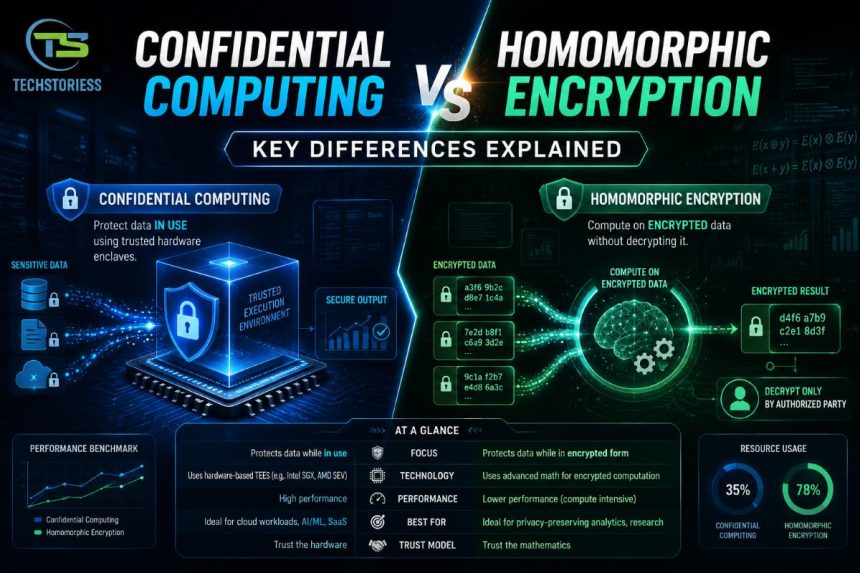
Confidential computing secures data in use – that is, while it’s being processed in memory. Conventional encryption generally misses this gap. While the data is encrypted at rest and in transit, but to be computed on the data must be decrypted. That gap is perfectly closed by Confidential computing – by employing Trusted Execution Environments (TEEs).
How TEEs Work
A TEE refers to an isolated, hardware-protected region of a processor. Here the code executes and data lives beyond the reach of every privileged layer – the operating system, hypervisor, or even the cloud provider’s own infrastructure. It is just like a securely locked vault inside the CPU itself, which restricts unauthorized visibility into workloads and memory.
The cornerstone of TEE cryptographically is remote attestation – a process that proves to external parties that specific code is running in a specific isolated environment. This facilitates integrity verification without trusting the underlying infrastructure.
Intel TDX and AMD SEV: The Market Leaders
Today the enterprise TEE landscape is dominated by Intel and AMD:
- Intel Trust Domain Extensions (TDX) – Introduced with 4th-gen Xeon Scalable processors, TDX creates hardware-isolated virtual machines called Trust Domains. In this model, the entire memory of the virtual machine is encrypted and isolated from the hypervisor. TDX plays a key role in full VM-level confidentiality, to support lift-and-shift existing workloads with minimal code changes.
- AMD Secure Encrypted Virtualization (SEV) – AMD’s answer encrypts each VM’s memory using unique per-VM encryption keys stored inside the processor. SEV-SNP, the latest generation, adds memory integrity protection which prevents replay and aliasing attacks at the hypervisor level.
- Arm Holdings Confidential Compute Architecture (CCA) – With the growing adoption of ARM-based server deployments, CCA introduces isolated execution environments at the VM level technically termed as “Realms” – and is gaining increasing relevance as ARM expands its footprint in cloud infrastructure.
Cloud Provider Adoption
Confidential VMs are now offered as generally available products by all three major cloud providers, namely AWS, Microsoft Azure, and Google Cloud. Google Cloud Confidential VMs, Microsoft Azure Confidential Computing, and AWS Nitro Enclaves each offer TEE-backed infrastructure – meaning confidential computing has gone beyond being a niche research prototype to becoming a production billing line item.
Rather than confidential computing you don’t need you to trust your hardware instead of trusting your cloud provider. That is a much smaller surface which is easier to audit and validate.
Homomorphic Encryption: Mathematics as a Shield
Homomorphic encryption (HE) applies a completely novel approach. It doesn’t isolate computation in hardware, but mathematically transforms the data so that operations performed on encrypted data produce an encrypted result – which upon decryption matches the result you would get from operating on the plaintext. Let’s understand by an example: for instance, a bank can run risk-analysis calculations on encrypted customer financial records without ever decrypting them.
In this instance, the notable point is that your data remains hidden from the server throughout the computation lifecycle – the server can not see your data even for a moment. It’s effectively manipulating encrypted mathematical representations. Only when you decrypt it with your private key does the meaningful answer emerge.
The Three Flavors
Partially Homomorphic Encryption (PHE) – This encryption supports only single operation (addition or multiplication) for an unlimited number of times. Being partially homomorphic, RSA is a practical cryptographic approach today for narrow use cases like encrypted voting or simple aggregations.
Somewhat Homomorphic Encryption (SHE) – This model supports addition as well as multiplication, but for a limited operational depth before noise accumulates and the ciphertext becomes unrecoverable. It is an ideal middle-ground solution for fixed-depth computations like certain ML inference tasks.
Fully Homomorphic Encryption (FHE) – FHE supports arbitrary computation on encrypted data. Craig Gentry’s 2009 paper proved the possibility of this concept; FHE has been made progressively more practical by schemes like CKKS, BGV, and TFHE. However, it is still 100–1,000× slower compared to plaintext computation.
Why Is It So Slow?
Every operation in FHE introduces “noise” into ciphertexts. Each multiplication increases noise and the decryption fails once it exceeds a threshold. To efficiently manage this enterprises need bootstrapping – an effective but extremely expensive operation to reduce noise. While the bootstrapping costs have been highly reduced with modern FHE schemes, the fundamental overhead remains a significant engineering challenge for complex computations.
Lets picture the comparison- if a neural network inference job consumes 10ms in plaintext it may take 10–30 seconds under FHE. That might be acceptable for batch offline processing, but it isn’t an ideal fit for real-time user-facing applications.
Performance & Practical Trade-offs
The most decisive factor between these two approaches is the performance gap. Confidential computing typically adds only a modest overhead – generally ranging between 5 and 15% on compute-intensive workloads as the data is still plaintext inside the enclave, and modern TEE implementations are heavily optimized.
Homomorphic encryption, especially FHE, on the other hand, introduces substantial computational overhead. While the widely cited 1,000X figure is directionally accurate for highly complex workloads, it reflects the worst case of operations such as deep neural network inference. However, it works extremely well for simpler computations like aggregations and linear operations using the CKKS scheme. In such instances the speed is much faster, sometimes only 10-50× overhead. The significant growth of OpenFHE and Microsoft SEAL have improved tooling maturity and developer accessibility, and GPU-accelerated FHE is fast emerging as a promising optimization layer.
Lets decrypt the feasibility of these models in today’s enterprise environment – today confidential computing is production-ready for almost any workload while FHE is production-ready only for specific, well-defined computation patterns – particularly the ones involving linear algebra at moderate depth.
EU AI Act & Regulatory Compliance
Both technologies have come under sharp regulatory focus under the EU AI Act, which mandates privacy-preserving computation for high-risk AI systems. These technologies can satisfy the Act’s requirements – but through different mechanisms.
Confidential computing relies on remote attestation to satisfy the Act’s requirements. Remote attestation is a cryptographically verifiable proof confirming that code is running in an isolated environment. It allows regulators to verify that a specific approved model version is running without modification, and that data never leaves a protected boundary.
Homomorphic encryption uses mathematical guarantees to satisfy requirements; the data processor itself is unable to access plaintext user data. This particularly satisfies the Article 10 (data governance) requirements mandating that the data minimization must be demonstrated technically rather than through policy.
GDPR alignment – Both approaches legally comply with GDPR’s “data protection by design” principle. While HE offers a stronger mathematical claim; CC assures stronger operational maturity and audit trail.
Healthcare and finance – confidential computing is increasingly cited in compliance architecture documentation in HIPAA-adjacent workloads in the U.S. and MiFID II in Europe. Its cloud-native availability and attestation capabilities make it easier to operationalize at enterprise scale.
Rather than mandating a specific technology the EU AI Act mandates demonstrable privacy preservation. While confidential computing and homomorphic encryption can satisfy this condition, documentation and attestation requirements favor CC for most teams due to its tooling maturity.
How to Choose: A Practical Framework
Instead of treating this as a binary choice based on ideological preference, a majority of modern privacy architectures use both technologies according to workload requirements- confidential computing for runtime workload isolation and homomorphic encryption for specific outsourced analytics. If you must choose then these questions will help you take informed decision:
What’s your latency tolerance?
If you need results in real time, HE is likely not operationally feasible. Go for confidential computing instead.
Who do you not trust?
If you don’t want to trust the hardware manufacturer, then HE is the only option to consider. In case if you can’t trust the cloud provider but trust Intel/AMD, then CC works best for you.
Is the computation well-defined and bounded?
When it comes to predictable and fixed algorithms like logistic regression, sum aggregations, or linear layers FHE is an excellent solution. Arbitrary application logic requires CC.
Do you have 6+ months to invest in cryptographic engineering?
For enterprise-grade FHE implementations you must possess or hire deep expertise. CC presents a much quicker deployment path as it can be deployed in days on existing cloud infrastructure.
Is quantum resistance required in your threat model?
For data having a sensitivity horizon of more than a decade, lattice-based FHE schemes assure post-quantum security that hardware TEEs do not.
Key Takeaways
As we approach the conclusion, let us summarise the key takeaways:
- Confidential computing is production-ready for today’s enterprise workloads and requires minimal overhead making it the right default for most regulated workloads.
- Homomorphic encryption, while mathematically stronger, can be operationally demanding making it an ideal choice for specific, bounded, latency-tolerant computations.
- Both the technologies satisfy the EU AI Act and GDPR; CC has stronger tooling for compliance documentation.
- Intel TDX and AMD SEV remain the most prominent forms of TEE infrastructure; all major clouds offer confidential VMs as GA products.
- In FHE the decisive constraint is 1,000× overhead that still limits mainstream deployment – but with hardware acceleration and algorithmic improvements this overhead is steadily shrinking.
- To gain maximum privacy resilience and architectural flexibility, consider using hybrid architectures that employ TEEs for key management and FHE for outsourced computation.
Conclusion
Gradually the gap between the two technologies – performance and practical deployability is narrowing. FHE is registering a continuous improvement in its performance – roughly 10× per 3–4 years with the introduction of hardware accelerators like FPGAs and dedicated ASICs. Bootstrapping has been made significantly faster by startups like Zama and academic labs at Massachusetts Institute of Technology, Stanford University, and Centrum Wiskunde & Informatica.
Talking about CC, the threat surface has been reducing as side-channel mitigations mature and attestation standards consolidate (see the Internet Engineering Task Force RATS working group). Over the next decade ARM CCA will hopefully bring confidential computing to billions of edge devices.
Hybrid architecture is the most interesting near-term development: employing a TEE to securely generate and manage FHE keys, then offloading encrypted computation to untrusted servers. This approach combines the performance of CC’s enclave for key operations with the mathematical guarantee of FHE for bulk analytics. Moreover, it’s already being prototyped in healthcare genomics and financial services which signals growing enterprise confidence in hybrid privacy architectures.
So instead of framing the debate as a winner-takes-all contest between two technologies it should be framed architecturally – which parts of your data pipeline need hardware isolation, and which parts need mathematical proof. It leads to a more practical answer: both technologies have value depending on the workload and threat model.