


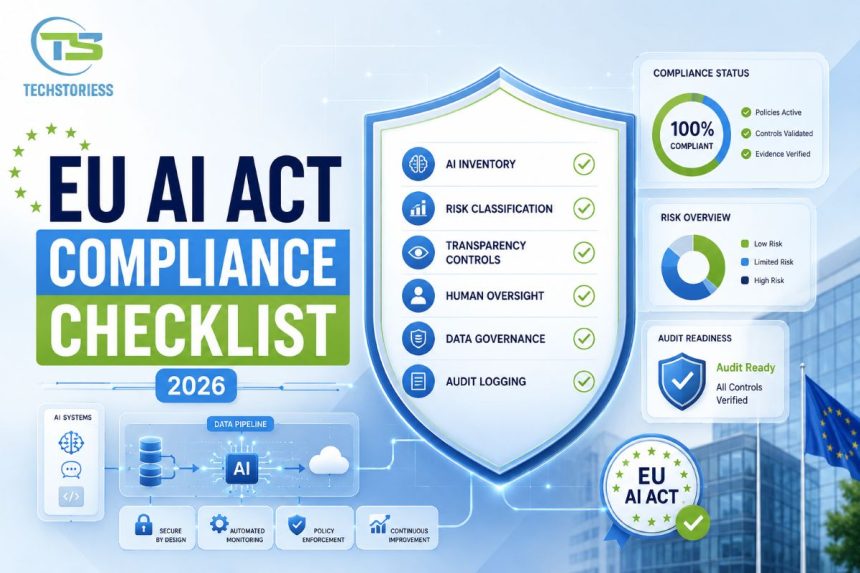
The EU AI Act — officially Regulation (EU) 2024/1689 — is the world’s first comprehensive legal framework for artificial intelligence, and its most consequential enterprise deadline falls on 2 August 2026. From that date, organisations that develop or deploy high-risk AI systems must demonstrate full compliance with Articles 9–17 (provider obligations) and Article 26 (deployer obligations), or face fines of up to €15 million or 3% of global annual turnover for high-risk AI violations — rising to €35 million or 7% for the most serious prohibited-practice breaches.
- What Is the EU AI Act?
- Why the August 2, 2026 Deadline Matters
- Understanding the EU AI Act Risk Categories
- EU AI Act Enterprise Compliance Checklist 2026
- Complete Documentation is Required for Compliance
- Data Governance and Security Controls
- Conduct AI Risk Assessments
- Human Oversight Requirements
- Third-Party AI Vendor Compliance
- Transparency and Explainability Measures
- Monitoring, Auditing, and Continuous Compliance
- Common Enterprise Mistakes to Avoid
- Enterprise Readiness Timeline Before August 2, 2026
- Common enterprise mistakes — fifth mistake added
- Conclusion: Turn Compliance Into Strength
- FAQs: EU AI Act Enterprise Compliance Checklist 2026
Compliance is not optional or departmental. If your organisation uses AI in recruitment, credit assessments, healthcare, law enforcement, or any system that influences outcomes for EU residents, this regulation applies — regardless of where your company is headquartered.
The EU AI Act enterprise compliance checklist 2026 below maps every obligation you need to action before the August 2 deadline. Whether you are building AI systems from scratch, integrating third-party tools, or deploying vendor-supplied AI in enterprise workflows, use this checklist to identify gaps, prioritise actions, and build a defensible compliance record.
What Is the EU AI Act?
Regulation (EU) 2024/1689 — commonly referred to as the EU AI Act — was signed into law on 13 June 2024 and published in the Official Journal of the EU on 12 July 2024. It establishes a risk-based regulatory framework for AI systems placed on or used in the EU market, covering safety, transparency, accountability, and fundamental rights protections across all industries.
Unlike sector-specific rules such as GDPR for data privacy, the EU AI Act applies horizontally. It distinguishes between two main actor roles that carry separate, independently enforceable obligations:
- Providers — organisations that develop an AI system or place one on the market under their own name or trademark.
- Deployers — organisations that use an AI system in a professional context, including enterprises that integrate third-party AI tools into business operations.
Both roles are in scope and cannot transfer liability to each other. A deployer cannot assume that its vendor’s compliance satisfies its own Article 26 obligations.
The Act has been rolled out in three phases:
- 2 February 2025: Prohibited AI practices (Article 5) and AI literacy obligations (Article 4) took effect. Organisations must have already eliminated any banned use cases.
- 2 August 2025: General-purpose AI (GPAI) model obligations (Articles 51–56) and EU AI governance infrastructure requirements took effect.
- 2 August 2026: The main compliance wave — Articles 6–49, covering high-risk AI systems listed in Annex III — enters full force. This is the deadline most enterprises are currently preparing for.
Enforcement note: The European AI Office (established within the European Commission) oversees GPAI model compliance. National market surveillance authorities — one designated per EU member state — handle high-risk AI systems. Non-EU companies with EU market exposure are equally subject to enforcement through their EU authorised representatives.
Why the August 2, 2026 Deadline Matters
2 August 2026 is when Articles 9–17 and Article 26 of the EU AI Act enter full force for high-risk AI categories defined in Annex III. From that date, national market surveillance authorities can conduct audits, impose fines, issue public warnings, and require the immediate withdrawal of non-compliant AI systems from use.
The penalty structure is tiered by severity:
| Violation type | Maximum fine |
| Prohibited AI practices (Article 5) | €35M or 7% of global annual turnover, whichever is higher |
| High-risk AI non-compliance (Articles 9–17) | €15M or 3% of global annual turnover |
| Providing incorrect information to authorities | €7.5M or 1.5% of global annual turnover |
These are maximum figures applicable to large enterprises. The Act includes provisions for proportionate penalties for SMEs and start-ups — but the reputational exposure from a public non-compliance finding operates independently of financial penalties and is not scaled to company size. The reason the coming weeks are critical is that demonstrating compliance by August 2 requires substantial operational work — not just policy updates. A realistic compliance programme for a mid-to-large enterprise typically requires 8–14 weeks to complete a full AI inventory, conduct risk assessments across all systems, build governance structures, produce Article 11 technical documentation, train staff, and validate oversight mechanisms. That timeline, starting now, takes you to the deadline with days to spare — but only if work begins immediately.
Understanding the EU AI Act Risk Categories
Before starting any compliance work, every AI system in your organisation must be classified under the Act’s four-tier risk framework. Classification determines your obligations — and the degree of enforcement exposure you carry from 2 August 2026.
| Risk tier | Annex | Representative examples | Key obligations | Deadline |
| Unacceptable (Prohibited) | N/A — banned outright | Social scoring by public authorities; real-time biometric surveillance in public spaces; subliminal manipulation; exploitation of vulnerable groups | Immediate elimination — no grace period. Fines up to €35M / 7% of turnover | Effective 2 Feb 2025 |
| High-risk (Annex III) | Annex III | CV-screening tools; automated interview scoring; credit models; medical diagnostic AI; predictive policing; border control systems; educational assessment AI | Full Articles 9–17 compliance: risk management system, data governance, technical documentation, record-keeping, transparency, human oversight, accuracy, cybersecurity | 2 August 2026 |
| Limited risk | Articles 50, 52 | Customer service chatbots; AI-generated text and image tools; deepfake generators; virtual assistants | Transparency obligations only: users must be informed when interacting with AI or viewing AI-generated content | 2 August 2026 |
| Minimal risk | None mandated | Spam filters; AI scheduling tools; basic recommendation engines; logistics optimisation | No mandatory obligations. Voluntary codes of conduct available | Ongoing |
Practical note: An AI system may fall into a higher risk tier than its vendor documentation suggests. Classification is the deployer’s responsibility under Article 26(2) — not the vendor’s alone. If your organisation deploys an off-the-shelf AI tool in an Annex III context (for example, using a general-purpose LLM for employee performance reviews), the full high-risk obligations apply regardless of how the tool is marketed.Before starting any compliance initiative, enterprises must understand how the regulation classifies AI systems.
EU AI Act Enterprise Compliance Checklist 2026
This comprehensive EU AI Act enterprise compliance checklist for 2026 can help organisations assess their readiness before the August 2 deadline.
1. Create a Complete AI Inventory
You cannot manage what you cannot identify. Many enterprises use dozens of AI systems without maintaining a centralized record. Departments often adopt AI tools independently, creating visibility gaps.
Document:
- AI applications in production
- Pilot programs
- Third-party AI vendors
- Generative AI platforms
- Internal machine learning models
- Automated decision-making systems
For each system, record:
- Purpose
- Owner
- Data sources
- Users
- Risk level
- Vendor information
A centralized inventory forms the foundation of AI governance.
2. Classify Every AI System by Risk
Once the inventory is complete, classify each system according to EU AI Act requirements.
Key questions include:
Does the system influence important decisions?
Examples include:
- Hiring decisions
- Loan approvals
- Insurance assessments
- Educational outcomes
Does it process sensitive data?
Systems handling personal or biometric data often require closer scrutiny.
Could the system impact individual rights?
If AI affects employment in finance, health care, and the legal system, there will be additional responsibilities. Risk classification and its regular monitoring should be documented.
3. Establish an AI Governance Framework
A good AI governance structure instils accountability within the organisation. Many compliance failures occur because ownership is unclear.
Define:
- Executive oversight
- Compliance responsibilities
- Risk management roles
- Model approval processes
- Incident response procedures
Create a governance committee that includes:
- Legal teams
- Compliance professionals
- Security leaders
- Data scientists
- Business stakeholders
Minimising compliance blind spots requires effective cross-functional management.
Complete Documentation is Required for Compliance
Documentation is one of the most important elements of the EU AI Act. Regulators won’t just accept organisations saying they are compliant; they will want to see it happen.
Maintain Technical Documentation
Every regulated AI system should have detailed documentation covering:
- System purpose
- Architecture
- Training methodology
- Performance metrics
- Testing procedures
- Risk assessments
- Data sources
Documentation should remain updated throughout the AI lifecycle.
Record Decision-Making Processes
Organizations should document:
- Model development decisions
- Risk evaluations
- Governance approvals
- Validation results
- Vendor assessments
Strong records simplify audits and investigations.
Data Governance and Security Controls
At its core, AI compliance centres on data quality and security. Inaccurate outcomes, the risk of discrimination, and regulatory violations are all potential consequences of poor data governance.
Strengthen Data Management Practices
Organizations should ensure:
- Data accuracy
- Data relevance
- Data completeness
- Data integrity
- Data lineage tracking
Teams need to be familiar with the sources of data and their flow within the AI system.
Improve AI Security Controls
AI systems introduce new cybersecurity challenges.
Recommended measures include:
- Access controls
- Encryption
- Monitoring systems
- Vulnerability assessments
- Secure model deployment
- Third-party security reviews
Cybersecurity and AI governance should operate as interconnected functions.
Conduct AI Risk Assessments
Risk assessments should not be a one-time occurrence.
Evaluate Operational Risks
Review whether AI systems could:
- Produce inaccurate outputs
- Cause business disruptions
- Create legal exposure
- Damage customer trust
Evaluate Ethical Risks
Organizations should analyze:
- Bias risks
- Fairness concerns
- Transparency issues
- Discrimination potential
Record any mitigation solutions identified.
Evaluate Regulatory Risks
Compliance teams should determine:
- Applicable EU AI Act obligations
- Industry-specific regulations
- Privacy requirements
- Cross-border data considerations
Risk assessments should not be a ‘one-off’ exercise, but should be repeated.
Human Oversight Requirements
The EU AI Act emphasises the importance of good human control. Using AI tools does not require them to make decisions; use them to help make decisions.
Define Human Review Procedures
Organizations should establish:
- Escalation pathways
- Approval workflows
- Manual intervention capabilities
- Override mechanisms
Compliance and operational risks are minimised with well-trained teams.
Train Employees Effectively
Employee training should cover:
- AI system limitations
- Risk indicators
- Compliance obligations
- Documentation requirements
- Incident reporting procedures
Well-trained teams reduce compliance and operational risks.
Third-Party AI Vendor Compliance
Many companies are heavily dependent on third-party AI vendors, but being a vendor does not mean you are exempt from regulations.
Assess Vendor Readiness
Request documentation regarding:
- AI governance programs
- Risk management practices
- Compliance certifications
- Security controls
- Model testing procedures
Vendor bid evaluation should be part of the procurement process.
Review Contracts Carefully
Contract language should address:
- Compliance obligations
- Liability allocation
- Incident reporting
- Audit rights
- Data protection requirements
Existing agreements to be reviewed before the compliance deadline should be updated by Legal teams.
Transparency and Explainability Measures
Transparency is one of the basic cornerstones of the regulation. It is essential for organisations to explain what AI systems are doing and how they are contributing.
Improve Explainability
Provide clear information about:
- System purpose
- Decision logic
- Data usage
- Risk controls
- Human oversight mechanisms
Complex AI models may require specialized explainability tools.
Inform Users Appropriately
Users should understand:
- When AI is being used
- What information is collected
- How decisions are influenced
- Available review options
Transparent communication helps to build trust and support compliance efforts.
Monitoring, Auditing, and Continuous Compliance
This is a pathway of compliance – it’s a journey. AI systems are dynamic, and time brings risks.
Implement Continuous Monitoring
Track:
- Model performance
- Accuracy metrics
- Security events
- Bias indicators
- Operational incidents
Regular monitoring enables faster issue detection.
Schedule Internal Audits
Audits should evaluate:
- Governance effectiveness
- Documentation completeness
- Risk management processes
- Vendor compliance
- Security controls
Organisations can benefit from quarterly reviews to stay on track with evolving needs.
Common Enterprise Mistakes to Avoid
- Waiting for harmonised standards. The legal obligations apply on 2 August 2026 regardless of standards status. Use the requirements in Articles 8–15 directly. Harmonised standards from CEN/CENELEC are a useful guide, but their absence doesn’t suspend your obligations.
- Assuming only EU-headquartered companies are in scope. The extraterritorial reach of the Act catches any organisation whose AI systems are used within the EU or produce outputs affecting EU residents — regardless of where the company is headquartered. US, UK, and APAC enterprises with EU market exposure are equally subject to the rules.
- Treating this as an IT project. The EU AI Act enterprise compliance checklist for 2026 requires governance, legal, HR, and business unit involvement. Risk management, human oversight, and fundamental rights impact assessments are not engineering deliverables alone.
- Treating deployer obligations as the vendor’s problem. As noted above, deployers carry independent, enforceable obligations. Your vendor’s compliance is necessary but not sufficient.
Enterprise Readiness Timeline Before August 2, 2026
With 34 days remaining to the 2 August 2026 compliance deadline, organisations must move immediately. This timeline assumes a standing start — compress or skip phases where work is already in progress.
Week 1 30 June – 6 July — Inventory and classification
- Complete full AI system inventory across all business units, including pilot programmes, shadow AI, and embedded third-party tools
- Identify system owners and assign compliance accountability by name and role
- Classify every system against the four EU AI Act risk tiers
- Flag all potential Annex III high-risk systems for immediate prioritisation
- Begin vendor outreach to obtain AI governance documentation
Week 2 7–13 July — Governance and gap assessment
- Stand up (or formalise) the AI governance committee with Legal, Compliance, Security, Data Science, and business unit representation
- Conduct Article 9 risk management gap assessments for all high-risk systems
- Begin drafting Article 11 technical documentation for each high-risk system
- Initiate contract review of all third-party AI vendor agreements for compliance clauses and audit rights
Week 3 14–20 July — Documentation and controls
- Complete Article 11 technical documentation for all Annex III systems
- Review and update Article 26 deployer records for all in-scope tools
- Implement or validate human oversight mechanisms required under Article 14
- Audit data governance practices against Article 10 requirements
- Confirm cybersecurity controls meet Article 15 requirements
Week 4 21–27 July — Audit and training
- Conduct internal compliance audit against Articles 9–17 and Article 26
- Complete staff training on AI system limitations, risk indicators, incident reporting, and override procedures
- Test escalation pathways and human override mechanisms in live systems
- Conduct final vendor compliance verification for all high-risk third-party tools
Final window 28 July – 1 August — Validation and sign-off
- Final documentation review and sign-off from Legal, Compliance, and C-suite oversight
- Confirm incident reporting procedures are operational end-to-end
- Retain timestamped audit trail demonstrating compliance readiness
- Brief senior leadership on any outstanding risks and mitigation status
Common enterprise mistakes — fifth mistake added
Underestimating deployer liability for third-party AI tools. Article 26 makes deployers independently liable for ensuring that high-risk AI systems they use comply with the Act’s requirements. Your vendor’s compliance documentation is necessary — but not sufficient. If a vendor cannot provide the Article 11 technical documentation you are required to retain as a deployer, or declines to grant the audit rights required under Article 26(6), that tool cannot legally be used in a high-risk context regardless of its commercial contract terms. Legal teams should audit all vendor agreements for compliance language before the August 2 deadline, not after.
Conclusion: Turn Compliance Into Strength
The EU AI Act enterprise compliance checklist 2026 is a list of actions, but it’s also an approach towards responsible AI, one that serves your organisation and your customers. As the August 2 deadline approaches, those who act swiftly will avoid penalties and build trust in an increasingly regulated world.
Actionable Takeaways:
- Complete your AI inventory this week.
- Prioritize high-risk systems.
- Document everything.
- Review vendor contracts.
- Build internal expertise now.
Compliance done right creates better, fairer, and more reliable AI systems.
FAQs: EU AI Act Enterprise Compliance Checklist 2026
What is the exact deadline for EU AI Act high-risk compliance in 2026?
The majority of commitments, including those for most high-risk systems in Annex III, will come into force on 2 August 2026. Plan as if this date is definitive, even if there may be some Omnibus changes.
Who does the EU AI Act apply to outside the EU?
It is applicable to providers of AI in the EU market, to deployers of these in the EU, and to systems whose outputs are used in the EU. Compliance is necessary for companies with EU presence or EU customers globally.
How do I know if my AI system is high-risk?
Look through the content and circles for Annex III uses (jobs, credit, school, etc) that may be particularly hazardous to rights/safety.
What are the biggest fines under the EU AI Act?
The EU AI Act uses a three-tier penalty structure. The most serious violations — breaches of the prohibited AI practices ban under Article 5 — carry fines of up to €35 million or 7% of total worldwide annual turnover, whichever is higher. Non-compliance with high-risk AI system obligations under Articles 9–17 carries fines of up to €15 million or 3% of global annual turnover. Providing incorrect, incomplete, or misleading information to national authorities carries fines of up to €7.5 million or 1.5% of turnover. For SMEs and start-ups, national authorities may apply proportionate measures. These figures are statutory maximums — actual penalties will reflect the severity, duration, and intentionality of the violation, the market impact, and the size and financial resources of the organisation.
Can small enterprises handle EU AI Act compliance?
Yes, with proportional application and support via sandboxes and codes of conduct. Begin with inventory and risk classification; many requirements are risk-dependent.
Ready for the August 2, 2026 Deadline?
Never be forced to wait for your Regulators at your door! Evaluate, audit and establish a robust AI Governance framework now to minimise risk exposure. By taking proactive steps to meet regulatory requirements, protect customer trust, and benefit from the long-term positive effects of ethical AI practices, organisations can leverage these tools effectively while maintaining customer satisfaction and compliance.
This article covers EU AI Act enterprise compliance obligations based on the text of Regulation (EU) 2024/1689 as published in the Official Journal of the EU on 12 July 2024. It reflects obligations in force as of June 2026 and does not constitute legal advice. Enterprises should seek qualified legal counsel to assess their specific compliance posture. Content reviewed for factual accuracy against the regulation text on 20 June 2026.
Get more tech updates and insights to your Email .. Subscribe to our NewsLetter