


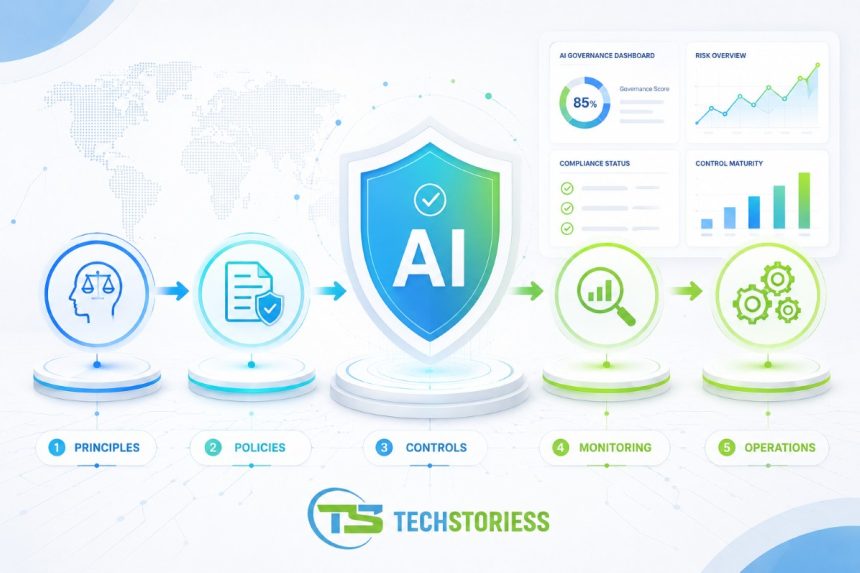
Operational AI governance enterprise implementation has become a key challenge of the AI era. If the past decade was about widespread AI adoption, the last five years have exposed an equally urgent problem: the acute disconnect between declared governance principles and enforceable, production-grade controls.
- Why Enterprise AI Governance Frameworks Collapse at Scale
- Defining Operational AI Governance Enterprise: From Policy to Runtime Control
- Embedding AI Risk Management Frameworks into Enterprise Workflows
- ADMT Compliance: Moving from Legal Obligation to System Capability
- Algorithmic Accountability: Designing Responsibility into AI Systems
- Converting Governance Principles into Operational Pipelines
- Audit Trails: The Foundation of Defensible AI Systems
- Overcoming Implementation Challenges and Scaling Best Practices
- The Future: Toward Autonomous Governance
- Conclusion: Engineering Trust as a Core Competitive Capability
Fairness, transparency, privacy, and accountability remain at the core of responsible AI governance frameworks worldwide. Yet industry evidence consistently shows that more than 80% of organizations claim to follow responsible AI practices, while fewer than 2530% can demonstrate enforceable governance controls within live production environments.
This disconnect has significant consequences. Biased credit scoring systems, flawed hiring algorithms, and costly hallucinations in AI copilots are becoming increasingly visible and increasingly consequential as AI is implemented in mission-critical responsibilities across high-stakes domains. Across the US, EU, and Asia, regulatory bodies are tightening oversight, particularly around Automated Decision-Making Technologies (ADMT). Frameworks such as GDPR Article 22, the EU AI Act, and NIST AI RMF 1.0 are fast redefining the compliance landscape, placing direct legal obligations on organizations that deploy AI systems affecting individuals’ rights.
The root cause is consistent: AI governance frameworks remain conceptual, not operational. This article moves beyond surface-level policy discussions to examine how enterprises can operationalize governance as an engineering discipline embedding AI risk management frameworks, achieving ADMT compliance, and designing algorithmic accountability into every stage of the AI lifecycle.
Why Enterprise AI Governance Frameworks Collapse at Scale
Governance failures in enterprise AI are generally not the result of negligence. They result from structural limitations in how organizations design, deploy, and oversee AI systems. When AI governance frameworks are treated as compliance checkboxes rather than operational infrastructure, they inevitably break under the pressures of scale, complexity, and velocity.
- Static Frameworks vs. Dynamic AI Systems: AI models are in a constant state of change driven by retraining cycles, data drift, and evolving user interactions. Yet governance policies are typically reviewed quarterly or annually, rendering them outdated almost immediately after deployment.
- The Auditability Deficit: Recent enterprise audits show that nearly 60% of AI deployments lack complete decision traceability, meaning organizations cannot fully reconstruct how a specific output was generated (McKinsey Global Institute, State of AI Report, 2024). In regulated sectors such as finance and healthcare, this gap elevates compliance, legal, and operational risk significantly.
- Fragmented Ownership: AI systems operate across multiple teams: data engineers, ML engineers, compliance officers, and business stakeholders. Without clearly defined ownership structures, algorithmic accountability becomes diluted, and when systems fail, responsibility cannot be cleanly assigned.
These systemic gaps expose a fundamental truth: AI governance frameworks cannot remain abstract documents. They must be directly engineered into systems to enable real-time enforcement, continuous oversight, and measurable accountability across the entire AI lifecycle.
Defining Operational AI Governance Enterprise: From Policy to Runtime Control
Operational AI governance enterprise refers to the systematic integration of governance principles directly into live AI systems, ensuring that every decision, output, and workflow adheres to predefined policies in real time without relying on manual checkpoints or periodic reviews.
Unlike conventional governance models relying on documentation and human oversight, operational AI governance is characterized by four core capabilities: policy-as-code implementation (governance rules embedded into AI and data pipelines for automated enforcement); continuous compliance validation at every lifecycle stage; end-to-end traceability linking every output back to its data, model version, and decision pathway; and automated risk detection that proactively identifies anomalies without manual intervention.
This approach transforms governance from a passive oversight function into an active control layer, analogous to how cybersecurity evolved from static perimeter defenses to continuous monitoring and adaptive response.
Real-world example: Large financial institutions now incorporate real-time bias monitoring and embedded explainability layers into AI-driven credit scoring systems. Every decision can be justified both internally and to regulators compliance is enforced continuously, not through periodic audits.
Embedding AI Risk Management Frameworks into Enterprise Workflows
Effective operational AI governance enterprise requires robust AI risk management frameworks enforced within live workflows not merely defined on paper. Modern enterprises aligned with standards such as NIST AI RMF 1.0 and ISO 42001 address four categories of risk:
- Model risk: drift, instability, and hallucinations impacting decision reliability
- Data risk: bias, data quality failures, and non-compliant data usage
- Operational risk: misuse, access control failures, and integration vulnerabilities
- Regulatory risk: ADMT compliance obligations under GDPR, the EU AI Act, and sector-specific regulations
Continuous Risk Scoring in Practice: The insurance sector offers a tangible example. AI models used for claims processing are now subjected to continuous risk scoring systems that dynamically assess risk levels based on input variability, model confidence, and historical performance. High-risk scenarios automatically trigger human review, ensuring regulatory compliance without slowing throughput. Organizations implementing continuous risk monitoring report a 3545% reduction in model-related incidents (IDC, AI Governance Benchmark Report, 2024).
ADMT Compliance: Moving from Legal Obligation to System Capability
Regulations governing Automated Decision-Making Technologies have evolved substantially under GDPR Article 22, the EU AI Act’s high-risk AI provisions, and emerging US state-level ADMT laws. These regulations require that AI-driven decisions be transparent, fair, and contestable with clear mechanisms for explanation, human review, and redress. Documentation alone cannot satisfy these requirements. ADMT compliance must be embedded into system design and enforced at runtime.
Operational ADMT compliance involves four interconnected capabilities: real-time explainability generating interpretable outputs alongside every prediction; bias detection and mitigation pipelines that trigger corrective actions when statistical deviations occur; human-in-the-loop controls enabling timely intervention in high-risk decisions as mandated under EU AI Act Article 14; and consent and data governance enforcement ensuring lawful data usage aligned with GDPR.
Digital lending platforms now illustrate this at scale. Regulatory requirements mandate that rejected applicants receive clear, actionable explanations for automated credit decisions. This has driven the integration of explainability engines directly into decision pipelines making ADMT compliance automatic rather than manual.
Regulatory alignment note: NIST AI RMF 1.0 maps directly to operational ADMT compliance requirements across its four functions Govern, Map, Measure, and Manage. ISO 42001 provides a certifiable framework for enterprise-level governance.
Algorithmic Accountability: Designing Responsibility into AI Systems
Most enterprises treat algorithmic accountability as a post-failure analysis mechanism. In practice, accountability must be proactively designed and embedded from inception, answering three fundamental questions: Who is responsible for the system and its outputs? How are individual decisions justified? What happens- procedurally and technically, when something goes wrong?
Operationalizing algorithmic accountability requires that every AI output is traceable to the specific dataset and data version used at inference, the model version and training configuration, the approval workflows governing deployment, and the decision logs linking inputs to outputs with associated explanations.
Technical traceability alone is insufficient. Algorithmic accountability must also be explicitly assigned across organizational roles ensuring no AI system operates without a named owner, a defined escalation path, and a clear incident response process.
Healthcare diagnostics presents a compelling example. These systems now maintain comprehensive decision logs enabling clinicians to review not just the output, but the underlying reasoning pathway satisfying regulatory requirements while significantly enhancing trust in AI-assisted decision-making. Organizations implementing robust algorithmic accountability frameworks report faster incident resolution, stronger audit readiness, and a significant reduction in compliance violations (Forrester, Responsible AI Readiness Index, 2024).
Converting Governance Principles into Operational Pipelines
The true measure of AI governance framework maturity is how effectively principles are executed within AI pipelines. Consider fairness, a principle that appears in virtually every enterprise responsible AI policy. In a non-operational model, fairness remains a high-level guideline with no enforcement mechanism. In an operational AI governance enterprise model, fairness becomes a multi-stage control system: datasets are analyzed for representation bias during ingestion; fairness constraints are applied as optimization criteria during training; statistical tests measure demographic parity and equalized odds during validation; dashboards continuously monitor fairness metrics during deployment; and automated alerts trigger when predefined thresholds are breached at runtime.
Similarly, transparency evolves from a guiding principle into a system-level feature, where every decision is accompanied by interpretable explainability outputs, persistently stored in audit logs, and readily accessible for regulatory review. This transformation demands tight integration between AI governance frameworks and engineering workflows ensuring governance is not bypassed in the pursuit of speed, but becomes an inherent part of how AI systems are built, deployed, and scaled.
Audit Trails: The Foundation of Defensible AI Systems
Auditability is the foundational pillar of operational AI governance enterprise. Without it, governance cannot be verified, enforced, or continuously improved. A comprehensive audit trail captures data lineage (origin, transformation, and version of every dataset), model lineage (versions, training parameters, evaluation metrics, and deployment approvals), decision logs (inputs linked to outputs with explanations and confidence scores), and user interactions (human interventions, approvals, overrides, and escalations).
In financial services, regulatory audits frequently require organizations to reconstruct decision pathways months or years after deployment. Companies with robust audit trails complete these investigations. Significantly faster mature audit capabilities reduce compliance investigation time by up to 50% (PwC, AI Regulatory Compliance Benchmark, 2023).
Beyond regulatory response, audit trails serve a broader strategic function: they convert abstract governance principles into concrete operational processes. Every logged decision, every recorded override, and every versioned model artifact becomes verifiable evidence that governance controls are not merely declared but actively enforced. This is the foundation on which defensible AI systems and lasting stakeholder trust are built.
Overcoming Implementation Challenges and Scaling Best Practices
Implementing operational AI governance enterprise-wide is complex. Organizations consistently face four challenges. Tool fragmentation across diverse platforms is addressed by AI adopting centralized governance platforms aligned with NIST AI RMF’s Govern function. Cultural resistance to the perception that governance slows innovation is countered by developer-aligned, automation-first strategies that reframe responsible AI governance as a risk reducer and trust builder. Skill gaps spanning AI engineering, security, legal compliance, and risk management are increasingly addressed through dedicated AI governance teams. And the evolving regulatory landscape, particularly the phased EU AI Act and growing US ADMT legislation, demands flexible governance architectures aligned with modular frameworks like ISO 42001.
To scale successfully, organizations should treat governance as infrastructure embedded directly in AI pipelines and MLOps workflows; adopt policy-as-code approaches; implement continuous monitoring in place of periodic audits; prioritize high-risk ADMT use cases subject to EU AI Act classification or GDPR Article 22; align with NIST AI RMF 1.0 and ISO 42001; and invest in automation for consistent, real-time algorithmic accountability enforcement.
The Future: Toward Autonomous Governance
The next evolution of AI governance frameworks will be defined by automation and intelligence. Emerging trends include AI systems monitoring other AI systems for real-time anomaly detection; self-healing governance mechanisms that automatically detect and correct policy violations; dynamic policy adaptation adjusting controls in real time based on risk signals; and global compliance orchestration aligning operational AI governance enterprise controls with multiple regulatory regimes EU AI Act, GDPR, NIST AI RMF, and sector-specific standards simultaneously.
These advancements will allow AI governance frameworks to evolve from reactive processes into proactive, adaptive systems capable of continuously managing risk, enforcing policies in real time, and keeping pace with the growing complexity of modern AI ecosystems.
Conclusion: Engineering Trust as a Core Competitive Capability
Operational AI governance enterprise implementation has evolved from a peripheral compliance concern into a core pillar of enterprise strategy. Organizations that fail to operationalize their AI governance frameworks risk not only regulatory penalties under the EU AI Act and GDPR, but also reputational damage and erosion of customer trust in an era where AI-driven decisions increasingly shape individual outcomes.
To build resilient, trustworthy, and sustainable AI systems, enterprises must embed governance as an engineering discipline leveraging robust AI risk management frameworks, ensuring ADMT compliance across every automated decision pathway, and designing algorithmic accountability into AI architecture from inception.
The organizations that achieve this will hold a clear competitive advantage: in a world where AI-driven decisions shape outcomes at scale, the ability to demonstrate trust, explainability, and accountability becomes the ultimate differentiator.
Contrary to common perception, AI governance frameworks do not restrict AI they make AI reliable enough to scale without fear. To achieve that reliability, governance must evolve from high-level principles on paper into enforceable, production-grade controls embedded within systems. The frameworks exist. The standards are defined. The imperative now is execution.