


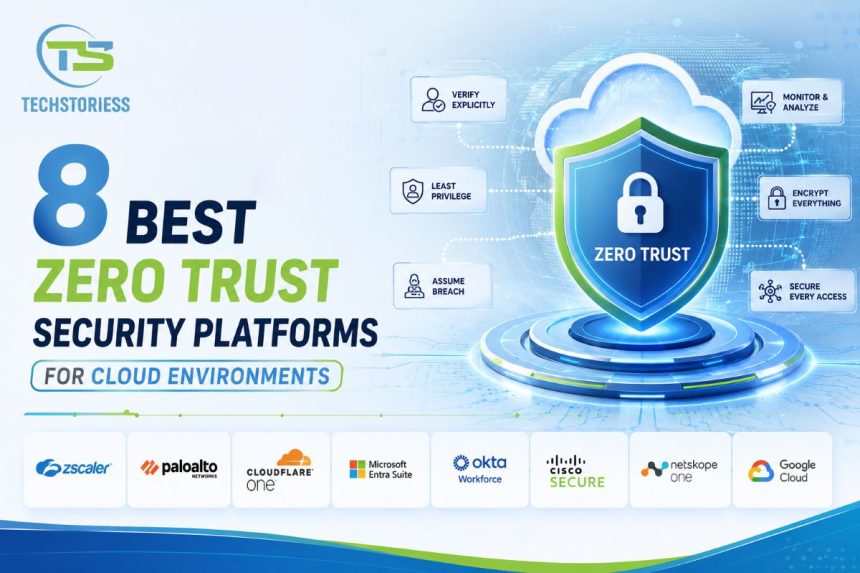
Enterprise cybersecurity strategies revolved around perimeter-based defense for many years – a model that lacked the depth required for modern distributed environments. Organizations scrutinized external traffic but generally trusted the users and devices operating inside the network. During that phase, when applications, workers, and infrastructure were largely confined to on-premises environments, this model worked reasonably well.
- What Is Zero Trust Security?
- ZTNA vs VPN: Why Enterprises Are Moving Away from Traditional VPNs
- Zscaler Zero Trust Exchange
- Palo Alto Networks Prisma Access
- Cloudflare One
- Microsoft Entra Suite
- Okta Workforce Identity Cloud
- Cisco Secure Access
- Netskope One Platform
- Google Cloud BeyondCorp Enterprise
- Key Features Enterprises Should Prioritize in Zero Trust Platforms
- Challenges Enterprises Still Face with Zero Trust Adoption
- Conclusion
That assumption is fast changing in 2026.
Modern enterprises operate across a sprawling landscape of multi-cloud environments, remote workforces, SaaS ecosystems, third-party APIs, AI-driven automation systems, and distributed identities. This significantly increases the attack surface where conventional perimeter-based security models frequently fail to provide adequate protection.
This transformation of the working environment has given rise to zero trust security platforms, which now occupy a central position in modern cybersecurity architecture.
Going by industry estimates, zero trust adoption has registered a year-over-year increase of nearly 60% as enterprises proactively accelerate migration toward identity-centric security models. Contextually, around 80% of modern breaches now involve identity compromise, making credential protection and continuous verification critical enterprise priorities.
Regulatory mandates also compel enterprises to adopt zero trust networks. The Cybersecurity and Infrastructure Security Agency zero trust framework has made it mandatory for all US-based organizations to implement zero trust architecture, significantly influencing enterprise cybersecurity standards worldwide.
Meanwhile, roughly 23% of major breaches in 2025 involved cloud misconfigurations – reinforcing the need for granular access control, continuous authentication, and contextual cloud visibility.
For enterprises, the challenge today is no longer whether they should adopt zero trust architecture. The real question is how to choose zero trust security platforms that are best equipped to secure increasingly complex cloud environments.
What Is Zero Trust Security?
In simple terms, zero trust is a cybersecurity model that follows one key foundational principle:
Never trust, always verify.
Zero trust architecture never assumes trust based on network location, but continuously validates signals like:
- User identity
- Device posture
- Application behavior
- Session risk
- Data sensitivity
- Contextual activity patterns
This architecture greatly reduces lateral movement and minimizes the scope of breaches by enforcing least-privilege access at every layer. So instead of granting broad access upon authentication, it evaluates every request independently and continuously.
Modern zero trust environments typically include various components:
- Zero Trust Network Access (ZTNA)
- Identity and Access Management (IAM)
- Multi-factor authentication (MFA)
- Cloud Access Security Broker (CASB)
- Endpoint detection and response
- Continuous monitoring and analytics
- Microsegmentation
- Identity-based cloud security policies
It results in a security posture that is specifically designed for cloud-native and hybrid enterprise infrastructure.
ZTNA vs VPN: Why Enterprises Are Moving Away from Traditional VPNs
The shift from VPN-centric access to Zero Trust Network Access (ZTNA) is among the biggest architectural shifts in enterprise cybersecurity.
Conventional VPNs operate by granting broad network-level access to users once authenticated. This creates multiple issues:
- Excessive lateral movement opportunities
- Expanded attack surfaces
- Limited application-level segmentation
- Poor visibility into user behavior
- Increased risk after credential compromise
ZTNA platforms work on a different principle.
ZTNA solutions do not expose entire networks – instead they provide identity-based access only to explicitly authorized applications or services. Access decisions are continuously reevaluated based on context, risk posture, and behavioral analytics. This dynamic approach meaningfully reduces the blast radius of any compromised credential.
In practical terms:
Let us compare the traditional VPN model with ZTNA to understand the differences more clearly:
- – Access Model: Traditional VPN operates at the network level. ZTNA on the other hand offers application-level access.
- – Trust Assumption: Traditional VPN trusts users after login while ZTNA continuously verifies identity and access legitimacy.
- – Lateral Movement Risk: after compromise VPN environments have a higher risk of lateral movement. ZTNA minimizes this risk through segmented access.
- – Visibility: Traditional VPNs provide limited visibility into user behavior and application access, whereas ZTNA provides granular monitoring and control.
- – Cloud Readiness: VPNs are moderately suited for cloud-first environments, while ZTNA is especially designed for highly cloud-native architectures.
- – Scalability: VPN scalability heavily relies on hardware infrastructure, while ZTNA scales more efficiently through cloud-native deployment models.
Due to this difference, many enterprises now consider ZTNA a core component of modern zero trust security platforms.
The above information gives a good overview of Zero Trust Network. It leads to the next possible concern: how to find the best ZTNAfor your enterprise’s needs? To answer this we have curated this list of 8 best solutions available today:
Zscaler Zero Trust Exchange
One of the strongest enterprise-focused zero trust providers in 2026 is Zscaler.
Its Zero Trust Exchange platform is especially built to deliver cloud-native security inspection, identity-aware access, and application segmentation without depending on conventional VPN infrastructure.
Its key strengths include:
- Mature ZTNA capabilities that eliminate implicit network trust
- Secure web gateway integration for comprehensive internet traffic inspection
- Advanced CASB functionality that enforces policy across SaaS environments
- Inline traffic inspection to prevent threats from unverified sources
- AI-driven threat analytics to detect and respond to anomalous behavior in real time
- Strong scalability for global enterprises supporting distributed workforce deployments without performance degradation
For organizations that operate large-scale remote workforce models and multi-cloud architectures, Zscaler is an ideal solution for enforcing consistent zero trust policy at global scale.
Palo Alto Networks Prisma Access
Through Prisma Access, Palo Alto Networks has aggressively expanded its portfolio of cloud-delivered security. Prisma Access allows organizations to enforce consistent security policy across remote users, branch offices, and cloud workloads from a unified platform.
The platform combines:
- Zero Trust Network Access tools
- Secure Access Service Edge (SASE)
- Cloud firewalling
- Threat prevention
- CASB capabilities
- Advanced endpoint integration
Prisma Access can seamlessly integrate with existing Palo Alto enterprise ecosystems – a key advantage for enterprise clients making it a popular choice for organizations that have already invested in its firewall and SOC infrastructure.
Prisma Access also excels at securing hybrid cloud deployments that critically demand centralized visibility and policy orchestration.
Cloudflare One
Cloudflare has graduated from CDN infrastructure into a zero trust security provider gaining wide popularity in its domain.
Cloudflare One provides:
- Identity-aware application access
- Browser isolation
- Secure web gateway
- Data loss prevention
- Remote browser security
- Network segmentation
Cloudflare’s globally distributed edge network acts as a key differentiator, helping enterprises reduce latency compared to many centralized VPN architectures.
For organizations that prioritize performance alongside security, Cloudflare One is emerging as a compelling choice.
Microsoft Entra Suite
Microsoft leverages Microsoft Entra to continue strengthening its identity-centric security ecosystem.
The platform heavily focuses on identity-based cloud security, including:
- Conditional access
- Identity governance
- Privileged identity management
- Passwordless authentication
- Risk-based adaptive access
Ecosystem integration is the biggest advantage Microsoft brings to this space.
Organizations deeply embedded within Microsoft environments like Azure, Microsoft 365, and Microsoft Defender can deploy zero trust policies with relatively streamlined operational overhead.
For enterprises that extensively use Microsoft infrastructure, Entra is undoubtedly the most operationally efficient choice.
Okta Workforce Identity Cloud
Okta claims a top-bracket position in identity and access management.
Some of its salient features include:
- Adaptive MFA
- Identity lifecycle management
- Single sign-on
- Device trust evaluation
- API security
- Behavioral authentication
As identity compromise is a key factor in most enterprise breaches, identity-first security platforms like Okta have become crucial components of zero trust architecture.
Okta excels in heterogeneous enterprise environments that run multiple cloud providers and SaaS ecosystems simultaneously.
Cisco Secure Access
In recent years, Cisco has upgraded its enterprise security portfolio around SASE and zero trust principles, adding cloud-native enforcement capabilities to its established networking heritage.
Cisco Secure Access combines multiple capabilities:
- ZTNA
- Secure web gateway
- DNS-layer protection
- User behavior analytics
- Threat intelligence
- Network segmentation
The key strength of Cisco lies in combining networking and security controls within large enterprise environments.
Cisco’s ability to integrate conventional networking visibility with cloud-native security enforcement is a meaningful advantage. Organizations operating globally distributed infrastructure often value this continuity between network management and security policy.
Netskope One Platform
Netskope is a prominent player in the space of CASB and cloud-native zero trust security.
Some of the major capabilities include:
- Cloud Access Security Broker functionality
- SaaS visibility
- Data protection
- Insider threat monitoring
- Shadow IT discovery
- Cloud risk analytics
With an increasing number of enterprises relying on SaaS ecosystems, CASB capabilities have become essential for enforcing policy consistency across decentralized cloud environments.
Netskope especially excels in organizations that prioritize granular data governance and cloud application visibility.
Google Cloud BeyondCorp Enterprise
Long before the BeyondCorp architecture became mainstream, Google Cloud leveraged the model to help enterprises adopt zero trust concepts. BeyondCorp architecture heavily focuses on:
- Identity-aware proxy access
- Device posture validation
- Context-aware access controls
- Secure remote work
- Browser-based protection
- Continuous risk evaluation
Google’s zero trust model has become highly influential across modern enterprise security design, establishing many of the architectural patterns that other platforms now follow.
BeyondCorp is especially a go-to solution for organizations that have heavily invested in cloud-native application delivery. It can natively integrate with Google Cloud infrastructure, which provides a meaningful deployment advantage for Google Cloud-centric enterprises.
Key Features Enterprises Should Prioritize in Zero Trust Platforms
Selecting the best zero trust security platform is a detailed process where decisions are majorly shaped by infrastructure maturity, cloud strategy, and operational complexity.
However, in 2026, several capabilities have become increasingly important.
Identity-Centric Security
As identity compromise is the key reason behind most breaches, organizations should prioritize:
- Adaptive MFA
- Continuous authentication
- Privileged access controls
- Behavioral analytics
Cloud-Native Architecture
Legacy security tools are not capable of adapting with sufficient efficiency to dynamic multi-cloud environments.
Modern platforms should support:
- SaaS visibility
- Hybrid cloud integration
- API security
- Container security
- Multi-cloud policy enforcement
Strong CASB Capabilities
Cloud Access Security Broker functionality plays a key role in monitoring SaaS usage, preventing data leakage, and identifying shadow IT risks.
AI-Driven Threat Detection
Modern attack patterns evolve too quickly for purely rule-based systems to keep pace.
AI-assisted behavioral analytics are increasingly effective at identifying threats like:
- Credential abuse
- Insider threats
- Account takeovers
- Unusual access patterns
Challenges Enterprises Still Face with Zero Trust Adoption
Despite fast-growing adoption, implementing zero trust architecture remains operationally challenging.
Legacy Infrastructure Compatibility
Many enterprises still operate legacy systems that are not built for identity-centric security models.
Policy Complexity
Granular access controls can become difficult to manage across large multi-cloud environments with hundreds of applications and diverse user populations.
User Experience Concerns
Poorly implemented zero trust environments with excessive friction can lead to unnecessary authentication overhead for employees.
Skills Gap
Organizations increasingly need specialists experienced in:
- Identity security
- Cloud-native security
- ZTNA architecture
- Security orchestration
- Policy automation
Due to these operational realities, many enterprises adopt zero trust incrementally rather than pursuing immediate full architectural replacement.
Conclusion
In 2026, the cybersecurity landscape is increasingly shaped by identity-based cloud security, distributed infrastructure, and continuous verification.
In modern environments defined by remote work, SaaS ecosystems, hybrid clouds, and AI-driven automation, conventional perimeter models are rapidly losing their effectiveness.
In this context, zero trust security platforms have shifted from optional modernization projects to an essential part of enterprise security infrastructure.
The best zero trust platforms deliver a combination of:
- Zero Trust Network Access tools
- Identity-centric access control
- CASB visibility
- AI-driven threat analytics
- Cloud-native scalability
- Continuous policy enforcement
Platforms such as Zscaler, Palo Alto Networks, Microsoft, Okta, and Cloudflare are more than another security vendor category. They are actively building the future architecture of enterprise trust itself.
As cloud adoption accelerates and identity-based attacks continue to rise, organizations must implement mature zero trust strategies early to gain substantial resilience advantages over competitors that still rely on traditional perimeter defenses.