


Quick Answer
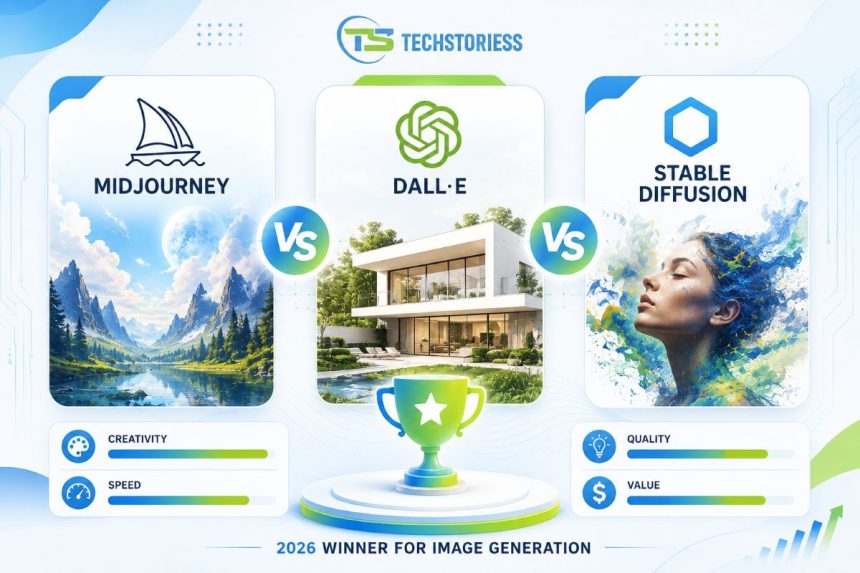
Midjourney produces the most polished, artistic images with the least prompt effort. DALL-E 3 follows detailed instructions most accurately, which makes it the fastest option for marketing assets with text or specific layouts. Stable Diffusion costs the least at scale and is the only one of the three you can fully customize and run on your own hardware, but it takes the most setup work. Most teams that outgrow one tool end up using two: something fast and controllable (DALL-E or Midjourney) for one-off creative, and Stable Diffusion for bulk or repeatable production.
- Quick Answer
- Midjourney vs DALL-E vs Stable Diffusion at a Glance
- How This Comparison Was Put Together
- What Actually Separates These Three Tools
- Midjourney: Best for Artistic Quality
- DALL-E 3: Best for Prompt Accuracy
- Stable Diffusion: Best for Customization and Cost at Scale
- Which Tool Fits Your Situation
- Licensing and Commercial Use
- Real-World Scenarios
- Final Verdict
- FAQ
The rest of this guide breaks down why, with pricing, licensing, and real use cases for each.
Midjourney vs DALL-E vs Stable Diffusion at a Glance
| Midjourney | DALL-E 3 | Stable Diffusion | |
|---|---|---|---|
| Best for | Artistic, high-aesthetic visuals | Prompt accuracy & text placement | Full customization & scale |
| Typical cost | $10–$30/month subscription | ~$20/month via ChatGPT Plus, or ~$0.04–$0.08 per image via API | Free (self-hosted) to low-cost (cloud GPU rental) |
| Ease of use | Easy, some prompt skill helps | Very easy — plain-English prompts work well | Moderate to steep — benefits from technical setup |
| Custom/trained models | Limited | Not supported | Extensive (LoRA, fine-tuning, ControlNet) |
| Commercial use | Yes, on paid plans (revenue-based rules for large companies) | Yes, under OpenAI’s usage policies | Depends on the specific model’s license — check before use |
| Best fit | Designers, agencies, brand/social creative | Marketers, content teams, fast turnaround work | Developers, agencies scaling production, e-commerce |
How This Comparison Was Put Together
This guide is based on each platform’s official documentation, pricing pages, and usage policies, plus patterns consistently reported across designer, marketing, and developer communities. It does not substitute for testing your own prompts — image quality is genuinely subjective and varies by use case, so treat the verdicts below as a starting point, not a guarantee.
TechStoriess team executed the Image Generation Prompt as Analysis and below are our observations
What Actually Separates These Three Tools
All three generate images from text prompts, but they’re built around different priorities:
- Midjourney is optimized for aesthetics. It tends to add cinematic lighting, strong composition, and polish even to simple prompts — often without you asking for it.
- DALL-E 3 is optimized for following instructions exactly. It’s built into ChatGPT, so you can draft copy and generate a matching image in the same conversation.
- Stable Diffusion is optimized for control. It’s open-source, so you can run it locally, fine-tune it on your own product photos, and generate images with no per-image fee.
Midjourney: Best for Artistic Quality
Midjourney is generally regarded as the strongest of the three for pure visual polish. It tends to produce images with cinematic lighting, rich texture, and strong composition even from short prompts — the kind of output that looks premium without much prompt engineering.
Where it wins: brand campaigns, product concept art, social media visuals, poster design, and any creative work where mood and aesthetic matter more than exact specification.
Where it struggles: literal instruction-following. Ask for “a red sneaker with the word SALE in the top-left corner” and you’ll often get something beautiful back. It may still ignore the text placement, the exact wording, or both. For precise, text-accurate output, DALL-E 3 handles this better.
Pricing: Plans generally run $10–$30 per month depending on generation volume and features like faster processing. Check Midjourney’s current pricing before committing, since tiers shift.
Commercial use: Allowed on paid plans. Companies above a certain annual revenue threshold have separate licensing requirements — worth confirming directly with Midjourney if you’re at that scale.
DALL-E 3: Best for Prompt Accuracy
DALL-E 3’s main advantage is instruction-following. Give it a specific prompt — the objects in the scene, their spatial relationships, exact text to include, a layout for a headline — and it tends to execute closer to what you actually asked for. The other two tools interpret a prompt more loosely.
Where it wins: landing page graphics, ad mockups, blog headers, and any asset where you need a specific composition rather than an interpretation of one. Its integration with ChatGPT also means you can write ad copy and generate the matching visual in a single workflow, which is a real time-saver for solo marketers and small content teams.
Where it struggles: distinctive artistic style. Output tends toward clean and correct rather than striking, and it offers less fine-grained stylistic control than Midjourney or a well-tuned Stable Diffusion model.
Pricing: Included with a ChatGPT Plus subscription (roughly $20/month as of this writing), or available pay-per-image through the OpenAI API at a per-image rate. See OpenAI’s current pricing for exact figures, since API rates are adjusted periodically.
Commercial use: Permitted under OpenAI’s usage policies. Image ownership terms are spelled out in OpenAI’s terms of service — worth a read if you’re using output for client work.
Stable Diffusion: Best for Customization and Cost at Scale
Stable Diffusion’s defining feature is that it’s open-source. You can run it on your own hardware, fine-tune it on your own product catalog, and generate unlimited images without a per-image or per-month fee once you’re set up.
Where it wins: any workflow that needs repeatability — thousands of product photos in consistent lighting, dozens of ad variations for A/B testing, or a custom-trained model that reproduces a specific character or brand style. Tools like ControlNet and LoRA fine-tuning let advanced users lock down consistency in ways the other two platforms don’t support.
Where it struggles: the learning curve. Getting a good result means choosing the right base model and tuning settings, usually through some trial and error. There’s no single “just works” default the way there is with DALL-E 3, and output quality varies with the community model you pick.
Pricing: Free to run locally if you have a capable GPU. Cloud GPU rental or hosted platforms add a modest cost, but per-image marginal cost is effectively zero once a model is set up — which is what makes it the cheapest option at high volume.
Commercial use: Depends entirely on the specific model you use. Base Stable Diffusion models typically carry permissive licenses, but community fine-tunes vary — some restrict commercial use. Check the license attached to whatever specific model you download.
Which Tool Fits Your Situation
| If you are a… | Start with | Why |
|---|---|---|
| Graphic designer or agency | Midjourney | Best default aesthetic, least prompt effort for premium-looking results |
| Content marketer or blogger | DALL-E 3 | Fastest path from brief to accurate, on-brief visual |
| Startup founder needing quick assets | DALL-E 3 | Low setup cost, integrates with existing ChatGPT workflow |
| Agency running both creative and production | Midjourney + Stable Diffusion | Midjourney for hero creative, Stable Diffusion for variations at scale |
| Developer building an image pipeline | Stable Diffusion | Only option with full API/model control and no per-image licensing lock-in |
| E-commerce brand needing product photos at volume | Stable Diffusion | Zero marginal cost per image once a product-trained model is set up |
If none of these map cleanly to you, the simplest test: if the win condition is “this needs to look great,” start with Midjourney. If it’s “this needs to say exactly what I specified,” start with DALL-E 3. If it’s “I need thousands of these, consistently, without a growing subscription bill,” start with Stable Diffusion.
Licensing and Commercial Use
Licensing terms matter most if you’re producing images for a client, running paid ads, or selling products with AI-generated visuals attached.
| Platform | Commercial use | Key caveat |
|---|---|---|
| Midjourney | Allowed on paid plans | Companies over a revenue threshold need an enterprise plan — check current terms |
| DALL-E 3 | Allowed under OpenAI’s usage policies | Review OpenAI’s terms of service for ownership specifics |
| Stable Diffusion | Depends on the model | Base models are usually permissive; community fine-tunes vary — verify per model |
Because these terms change, don’t rely on a comparison article (including this one) as your final word before a client deliverable or ad campaign — confirm directly against the platform’s current terms of service.
Real-World Scenarios
Social media agency, ~30 creatives a week: Midjourney is generally the faster path to something that looks finished with minimal revision, which matters when volume and turnaround time are the constraint.
SaaS startup needing blog headers and landing visuals fast: DALL-E 3’s speed and ChatGPT integration tend to fit a lean team’s workflow better than a tool requiring more prompt iteration.
Agency producing 500 product mockups across colors, angles, and backgrounds for one e-commerce client: Stable Diffusion, with a model trained on the client’s actual product photos, is the only one of the three built for this kind of repeatable, high-volume, brand-consistent output — and it does it at effectively zero marginal cost per image.
Final Verdict
There’s no single winner in Midjourney vs DALL-E vs Stable Diffusion — the right pick depends on what you’re optimizing for.
Midjourney wins if the priority is aesthetic quality with minimal effort. DALL-E 3 wins if the priority is following specific instructions quickly, especially inside an existing ChatGPT workflow. Stable Diffusion wins if the priority is customization, brand consistency, and cost control at volume — at the price of a steeper setup.
Many teams end up using more than one: something fast and polished for one-off creative, and Stable Diffusion for anything that needs to scale.
FAQ
Which is better overall, Midjourney, DALL-E, or Stable Diffusion?
There’s no universal winner. Midjourney leads on artistic polish, DALL-E 3 leads on prompt accuracy, and Stable Diffusion leads on customization and per-image cost. The right choice depends on whether your priority is beauty, precision, or control.
Which is best for marketers specifically?
DALL-E 3, for most day-to-day content needs — it’s fast, integrates with ChatGPT for copy-plus-image workflows, and follows layout instructions well. Teams doing high-volume ad testing often add Stable Diffusion once they outgrow one-off generation.
How does pricing actually compare?
Midjourney runs roughly $10–$30/month. DALL-E 3 is included with a ChatGPT Plus subscription (~$20/month) or available per-image via the OpenAI API. Stable Diffusion is free to self-host, with cloud hosting as an optional low-cost add-on. All three adjust pricing periodically — check official sites for current rates.
Can I use images from these tools commercially?
Generally yes, but the specifics differ. Midjourney requires a paid plan and has separate terms for high-revenue companies. DALL-E 3 falls under OpenAI’s usage policies. Stable Diffusion depends entirely on which specific model’s license you’re using — always check before commercial use.
Is Stable Diffusion hard to set up compared to the others?
It has a real learning curve and needs a reasonably capable GPU, but interfaces like Automatic1111 or ComfyUI make it more approachable than running it from raw code. Most people who want it start with Midjourney or DALL-E first and move to Stable Diffusion once they need more control than either provides.