


For the last few years, most organizations have been experimenting with generative AI through copilots, chat interfaces, internal productivity tools, and isolated proof-of-concept projects. These pilots helped teams understand what large language models can do. They also created excitement across business functions, from customer support and operations to finance, compliance, HR, and software engineering.
- From GenAI Pilots to Agentic AI Systems
- Why Autonomous AI Creates New Governance Challenges
- Why AI Governance Is Non-Negotiable for BFSI and Regulated Industries
- What Is an AI Governance Platform?
- The Four Core Pillars of Enterprise AI Governance
- 1. Security: Controlling Access, Data, and Agent Capabilities
- 2. Compliance: Making AI Auditable by Design
- 3. Observability: Seeing What AI Agents Actually Do
- 4. Human Oversight: Keeping Accountability in the Loop
- A Practical Roadmap to Implementing an AI Governance Platform
- Best Practices for Responsible Enterprise Agentic AI Deployment
- Start With Low-Risk, High-Value Workflows
- Define Agent Roles and Boundaries Clearly
- Build Governance Into the Workflow, Not After It
- Use Human Oversight Where It Creates Real Control
- Maintain Audit Trails for Every Critical Action
- Monitor Agents Continuously
- Why Governance Is the Real Scaling Layer for Agentic AI
- Final Thoughts
But pilots are not the final destination.
The real shift happening now is from generative AI as an assistant to agentic AI as an operational system.
Agentic AI systems do not simply respond to prompts. They can plan tasks, call tools, retrieve information, coordinate across systems, trigger workflows, and take actions with varying levels of autonomy. That makes them far more powerful than traditional chatbots or static automation. It also makes them far riskier if they are deployed without the right governance layer.
For enterprises, especially those operating in regulated industries, the central question is no longer, “Can we build AI agents?”
The better question is: Can we govern them?
That is why the AI governance platform is becoming the missing layer in enterprise agentic AI.
From GenAI Pilots to Agentic AI Systems
Most enterprise AI journeys begin with experimentation.
- A team tests a chatbot.
- A department builds an internal knowledge assistant.
- A marketing team uses AI for content drafts.
- A support team tries AI-assisted ticket replies.
- A developer team experiments with code generation.
These use cases are useful, but they are usually limited. They sit around the edges of business operations. They may improve productivity, but they rarely touch the core operating model of the enterprise.
Agentic AI changes that.
An agentic AI system can participate directly in workflows. For example, it can help process loan applications, review contracts, qualify leads, triage support tickets, summarize compliance documents, monitor transactions, or orchestrate multi-step business processes.
- This is a very different level of responsibility.
- A GenAI pilot may generate a recommendation.
- An AI agent may act on that recommendation.
- A chatbot may answer a question.
- An agentic workflow may retrieve data, update a system, route a case, and notify a human reviewer.
- That movement from response to action is the reason governance becomes critical.
When AI starts operating inside business workflows, enterprises need more than model access, prompt templates, and API connections. They need a control layer that defines what the agent can do, what it cannot do, who approves sensitive actions, how decisions are logged, and how failures are detected.
Without that layer, agentic AI remains difficult to scale responsibly.
Why Autonomous AI Creates New Governance Challenges
Traditional enterprise software usually follows predictable rules.
- A workflow is configured.
- A user clicks a button.
- A system executes a defined process.
- The output is usually deterministic.
Agentic AI is different.: AI agents can interpret intent, choose tools, generate intermediate steps, and adapt their path based on context. This flexibility is what makes them valuable. But it also creates governance challenges that older control models were not designed to handle.
In regulated environments, these challenges become even more serious.
- A bank cannot allow an AI agent to make unsupported credit recommendations.
- An insurer cannot allow an AI workflow to process sensitive customer data without proper controls.
- A healthcare organization cannot allow patient-facing AI systems to operate without oversight.
- A legal team cannot rely on AI-generated contract analysis without traceability.
- A financial institution cannot deploy autonomous workflows without audit readiness.
The risk is not only that an AI system may produce a wrong answer.
The larger risk is that no one can explain how the answer was produced, what data was used, which tool was called, which policy applied, whether a human reviewed it, and where accountability sits.
That is the governance gap.
As frameworks such as the EU AI Act and ISO/IEC 42001 push organizations toward transparency, risk management, human oversight, and structured AI management systems, enterprises need governance to become part of the AI architecture itself rather than a policy document stored somewhere after deployment. The EU AI Act specifically emphasizes transparency and human oversight for high-risk AI systems, while ISO/IEC 42001 provides a structured management-system approach for responsible AI use.
Why AI Governance Is Non-Negotiable for BFSI and Regulated Industries
Nowhere is this governance gap more visible than in banking, financial services, and insurance.
BFSI institutions sit at the intersection of high transaction volume, sensitive personal data, and heavy regulatory scrutiny. An agentic AI system that processes a KYC document, scores a credit application, or triages a claim is not just automating a task — it is making decisions that regulators, auditors, and customers can later demand an explanation for.
Regulatory anchors are already shaping how agentic AI must be built and deployed in this sector:
- The RBI FREE-AI Framework (2025) sets expectations for fairness, resilience, ethics, and accountability in AI systems used by regulated financial entities in India.
- The DPDP Act (2023) governs how personal data is collected, processed, and retained, which directly affects what data an AI agent is permitted to access and store.
- The RBI KYC Master Directions (2025) define the verification, documentation, and audit standards that any AI-driven KYC or onboarding agent must satisfy.
- The EU AI Act classifies many financial-services use cases (credit scoring, insurance risk assessment) as high-risk, requiring transparency, human oversight, and documented risk management.
- ISO/IEC 42001 offers a certifiable AI management-system standard that BFSI institutions can use to demonstrate structured governance to regulators and auditors.
For a bank or insurer, none of these frameworks are optional reading. They are the baseline an AI governance platform has to be built against. An agentic AI system that cannot show which policy applied to a credit decision, which data source informed a KYC check, or which human approved a claim payout will struggle to pass an internal audit — let alone a regulatory one.
This is why, in BFSI specifically, governance is not a feature added after deployment. It is the entry ticket to deployment.
What Is an AI Governance Platform?
An AI governance platform is the operational control layer that helps enterprises manage AI systems across their lifecycle.
- It is not just a compliance dashboard.
- It is not just a policy document.
- It is not just a model monitoring tool.
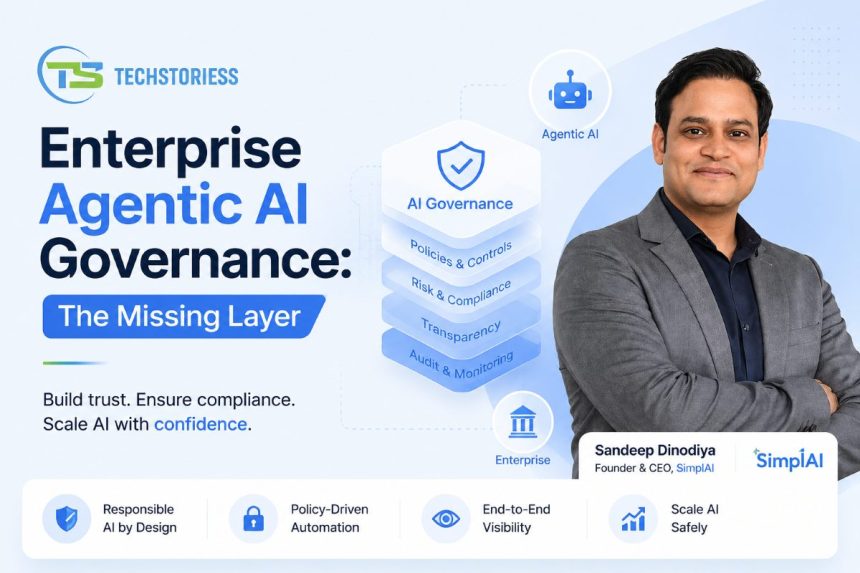
A real AI governance platform connects policies, permissions, observability, human oversight, risk controls, audit logs, and workflow execution into one continuous system.
For agentic AI, this is especially important because the agent is not only generating text. It may be interacting with tools, accessing data, making workflow decisions, and escalating tasks across business systems.
An AI governance platform helps answer questions such as:
- Which agents are running in the organization?
- What data can each agent access?
- Which tools can each agent use?
- What actions require human approval?
- What policies apply to each workflow?
- What happened during each agent execution?
- Why did an agent produce a specific output?
- Who reviewed or approved the result?
- Where are the audit logs?
- How do we detect risky or non-compliant behavior?
These are not optional questions for enterprise AI. They are the questions that determine whether agentic AI can safely move from pilot to production.
The Four Core Pillars of Enterprise AI Governance
A strong AI governance platform should cover four core pillars: security, compliance, observability, and human oversight.
Each pillar matters on its own. But the real value comes when they work together.
1. Security: Controlling Access, Data, and Agent Capabilities
Security is the foundation of enterprise agentic AI.
AI agents often need access to sensitive systems and data. They may interact with documents, databases, APIs, CRMs, internal applications, customer records, or operational workflows.
That access needs to be controlled carefully.
Enterprises should define:
- Which data sources an agent can access
- Which tools an agent can call
- Which user roles can create or modify agents
- Which actions require approval
- Which environments agents can run in
- How credentials and secrets are managed
- How sensitive data is protected
- How agent behavior is restricted by policy
This is especially important for industries such as banking, insurance, healthcare, government, telecom, and legal services, where data exposure can create regulatory, financial, and reputational consequences.
Security for agentic AI cannot be treated like a simple API permission model. Agents need capability-level governance.
The question is not only, “Can this user access the system?”
The better question is, “What is this agent allowed to do on behalf of this user, in this specific workflow, under this specific risk condition?”
That is the level of control enterprises need.
2. Compliance: Making AI Auditable by Design
Compliance teams do not only need AI systems to work. They need AI systems to be explainable, reviewable, and auditable.
This is where many AI pilots fail.
A team may build a useful AI workflow, but when risk, legal, or compliance teams ask for evidence, the answers are often weak.
- What data was used?
- Which model generated the output?
- Was the result reviewed?
- Was the user informed?
- Was the action logged?
- Was the policy applied?
- Can we reproduce or inspect the workflow?
- Can we prove that controls were followed?
If the organization cannot answer these questions, the AI system may never move into production.
A governance platform should make auditability part of the workflow from the beginning. Every important agent action should create a record. Every approval should be captured. Every sensitive decision should be traceable. Every policy should be enforceable.
In mature enterprises, compliance cannot depend on screenshots, manual notes, or scattered logs.
It must be built into the agentic AI operating model.
This is where a platform like SimplAI — built as an enterprise Agentic AI Operating System for cloud, on-prem, and air-gapped deployments — becomes relevant, since policy controls, workflow automation, traceability, and audit readiness are exactly the governance primitives regulated enterprises need before they can move agentic AI into production.
The important point is not that every enterprise needs the same vendor. The important point is that enterprises need this category of capability: a governance-first operating layer for agentic AI.
3. Observability: Seeing What AI Agents Actually Do
You cannot govern what you cannot see.
Observability is one of the most important requirements for enterprise agentic AI because agent workflows can involve multiple steps, tools, data sources, prompts, models, and outputs.
When something goes wrong, teams need to understand the full execution path.
- Did the agent retrieve the right document?
- Did it call the correct tool?
- Did it misread user intent?
- Did it skip a required step?
- Did a policy block the action?
- Did the workflow fail because of missing data?
- Did the human reviewer approve the output?
Without observability, teams are left guessing.
This is dangerous in enterprise environments because AI errors are not always obvious. A flawed output may look confident. A wrong tool call may appear successful. A missing approval step may go unnoticed until a compliance review.
Agent observability should include:
- Execution traces
- Tool-call history
- Input and output records
- Retrieval logs
- Policy enforcement events
- Human review points
- Error states
- Workflow performance metrics
- Model and prompt version history
- Escalation paths
For agentic AI, observability is not only a technical debugging feature. It is a governance requirement.
- It helps product teams improve workflows.
- It helps engineering teams debug failures.
- It helps compliance teams inspect decisions.
- It helps business leaders understand operational risk.
When AI agents begin operating at enterprise scale, observability becomes the control room.
4. Human Oversight: Keeping Accountability in the Loop
One of the biggest misconceptions about agentic AI is that autonomy means removing humans completely.
In reality, enterprise-grade agentic AI should not eliminate human judgment. It should apply human judgment where it matters most.
Human oversight is especially important for high-risk workflows, regulated decisions, customer-impacting actions, and irreversible outcomes.
For example:
- An AI agent can summarize a mortgage file, but a human should approve the final decision.
- An AI agent can draft a compliance response, but a compliance officer should review sensitive language.
- An AI agent can classify a support ticket, but a human should handle escalations involving legal or financial risk.
- An AI agent can recommend next actions, but business owners should approve policy-sensitive execution.
Good governance platforms support different levels of autonomy.
- Some workflows can be fully automated.
- Some can be automated with monitoring.
- Some need human-over-the-loop supervision.
- Some require human-in-the-loop approval before execution.
The right model depends on risk.
This is the principle enterprises should follow: automate where the risk is low, supervise where the risk is moderate, and require explicit approval where the risk is high.
That is how agentic AI becomes scalable without becoming reckless.
A Practical Roadmap to Implementing an AI Governance Platform
Enterprises asking “how to implement AI governance” rarely need another framework document. They need a sequence of concrete steps. Here is a five-step path that maps directly to the four pillars above.
1. Inventory every agent and workflow
Before governing anything, list every AI agent in production or pilot, the data it touches, and the tools it can call. You cannot govern an agent that compliance does not know exists.
2. Classify workflows by risk
Sort each workflow into low, moderate, or high risk based on reversibility, regulatory exposure, and customer impact. This classification decides how much autonomy each agent is allowed.
3. Attach policy and approval rules to each risk tier
Low-risk workflows can run with monitoring only. Moderate-risk workflows get human-over-the-loop review. High-risk workflows require human-in-the-loop approval before execution.
4. Instrument observability from day one
Turn on execution traces, tool-call logs, and retrieval logs before the agent goes live, not after the first incident. Retrofitting observability after a failure is far harder than building it in.
5. Run continuous audits, not annual ones
Schedule recurring reviews of agent behavior, policy violations, and escalation rates so governance keeps pace with prompt, model, and data changes.
Best Practices for Responsible Enterprise Agentic AI Deployment
Enterprises should not approach agentic AI as a one-time technology rollout. It should be treated as an operating-model change.
Here are practical best practices for deploying agentic AI responsibly.
Start With Low-Risk, High-Value Workflows
Not every process should be automated first.
Start with workflows where the value is clear but the risk is manageable.
Good starting points may include:
- Internal knowledge search
- Document summarization
- Support ticket classification
- Report generation
- Sales research
- Employee onboarding assistance
- Process documentation
- Internal operations workflows
Avoid giving agents broad autonomy over sensitive, regulated, or irreversible decisions too early.
The goal is to build trust gradually.
Define Agent Roles and Boundaries Clearly
Every AI agent should have a defined role.
- What is the agent responsible for?
- What systems can it access?
- What decisions can it make?
- What actions are prohibited?
- When should it escalate to a human?
Undefined agents are risky agents.
Enterprises should treat AI agents more like digital workers with scoped responsibilities than generic AI tools with unlimited flexibility.
Build Governance Into the Workflow, Not After It
Governance should not be added after the agent is already live.
It should be designed into the workflow from the start.
That means defining:
- Approval points
- Risk thresholds
- Data-access rules
- Tool permissions
- Audit logs
- Escalation rules
- Output validation
- Monitoring requirements
When governance is built late, it often becomes a bottleneck. When governance is built early, it becomes an enabler.
Use Human Oversight Where It Creates Real Control
Human oversight should not be symbolic.
A checkbox approval step does not automatically create governance. In some cases, humans may approve AI outputs without reading them carefully, especially if they are overloaded.
Effective oversight must be designed intentionally.
The human reviewer should know:
- What they are reviewing
- Why review is required
- What risks to check
- What evidence is available
- What happens after approval or rejection
Human oversight should create accountability, not friction.
Maintain Audit Trails for Every Critical Action
If an AI agent performs or recommends a critical action, the enterprise should be able to reconstruct what happened.
A strong audit trail should show:
- The user request
- The agent involved
- The data accessed
- The tools used
- The output generated
- The policies applied
- The approval status
- The final action taken
- The timestamp and owner
This is especially important for regulated industries where decisions may be reviewed by internal auditors, regulators, customers, or legal teams.
Monitor Agents Continuously
AI governance is not a one-time checklist.
Agent behavior can change when prompts are updated, models are changed, tools are added, data sources are modified, or business rules evolve.
That is why continuous monitoring is necessary.
Enterprises should track quality, accuracy, failure patterns, policy violations, user feedback, escalation rates, and workflow outcomes.
Responsible AI deployment is not only about preventing failure. It is about learning from every execution and improving the system over time.
Why Governance Is the Real Scaling Layer for Agentic AI
Many enterprises already have access to powerful AI models.
They also have cloud infrastructure, internal data, APIs, automation tools, and business use cases.
So why is enterprise agentic AI still hard to scale?
Because the missing layer is governance.
- Without governance, agentic AI remains trapped in pilots.
- With governance, agentic AI can move into production workflows.
- Without governance, business teams move fast but create risk.
- With governance, business teams can innovate within controlled boundaries.
- Without governance, compliance teams block deployment.
- With governance, compliance teams can review evidence and approve responsibly.
- Without governance, AI agents become black boxes.
- With governance, they become observable, auditable, and accountable systems.
This is why the AI governance platform is not just a technical tool. It is the foundation for enterprise trust.
Final Thoughts
Agentic AI will reshape enterprise operations, but only if organizations can deploy it responsibly.
The future of enterprise AI is not just about smarter models or more capable agents. It is about building systems where autonomy and accountability work together.
Enterprises need AI agents that can act.
They also need platforms that can govern those actions.
That is the missing layer.
An AI governance platform gives enterprises the security, compliance, observability, and human oversight needed to move from isolated GenAI pilots to production-ready agentic AI systems.
For regulated industries, this is not optional. It is the difference between experimentation and adoption.
The companies that win with agentic AI will not be the ones that automate the fastest.
They will be the ones that automate responsibly, with governance built into the foundation from day one.
Article Contributed by Shanmugaraj Y, Marketing team at SiplAI.ai Request for a Quick Demo