



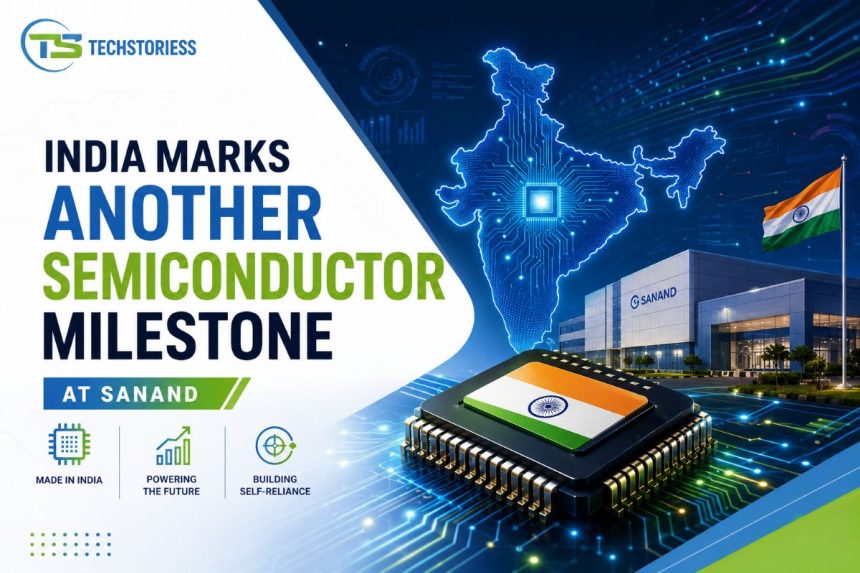
Prime Minister Narendra Modi inaugurated commercial production at CG Semi’s Outsourced Semiconductor Assembly and Test (OSAT) facility in Sanand, Gujarat, on July 4, 2026. The plant is a joint venture between CG Power and Industrial Solutions, Japan’s Renesas Electronics, and Thailand’s Stars Microelectronics. It represents an investment of roughly ₹7,600 crore, or about $870 million. (News on Air; Swarajya
What Happened at the Inauguration
Union Electronics and IT Minister Ashwini Vaishnaw and Gujarat Chief Minister Bhupendra Patel joined the Prime Minister at the site. Modi toured the production line, spoke with engineers, and met young employees before addressing the gathering. He framed the launch as part of a wider ecosystem-building effort, not a single standalone project, and tied it to the government’s “Design in India, Make in India” push. (India Strategic; Indiablooms)
What OSAT Actually Means — and Doesn’t
OSAT stands for Outsourced Semiconductor Assembly and Test. It covers the steps that turn a finished silicon wafer into a usable chip: assembly, testing, and packaging. That’s a materially different business than fabrication, which grows and patterns the silicon itself.
India’s strategy here is deliberate. Packaging and testing need less capital than fabrication. They generate revenue faster. And they build a skilled workforce that can eventually support more advanced manufacturing. CG Semi’s launch is one step in that sequence, not the end of it.
Sanand’s Rapid Transformation
Sanand has shifted quickly from an automotive manufacturing town into India’s first chip-packaging cluster. Micron Technology brought its assembly, test, mark, and pack facility online there in February 2026. Kaynes Semicon followed with its own OSAT unit in March. (Expert Market Research)
With CG Semi’s launch, Sanand became the third facility in the town to reach commercial production within roughly five months. That pace points to deliberate clustering, not coincidence — suppliers and service providers now have a real reason to locate nearby.
Gujarat’s Six-Project, $14.7 Billion Bet
Gujarat was the first Indian state to introduce a dedicated semiconductor policy, and it has leaned into the role aggressively. Six projects are now approved in the state under the India Semiconductor Mission: Tata Electronics, Micron, CG Semi, Kaynes Semicon, Suchi Semicon, and Crystal Matrix. Together they represent about $14.7 billion in investment and an estimated 50,000 direct and indirect jobs. (Republic World; India Gazette)
Among that list, one project stands apart: Tata Electronics’ front-end fabrication plant in Dholera. That’s the one project that would actually move India from packaging into chip fabrication — more on that below.
Reading the Capacity Numbers Carefully
Reported figures for CG Semi’s output vary widely across sources, and they don’t fully reconcile. Rather than pick one number and present it as settled, it’s more useful to see what each figure actually describes:
| Source | Figure Reported | What It Likely Describes |
|---|---|---|
| CG Semi corporate statement | ~200 million units/year at start, scaling to 4.7 billion units/year | Company’s own five-year installed-capacity target (WebProNews) |
| Government release (PIB / News on Air) | Up to 5 billion units/year | Fully-ramped, longer-term output once operations mature (News on Air) |
| Multiple news outlets | 15 million units/day | Peak daily rate once fully ramped — roughly consistent with the 5 billion/year figure (Manorama Yearbook) |
| Government release, combined figure | 1.5 crore (15 million) chips/day | Combined capacity across G1 and the upcoming G2 plant, not G1 alone (Swarajya) |
| Day-one reporting | ~0.5 million units/day currently | Actual output today, at commercial launch (CryptoBriefing) |
The pattern across these figures is consistent even if the exact numbers aren’t: current output is a small fraction of the eventual target, and that target is itself a multi-year, multi-plant goal rather than a same-day result. Sized against established OSAT leaders like Taiwan’s ASE Group or Amkor Technology, India’s starting point is still modest. Reaching billions of units a year will take sustained capital and years of operational maturity — not one inauguration.
A second CG Semi plant, G2, is expected to come online later in 2026 and would meaningfully expand total capacity.
The Real Fabrication Story: Tata’s Dholera Fab
If OSAT is about packaging, Dholera is about fabrication — and it’s the more consequential project on Gujarat’s list.
Tata Electronics is building India’s first commercial 300mm chip fab in Dholera, in partnership with Taiwan’s Powerchip Semiconductor Manufacturing Corporation (PSMC), at a planned investment of roughly ₹91,000 crore (~$11 billion). PSMC is licensing process technology covering 28nm to 110nm nodes. In May 2026, Tata Electronics and ASML of the Netherlands signed a partnership under which ASML will supply the lithography tools needed to bring the fab online. (ASML; Tom’s Hardware)
The site was formally designated a Special Economic Zone in April 2026. At full capacity, it’s designed to produce 50,000 wafers a month, and first silicon is targeted for late 2026, with commercial production expected to scale through 2027 and 2028. (Tom’s Hardware)
Worth keeping in perspective: 28nm is a mature process node, not a leading-edge one — the global frontier is now closer to 2nm. Dholera is a foundation for India’s fabrication capability, not a claim to compete at the cutting edge.
The Policy and Market Backdrop
The launch reflects a broader national push. India’s semiconductor market was valued at roughly $15 billion in 2020 and is officially projected to reach $63 billion by 2026, largely on the back of government efforts to cut dependence on imported chips. (India Science, Technology & Innovation Portal)
The India Semiconductor Mission has approved a cluster of projects spanning assembly, testing, and — eventually — fabrication, with Gujarat as its most visible proving ground so far.
Three Things to Watch Next
- The G2 facility’s timeline. CG Semi’s second Sanand plant is due later in 2026 and will be the real test of whether capacity claims translate into output.
- Progress at Tata’s Dholera fab. First silicon, targeted for late 2026, will show whether India’s fabrication ambitions are on schedule.
- CG Semi’s export pipeline. Shipments reportedly began ahead of the formal inauguration. Whether they convert into durable international customer relationships — rather than one-off orders — will say more about the plant’s staying power than any single capacity figure.
The inauguration is a real data point in India’s semiconductor ambitions. Whether it becomes a turning point depends on what gets built next.