


For the last 40 years, the enterprise data center followed a conventional, partitioned tradition. Commodity x86 servers handled the chaotic traffic of web servers, databases, and distributed business applications. IBM z/Architecture mainframes commanded the core – sitting in the raised-floor glass house with a certain air of exclusivity, running the economic nervous system of global finance, logistics, and governance with unyielding predictability. This environment represented an exclusive exceptionalism, relying on a proprietary software stack and an instruction set architecture that remained politely indifferent to open-source hardware shifts. Those times of architectural isolationism are over.
On April 2, 2026, IBM and Arm’s strategic partnership reflected a fundamental reality: Armonk could no longer ignore that modern engineering talent and cloud-native software have standardized on architectuĺres beyond the mainframe. This dual-architecture initiative is a quiet acknowledgment that single-architecture exceptionalism has become a structural liability.
The Hybrid Blueprint: Virtualization and the Fight for the Edge
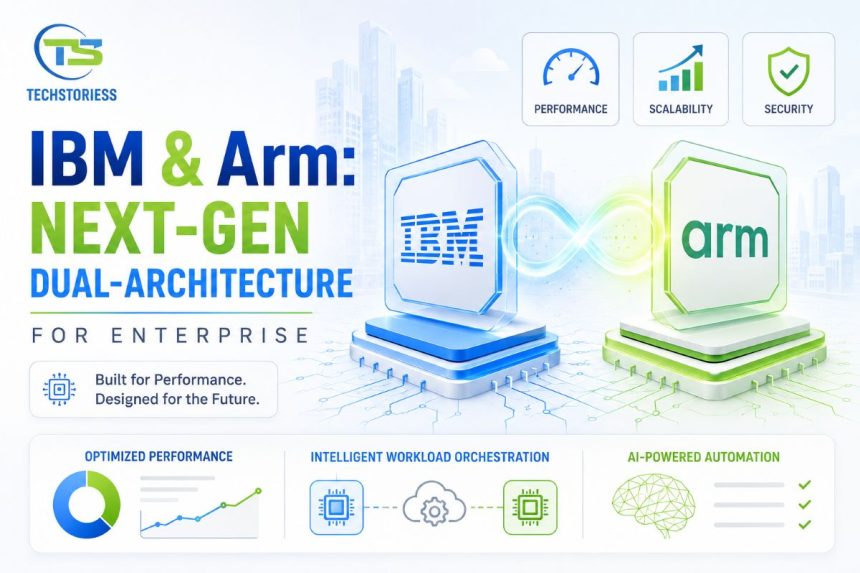
The technical premise of this collaboration reveals a deep architectural friction. IBM is embedding Arm-based software environments directly into IBM Z and LinuxONE mainframes through hardware hypervisor virtualization and optimized emulation layers.
This shows that the historical division of labor has disintegrated. Enterprises can no longer afford to maintain separate infrastructure silos where modern, energy-efficient AI inference pipelines and containerized microservices are written natively for Arm, while the core transactional data remains locked inside the mainframe’s traditional z/Architecture. It addresses a crucial engineering challenge: bridging Arm’s high-velocity, low-overhead container ecosystem with IBM’s rigid, high-reliability transaction environment without crippling both.
The initiative targets three specific focus areas: deep hypervisor-level virtualization integration, optimization for enterprise AI infrastructure 2026 demands, and joint software ecosystem expansion.
It does not eclipse IBM’s proprietary silicon investments, like the Telum II processor and the dedicated Spyre Accelerator designed for on-chip deep learning. Instead, it attempts to graft an agile processing deck onto a heavy transaction engine.
Arm Cloud AI Business Unit executive vice president Mohamed Awad noted that bringing Arm’s efficiency to IBM’s secure platforms allows enterprises to execute complex, modern services directly where their most sensitive data already resides, thus avoiding the latency and security vulnerabilities of external data transfers.
The Cracked Moat and the Revenue Realities of 2026
The market dynamics driving IBM’s compromise are visible in the shifting balance of server room power. Mercury Research’s data from the third quarter of 2025 shows that the historic x86 server monopoly has experienced unprecedented erosion.
Intel’s server central processing unit market share dropped to an all-time low of 72.2 percent, while AMD captured 27.8 percent as per the reports. More tellingly, the Arm server ecosystem enterprise footprint expanded to claim 13.2 percent of total server revenue, driven by a massive 50 percent year-over-year surge in unit shipments.
The x86 moat is cracking, and the enterprise landscape has definitively transformed into a multi-architecture computing reality. IBM’s leadership understands that the mainframe cannot remain insulated in this environment. This Arm alliance follows a pattern of pragmatic co-opetition, coming less than a month after IBM deepened its enterprise Nvidia cooperation at GTC 2026 to ensure its systems can anchor multi-architecture AI pipelines rather than being bypassed by them.
IBM Chief Executive Officer Arvind Krishna telegraphed this strategy in February 2026, stating that the year would accelerate innovation across AI, hybrid cloud, and specialized hardware architectures.
Moor Insights & Strategy founder Patrick Moorhead shrewdly observed regarding the announcement that modern enterprise infrastructure priorities have fundamentally changed. Flexibility, workload portability, and ecosystem coverage are now just as critical to a Chief Technology Officer as raw single-core performance or traditional uptime metrics. For IBM, clinging to a single proprietary architecture poses a systemic risk to the long-term relevance of its high-margin hardware business.
Redefining Mainframe Worth in the Shadow of Broadcom
This architectural pivot fundamentally redefines the value proposition of the IBM Z mainframe, shifting it from a highly specialized transaction engine toward a universal enterprise compute fabric.
The primary structural limitation of the mainframe has never been its hardware engineering; it has been the narrow z/Architecture instruction set (s390x) making it complex to adopt modern, open-source software tools. This challenge is exactly what incorporating Arm capabilities directly into IBM LinuxONE virtualization layers addresses, opening an aggressive, unexpected front in the data center consolidation wars.
According to Gartner analysts, dual-architecture enterprise hardware significantly lowers the technical barriers for organizations that want to execute VMware migrations away from traditional x86 server farms and onto mainframe-class infrastructure.
Spurred by Broadcom’s aggressive pricing overhauls, enterprise infrastructure architects are actively scouting for hypervisor alternatives. By hosting Arm-native workloads directly alongside core databases, IBM can pitch LinuxONE as the ultimate consolidation target for disaffected VMware clients, capturing workloads that previously would have required hundreds of commodity x86 blades.
Furthermore, the combination targets the immediate challenge of enterprise AI inference, allowing organizations to execute machine learning models (like PyTorch, TensorFlow, and llama.cpp) against live transactional data within the mainframe’s secure, audited envelope. Yet, significant friction remains. Emulation and translation layers always add architectural overhead, independent software vendor (ISV) certification timelines can drag on for years, and enterprise architects must weigh whether this promises true interoperability or merely adds another layer of management complexity to an already dense infrastructure stack.
IBM Z and LinuxONE Chief Product Officer Tina Tarquinio emphasized that the ultimate goal is to offer clients unprecedented flexibility in how they build and scale their secure workloads. However, the success of this initiative will hinge on whether IBM delivers near-zero virtualization overhead and forces major independent software vendors to aggressively certify their Arm-based applications for this hybrid environment.
The Critic’s Verdict: A Strategy for Survival, Not a Revolution
Rather than an engineering revolution, this collaboration is a calculated, cold-eyed play for architectural preservation. IBM is deploying a smart, incremental survival strategy as it recognizes that software developer momentum has permanently shifted away from proprietary architectures.
By hosting an Arm environment inside its classic enterprise hardware, IBM builds an essential bridge to ensure its platforms can natively host the next generation of enterprise software applications.
Arm benefits from an institutional seal of approval within the most conservative, highly regulated environments in the world.
However, the primary benefactor here is undoubtedly IBM as it fights to prevent the mainframe from fading into historical obsolescence.
Enterprise technology leaders should look beyond the marketing promises of harmony; IBM isn’t saving the mainframe-it’s renegotiating the terms of its survival. Intent is one thing, and twenty-four months of benchmark data will make the distinction painfully clear.